
Is China Guardian of the ‘Postwar International Order’?
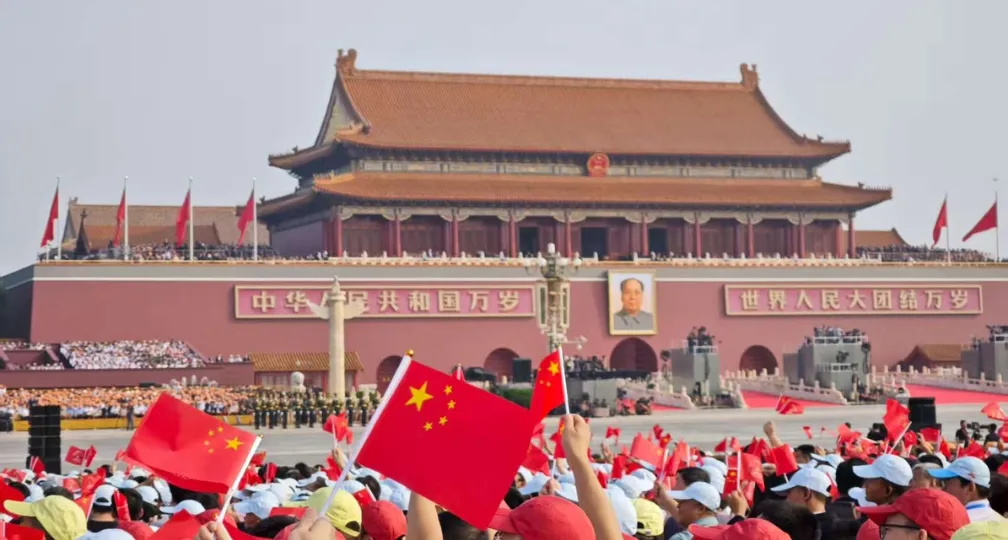
Tensions in Japan-China relations have escalated following Prime Minister Sanae Takaichi’s Nov. 7 remarks on the right to collective self-defense, with Chinese Foreign Minister Wang Yi calling them “shocking” and repeatedly demanding a retraction. Key to China’s argument is its positioning of itself as the guardian of the “postwar international order” while portraying Japan as its destroyer in a year that marks the 80th anniversary of the end of World War II.
Chinese narratives of the Second Sino-Japanese War (1937-1945) and World War II have undergone a gradual but significant transformation since the Jiang Zemin and Hu Jintao eras that preceded Chinese leader Xi Jinping’s rise to power in 2012-2013. One notable shift is the movement away from a victim-centered narrative toward a portrayal of China — specifically the Chinese Communist Party — as a major Allied power that secured victory and helped establish the “postwar international order.”
At a symposium marking the 69th anniversary of World War II victory in 2014, Xi declared that China had served as the “main theater of war in the East” and “an important component of the World Anti-Fascist War.” He argued that China must “defend the achievements of the victory against fascism” and “resolutely uphold the postwar international order.”
In Xi’s telling, China was a central protagonist leading the Allies to victory, a co-architect of the postwar system, and therefore a rightful guardian of its principles. This constitutes the “correct view of the Second World War” that Xi seeks to promote.
This narrative functions as a counternarrative to the liberal international order framework, which often casts China as a revisionist challenger. In 2025, Beijing has intensified its messaging, leveraging the symbolic timing of the 80th anniversary of the war’s end.
First, China has begun invoking the phrase “safeguarding the postwar international order” with greater frequency. As the Trump administration retreats from United Nations agencies and international frameworks and imposes tariffs that violate World Trade Organization principles, Beijing has sought to exploit this moment by painting the United States — not China — as the real disrupter of the “postwar international order.”
Second, China is aggressively asserting that “Taiwan’s return to China is an essential component of the postwar international order.” Beijing has repeatedly emphasized that the Cairo Declaration of 1943 mandated the return of Taiwan and the Pescadores to China; that the 1945 Potsdam Declaration required compliance with Cairo; and that the 1951 San Francisco Peace Treaty — which did not explicitly define Taiwan’s sovereign status — was concluded without China’s participation and is therefore “illegal and invalid.” In this logic, unification with Taiwan represents the rightful and intended state of the postwar system.
Beijing has extended this narrative to the South China Sea. Stretching the historical logic, the Xinhua Institute report released in August claimed that Cairo and Potsdam confirm China’s sovereignty over South China Sea islands and that denying this equates to “rejecting the postwar order and openly violating international law.” China is thus embedding its territorial claims within the moral and legal legitimacy of the postwar settlement — an expanded form of cognitive, legal and historical warfare.
Meanwhile, the discourse positioning Japan as a challenger to the “postwar international order” over control of the Senkaku Islands, which had been actively promoted in 2012-2014, has fallen silent. China initially appears to have sought to avoid worsening relations with Japan during its campaign marking the 80th anniversary of World War II’s end.
But that changed dramatically after Prime Minister Takaichi’s Nov. 7 Diet remarks. She stated that if China were to impose a military blockade around Taiwan and use force against U.S. forces coming to its relief, this could constitute a “survival-threatening situation” for Japan. Viewing such a scenario — one in which the use of military bases in Okinawa by U.S. forces is anticipated and the safety of residents in the Southwest Islands could be threatened — as “potentially constituting a survival-threatening situation” does not deviate from previous government policy.
In this case, the right to collective self-defense is exercised only to the minimum extent necessary for national defense, not for the purpose of defending Taiwan itself. Furthermore, as reaffirmed by Prime Minister Takaichi in the same Diet debate, overseas deployment of the Self-Defense Forces for the purpose of exercising force is not permitted.
However, China, disregarding this context entirely, has interpreted the statement as signaling “Japan’s military intervention in the Taiwan Strait” and “external aggression under the guise of self-defense.” China has harshly condemned Japan not only domestically but also before the international community, stating, “We absolutely will not tolerate the revival of Japanese militarism or challenges to the postwar international order.”
This campaign condemning Japan will likely gradually subside once it has served its purpose of clearly demonstrating to Prime Minister Takaichi what constitutes a “red line” and deterring the activation of “Taiwan independence forces.” However, the narrative portraying Japan as a destroyer of the “postwar international order” will resurface whenever, for example, the Japanese government seeks to increase defense spending.
Furthermore, there is a possibility that the so-called Ryukyu Undetermined Status Theory — Beijing’s narrative suggesting that the sovereignty of Okinawa is not definitively settled under international law — will be further propagated and that influence operations targeting Okinawan citizens will be intensified. Such efforts could aim to amplify opposition to the use of Okinawa bases by U.S. forces in the event of a Taiwan contingency or to delegitimize Japan’s defense of Okinawa itself. It is therefore necessary to share a sense of crisis regarding such developments with the United States.
What, then, should be done to prevent Beijing’s narratives from taking hold? Japan and its allies must counter them by first using rational language, second, basing arguments on evidence, and third, responding promptly and on a point-by-point basis. The Japanese government is already implementing this approach.
On Nov. 21, China’s ambassador to the United Nations submitted a letter to the U.N. secretary-general condemning Prime Minister Takaichi’s remarks and requesting that it be circulated. Japan’s ambassador to the U.N. submitted a rebuttal letter three days later, which was later reiterated in a Dec. 4 letter. The letter emphasized that Japan has consistently followed the path of a peaceful nation throughout the postwar period and reaffirmed Japan’s consistent stance of “expecting that issues concerning Taiwan will be resolved peacefully through dialogue.”
In doing so, the letter drew a clear distinction between Japan and countries that have “engaged in the prolonged expansion of military capabilities in a nontransparent manner” or “continue to attempt unilateral changes to the status quo by force or coercion, despite opposition from neighboring countries.” It also explained that, contrary to the Chinese side’s claims, Japan’s exercise of the right to collective self-defense is passive in nature and permissible only within an extremely limited scope — specifically, in situations where another country uses force and threatens Japan’s very existence.
Furthermore, in response to China’s reference to the “Enemy Clause” in the U.N. Charter, which immediately after World War II allowed enforcement action against Axis powers without Security Council authorization, Japan’s Ministry of Foreign Affairs countered by pointing out that the clause had been “rendered obsolete” by a 1995 U.N. General Assembly resolution and that China itself had voted in favor of that resolution.
While the importance of such timely and appropriate counterarguments is undeniable, the longer-term goal is to secure an advantage in the discourse space by gaining broad international support. To achieve this, greater effort is needed to communicate Japan’s position — as articulated in the ambassador’s letter — to the international community not reactively, but proactively.
Also, Japan should work with the more than 40 countries that signed and ratified the San Francisco Peace Treaty to reaffirm its validity and historical significance. Taiwanese President Lai Ching-te and his administration have already pushed back against Beijing’s narrative by emphasizing the treaty’s legitimacy, with the U.S. (through the American Institute in Taiwan) echoing that stance. Japan cannot overlook the Chinese Foreign Ministry’s statement that Japan’s exercise of collective self-defense rights would be restricted as it is a “former enemy state.” The fact that China did not sign the treaty cannot serve as grounds to delegitimize the postwar regional order built upon it.
Given China’s rising economic influence and the weakening of U.S. normative power, ignoring these narratives as mere propaganda would be a mistake. The contest over who represents and who challenges the postwar international order is already under way — and its outcome will shape the strategic landscape of the Indo-Pacific for years to come.
(Photo Credit: Mainichi Shimbun / Getty Images)
[Note] This article was posted to the Japan Times on Dec 12, 2025:
https://www.japantimes.co.jp/commentary/2025/12/12/japan/china-guardian-of-postwar-order/
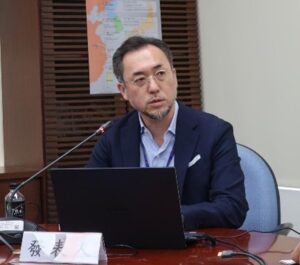
Shinya Kadozaki
Senior Research Fellow at the Kazankai Foundation
Shinya Kadozaki is a senior research fellow at the Kazankai Foundation, specializing in Chinese politics and modern Chinese history. Geoeconomic Briefing is a series featuring researchers at the Institute of Geoeconomics focused on Japan’s challenges in that field. It also provides analyses of the state of the world and trade risks, as well as technological and industrial structures.
Disclaimer: The views expressed in this Geoeconomic Briefing do not necessarily reflect those of the API, the Institute of Geoeconomics (IOG), or any other organizations to which the author belongs.
API/IOG English Newsletter
Edited by Paul Nadeau, the newsletter will monthly keep up to date on geoeconomic agenda, IOG Intelligence report, geoeconomics briefings, IOG geoeconomic insights, new publications, events, research activities, media coverage, and more.



 Orbán in the Public Eye: Anti-Ukraine Argument for Delegitimising Brussels2026.02.04
- Fed-Treasury Coordination as Economic Security Policy2026.02.13
- The Supreme Court Strikes Down the IEEPA Tariffs: What Happened and What Comes Next?2026.02.27
- India and EU Sign Mother of All Deals2026.02.09
- Oil, Debt, and Dollars: The Geoeconomics of Venezuela2026.01.07