
Fed-Treasury Coordination as Economic Security Policy
The Latest Regulatory Developments on Economic Security & Geoeconomics
By Paul Nadeau, Visiting Research Fellow, Institute of Geoeconomics (IOG)
EU Adopts Plan to Phase Out Russian Gas: On January 26, the member states of the European Union formally adopted the regulation to phase out Russian imports of both pipeline gas and liquified natural gas (LNG) into the EU. Under the regulation, importing Russian pipeline gas and LNG into the EU will be prohibited beginning six weeks after the regulation enters into effect while existing contracts will have a transition period. The full ban on LNG will take effect at the beginning of 2027 and the ban on pipeline gas in autumn 2027.
EU, India Reach Trade Agreement: On January 27, the European Union and India announced a free trade agreement following almost 20 years of negotiations. The agreement would see India eliminate tariffs on most exports of chemicals, machinery, electrical equipment, aircraft, and spacecraft, while tariffs on autos will be cut to 10 percent under a 250,000 vehicle quota. The EU would eliminate or reduce tariffs on textiles, leather, marine products, handicrafts, gems, and on some commodities such as tea, coffee, spices and processed foods. Both sides also agreed to provide a mobility framework for professionals to travel between the two entities.
EU Targets Russian Hybrid Activities: On January 29, the European Council adopted restrictive measures against six individuals, including three television presenters, an actor, and a ballet dancer, for their role in Russia’s hybrid activities, particularly foreign information manipulation and interference against the EU and its member states and partners.
Countries Place New Sanctions on Iran: The U.S. Treasury Department’s Office of Foreign Assets Control (OFAC) announced new sanctions targeting nine vessels of Iran’s shadow fleet on January 23. This was followed by an announcement on January 30, where OFAC announced sanctions against Iran’s Interior Minister Eskandar Momeni Kalagari for the violent suppression of protests in Iran, an Iranian investor who embezzled billions of dollars in Iranian oil revenue, and two digital asset exchanges that have processed large volumes of funds associated with counterparties to Iran’s Revolutionary Guard. On January 29, the European Union imposed restrictive measures on individuals and entities responsible for human rights violations and for Iran’s support for Russia’s invasion of Ukraine, and also included the Revolutionary Guard on list of terrorist organizations. On February 2, the British Foreign, Commonwealth, and Development Office announced that it would also sanction Iran’s Interior Minister Kalagari, as well as police chiefs and members of the Revolutionary Guard for their role in the violence against protestors in Iran. On February 3, Australia’s foreign minister additionally announced sanctions against 20 individuals and 3 entities associated with Iran’s Revolutionary Guard for the violence against protestors.
U.S. Eases Restrictions on Venezuelan Oil: The U.S. Treasury Department’s Office of Foreign Assets Control (OFAC) issued two separate general licenses regarding Venezuela’s oil industry. The first, issued on January 29, effectively makes it easier for foreign actors to trade in Venezuelan oil while prohibiting, Iranian, North Korea, Russian, certain corporate Chinese purchasers and those involved with the shadow fleet or cryptocurrency transactions. The second, issued on February 3, reduces restrictions on the sale of U.S.-origin diluents to Venezuela which is used in processing Venezuela’s heavy crude.
U.S. Launches Critical Minerals Initiative: On February 4, the U.S. State Department launched the first ministerial meeting in an effort to shape a network for critical minerals to secure supplies and support markets from the possible impact of oversupply. The event was attended by Australia, the Democratic Republic of Congo, the European Union, India, Japan, South Korea, the United Kingdom, and other organizations. Among the ideas suggested was the introduction of U.S. tariffs to create a price floor to support continued investment as well as “coordinated trade policies and mechanisms” to ensure access to critical mineral supplies.
India, U.S. Reach Interim Trade Framework: On February 7, India and the United States announced that they had reached an interim framework that, among other things, reaffirmed their commitment toward a fuller bilateral trade agreement. As a result of the framework, Donald Trump removed the 25 percent tariff on Indian goods, lowering the tariff to 18 percent in return for a commitment from India not to directly or indirectly purchase Russian oil and lowering other trade barriers and a commitment to purchase $500 billion of U.S. goods over a five-year period, including oil, gas, coal, aircraft and aircraft parts, precious metals, and technology including for AI applications, and agreed to address non-tariff barriers on imports of agricultural products, medical devices and communications gear.
Analysis: Fed-Treasury Coordination as Economic Security Policy
By Andrew Capistrano, Visiting Research Fellow, Institute of Geoeconomics (IOG)
The nomination of Kevin Warsh as the next Chair of the Federal Reserve comes at a time when US monetary governance is increasingly entangled with a broader shift toward economic security. Commentary has tended to focus on whether Warsh’s past “hawkish” positions will guide his tenure, or be tempered by Trump’s “dovish” demand for lower interest rates. However, this risks overshadowing another backdrop to Warsh’s nomination: the Treasury Department’s growing recognition that reconfiguring the US growth model under conditions of strategic competition will require monetary, fiscal, and financial institutions to operate in closer concert.
To understand why, consider that in the post-Cold War era, US macroeconomic policy was organized around demand stabilization, financial deepening, and global integration, with the Fed’s monetary policy largely independent from Treasury’s execution of fiscal policy. That framework supported growth through consumption and asset appreciation as well as persistent fiscal deficits to stabilize downturns, particularly after the global financial crisis. But it also led to compounding vulnerabilities, including a hollowed-out tradable sector, entrenched external imbalances, exposure to Chinese industrial policy, and greater reliance on the public balance sheet as the economy’s primary shock absorber.
Those vulnerabilities have now hardened into liabilities. With federal debt exceeding 120% of GDP, the interaction between monetary policy and debt management has become a binding constraint. And as geoeconomic competition intensifies, the limits of a consumption and asset-driven framework are now much clearer, elevating productive capacity, industrial investment, and supply-chain resilience from sectoral concerns to core elements of economic security—thereby bringing the “technocratic” role of monetary policy into the domain of economic statecraft.
This shift has directed attention to the idea of “Fed-Treasury coordination” for two reasons. First, fiscal and monetary constraints have become embedded in the US growth model, with the Fed shaping expectations as much as outcomes. According to Warsh, the incentives generated by post-crisis monetary policy helped drive rising public debt and distorted capital allocation toward financial assets. Fiscally, the expectation that the Fed would act as a backstop for Treasury markets enabled larger government deficits and reduced the immediate discipline imposed by borrowing costs; financially, prolonged accommodation reinforced an imbalance between speculative and productive investment.
Warsh and Treasury Secretary Scott Bessent have emphasized that US debt dynamics do not stem primarily from debt levels in isolation, but from a growth model in which consumption and asset inflation “mechanically reproduce” fiscal dependence and deindustrialization. Their shared diagnosis is buttressed by a common mentor: hedge fund legend Stanley Druckenmiller, an influence visible in their views on capacity, discipline, and investment-led growth. In this context, Warsh’s selection should be read not only as a signal on interest rates, but as part of an effort—shared with Bessent—to drive credit creation that supports large-scale capital formation rather than just financial activity.
A second but lesser understood reason for revisiting Fed-Treasury coordination flows from economic security considerations. An economy that lacks domestic capacity in energy infrastructure, advanced manufacturing, and technology inputs may appear stable during periods of abundant liquidity, but it remains exposed to external pressure and supply disruptions. Because these risks are rooted in investment and capital formation dynamics, they hinge on how monetary and fiscal policies interact.
Both reasons are structural rather than cyclical. When annual federal interest costs approach $1 trillion and the Fed’s balance sheet is still far above its pre-2008 size, the relationship between monetary operations, debt management, and the composition of growth has become consequential for economic stability as well as economic security.
Importantly, this discussion is not occurring in a historical vacuum. Fed-Treasury coordination has surfaced during periods of extraordinary fiscal and strategic strain. Most notably, during the World War II era, the Fed capped bond yields to facilitate wartime finance before the 1951 Fed-Treasury Accord reasserted central bank independence. Warsh has argued that the scale and persistence of post-2008 Fed balance-sheet expansion (especially during the pandemic) blurred the boundaries between debt management and monetary policy that the Accord was meant to regulate; last spring, Bessent wrote that this represented the real threat to Fed independence. In pre-nomination interviews, Warsh suggested revisiting the Accord, not to reintroduce explicit yield caps, but to reassess how the Fed’s balance sheet interacts with Treasury’s debt management under contemporary conditions.
What this implies in practice remains uncertain, and more details will likely emerge during Warsh’s confirmation hearings. Fed-Treasury coordination could range from a narrow clarification of operational boundaries to a far more substantive transformation. But as economic security policy, coordination is less about institutional overhaul than aligning the Fed’s balance sheet, Treasury issuance, and the sequencing of monetary normalization so that policy interactions reinforce, rather than undermine, an investment-led rebalancing of the economy.
The logic of Fed-Treasury coordination thus runs through the links between debt sustainability and growth, capital and capacity expansion, and liquidity management during the transition.
To begin with, institutional alignment will directly affect how the US resolves its underlying debt constraint. At the heart of the argument for Fed-Treasury coordination lies a fundamental macroeconomic problem: high public debt can be addressed only through austerity, inflation, or growth. Bessent’s signaling points toward this third option, which is also the most politically palatable. In short, rather than shrinking demand through fiscal retrenchment, or eroding debt burdens through sustained inflation, the objective is to recompose growth by expanding productive capacity. And this will require a strategy that rebalances capital toward infrastructure, industry, and more secure supply chains.
Favoring growth also carries clear advantages from an economic security perspective. Over time, capacity expansion eases inflationary constraints, reduces external exposure, and strengthens the domestic base for energy, manufacturing, and strategic technologies.
One example of capacity expansion is the ongoing investment surge in AI and its supporting infrastructure. Hundreds of billions of dollars are now being deployed into data centers, semiconductors, energy systems, and related supply chains. Both Bessent and Warsh have publicly framed this surge as a supply-side opportunity: near-term demand pressures are expected to give way to productivity gains as AI diffuses across the economy, which offers the prospect of higher trend growth without proportionate inflation. Fed-Treasury coordination matters here because monetary policy shapes credit conditions during the investment phase, and Treasury policy influences whether capital reinforces domestic capacity or leaks offshore.
The implication is a deliberately forward-looking regime. Instead of waiting for lagging productivity statistics, policy coordination would create the financial and regulatory space for the AI investment cycle to run to completion. That will be crucial as the economy absorbs the capital investment surge that may be keeping interest rates elevated independent of inflation expectations. As the AI experience could apply to other economic security domains, like advanced manufacturing or critical mineral processing, Fed-Treasury coordination has taken on strategic importance.
Rather than a symbolic adjustment to institutional roles, coordination might operate through specific mechanisms that shape how liquidity and investment are distributed across the economy. First, clearer alignment between monetary operations and debt issuance alters expectations about liquidity and financing conditions, lowering uncertainty for long-horizon private investment and reducing the risk that productive capital formation is crowded out by policy-driven financial volatility. In practical terms, this could mean sequencing Treasury bond issuance toward longer maturities while the Fed normalizes its balance sheet gradually, so that financial conditions remain supportive of capital expenditure and supply expansion rather than tightening abruptly in ways that choke off private investment.
Second, by aligning liquidity conditions with an investment-led growth strategy, Fed-Treasury coordination can help redirect capital away from asset inflation and toward productive capacity, amplifying reindustrialization initiatives and technological upgrading rather than speculative demand. Easier financial conditions tend to be inflationary when they fuel consumption or speculative asset markets, but can be capacity-expanding when paired with policies that channel capital to investment and production. If successful, coordination can reduce the economy’s reliance on repeated emergency interventions by supporting a growth composition that generates resilience endogenously—through capacity expansion instead of Fed balance-sheet expansion.
Taken together, these two mechanisms link monetary governance to economic security outcomes by aligning institutional incentives with strategic objectives. Whether rebalancing succeeds without a return to crisis-era policy ultimately depends on how liquidity is withdrawn during the transition—specifically, on the relationship between the Fed’s balance-sheet framework and Treasury’s debt management.
Warsh’s nomination suggests the emphasis is shifting from a Fed that insulates the economy from volatility through perpetual intervention, to one that can rebuild the economy’s capacity to absorb shocks without extraordinary measures. His and Bessent’s critiques of balance-sheet expansion and “mandate creep” are best read in this light. They reflect a concern that the post-crisis monetary policy regime entrenched macroeconomic dependency, and reducing that dependency might require a new Fed-Treasury Accord. If so, this will likely be a monetary framework aligned with fiscal efforts to redirect growth toward investment and production.
Seventy-five years ago, the Fed and the Treasury stepped back from wartime coordination via the 1951 Accord, codifying a monetary order suited to a very different global economy. The question today is whether US economic governance can adapt to another era defined by strategic rivalry, balance-sheet constraints, and the centrality of productive capacity. Unlike in wartime, however, the new operating environment is indefinite economic competition rather than temporary military mobilization. Still, then as now, Fed-Treasury coordination is best understood not just as a retreat from central bank independence, but as a test of whether American economic statecraft can sustain national security in a more uncertain world.
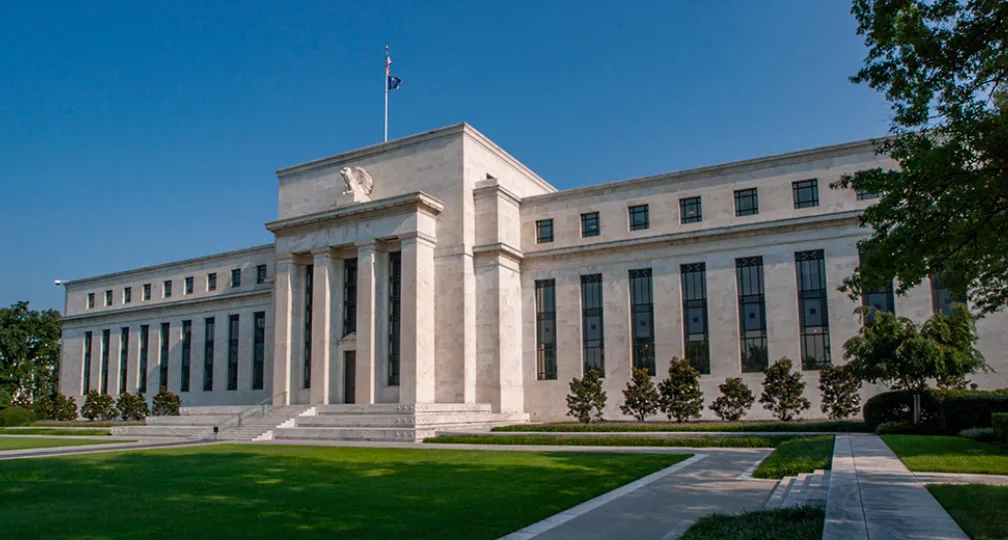
(Photo Credit: Federal Reserve Website)
Disclaimer: The views expressed in this IOG Economic Intelligence Report do not necessarily reflect those of the API, the Institute of Geoeconomics (IOG) or any other organizations to which the author belongs.
API/IOG English Newsletter
Edited by Paul Nadeau, the newsletter will monthly keep up to date on geoeconomic agenda, IOG Intelligence report, geoeconomics briefings, IOG geoeconomic insights, new publications, events, research activities, media coverage, and more.


Visiting Research Fellow
Andrew Capistrano is Director of Research at PTB Global Advisors, a Washington DC-based geopolitical risk consulting firm. Specializing in economic competition between the US/EU and China, he analyzes how trade, national security, and industrial policies impact markets, and his firm’s clients include Japanese corporations and government agencies. He previously worked in Tokyo at the US Embassy’s American Center Japan and as a research associate at the Rebuild Japan Initiative Foundation / Asia-Pacific Initiative. Dr Capistrano holds a BA from the University of California, Berkeley; an MA in political science (international relations and political economy) from Waseda University; and a PhD in international history from the London School of Economics. His academic work focuses on the diplomatic history of East Asia from the mid-19th to the mid-20th centuries, applying game-theoretic concepts to show how China's economic treaties with the foreign powers created unique bargaining dynamics and cooperation problems. During his doctoral studies he was a research student affiliate at the Suntory and Toyota International Centres for Economics and Related Disciplines (STICERD) in London.
View ProfileVisiting Research Fellow
Paul Nadeau is an adjunct assistant professor at Temple University's Japan campus, co-founder & editor of Tokyo Review, and an adjunct fellow with the Scholl Chair in International Business at the Center for Strategic and International Studies (CSIS). He was previously a private secretary with the Japanese Diet and as a member of the foreign affairs and trade staff of Senator Olympia Snowe. He holds a B.A. from the George Washington University, an M.A. in law and diplomacy from the Fletcher School at Tufts University, and a PhD from the University of Tokyo's Graduate School of Public Policy. His research focuses on the intersection of domestic and international politics, with specific focuses on political partisanship and international trade policy. His commentary has appeared on BBC News, New York Times, Nikkei Asian Review, Japan Times, and more.
View Profile




 Orbán in the Public Eye: Anti-Ukraine Argument for Delegitimising Brussels2026.02.04
- Is the Iran Operation Really About China?2026.03.12
- The Supreme Court Strikes Down the IEEPA Tariffs: What Happened and What Comes Next?2026.02.27
- India's Rising Gravitational Pull2026.03.06
- Fed-Treasury Coordination as Economic Security Policy2026.02.13