
The 2026 Hungarian Parliamentary Elections: Opinion Polls, Seat Projections, and Potential Scenarios
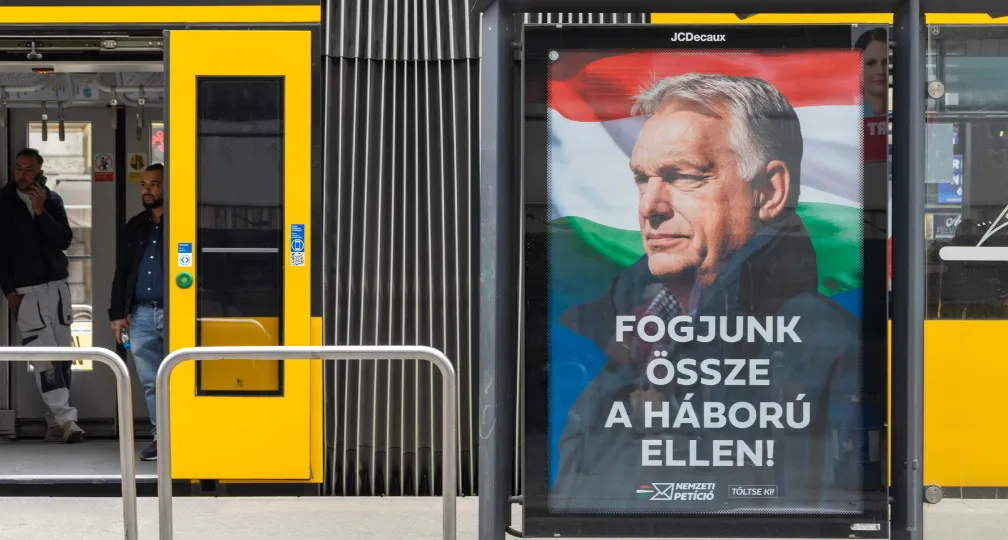
In the upcoming Hungarian elections, five parties have fielded candidates for a total of 199 seats, consisting of 106 single-member district seats and 93 proportional representation seats. The parties are the ruling Fidesz, the newly emerging center-right opposition party Tisza, the far-right Mi Hazánk (Our Homeland) party, the center-left DK (Democratic Coalition), and the satirical MKKP (Hungarian Two-Tailed Dog Party).
However, the election has effectively become a two-way contest between the ruling Fidesz, led by Prime Minister Viktor Orbán, and the opposition Tisza party, led by Péter Magyar, which advocates improving relations with the EU, combating corruption, and strengthening investment in domestic public infrastructure.
It is because, like many European countries, Hungary has an electoral threshold for smaller parties: a party must obtain at least 5 percent of the vote to gain parliamentary representation. At present, only Fidesz and Tisza achieve to gain support in the double digits. Among the remaining smaller parties, the only one consistently polling around the 5 percent threshold is Mi Hazánk, which won roughly 6 percent of the vote in the last 2022 election.
What kinds of seat distributions are possible, and how might they affect governance after the election? This article examines several possible seat allocation scenarios based on the latest polling trends and considers potential post-election political outcomes.
Polls Show Opposition Advantage but…
Compared with previous Hungarian parliamentary elections, predicting the outcome of this general election is extremely difficult. Since around the autumn of 2024, assessments of which party holds the advantage have differed dramatically depending on whether the polling organization is government-aligned or independent (Table 1).
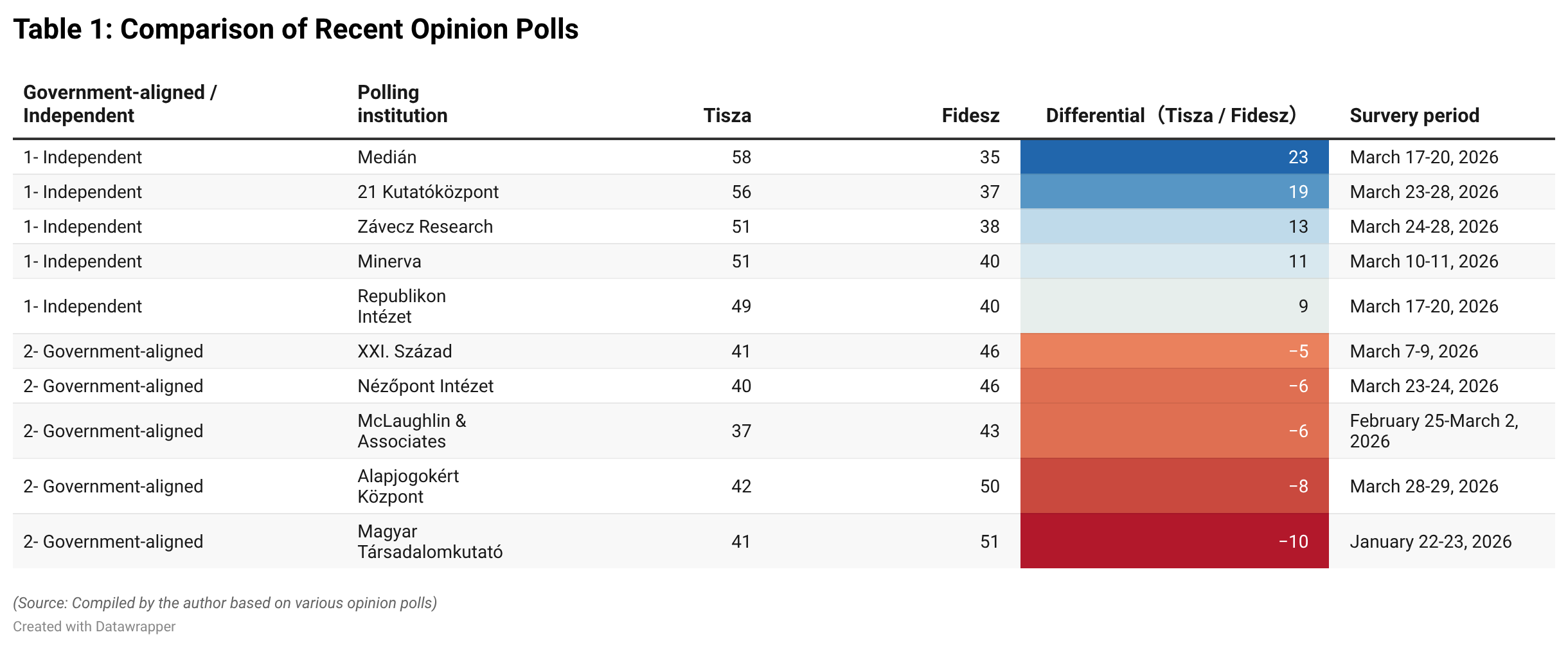
For example, according to the latest Medián survey conducted from March 17 to 20, 2026, support for Tisza reached 58 percent, while support for Fidesz stood at 35 percent. Similarly, another independent polling organization, 21 Kutatóközpont, conducted a survey between March 23 and 28 that showed Tisza leading with 40 percent to Fidesz’s 28 percent among all voters, and 56 percent to 37 percent among voters who had firmly decided how to vote.
On the other hand, a survey conducted on March 23–24 by the government-aligned Nézőpont Institute reported support levels of 40 percent for Tisza and 46 percent for Fidesz. Likewise, another government-aligned XXI. Század Institute reported similar results earlier in the same month, again showing Tisza at 40 percent and Fidesz at 46 percent. Nevertheless, it appears that both the Orbán government and government-aligned polling organizations recognize that Fidesz faces a more difficult race. In fact, in the Nézőpont Institute’s final pre-election poll before the 2022 election, Fidesz support was predicted to reach 50 percent, whereas current figures fall below that level.
There may be legitimate questions about how much trust should be placed in politically colored government-aligned polling. Even so, given that the forecasts of government-aligned and independent polling organizations diverge far more sharply than in previous elections, it is necessary to consider multiple possible outcomes when analyzing Hungary’s 2026 general election.
<Related Article>
“Orbán in the Public Eye: Anti-Ukraine Argument for Delegitimising Brussels” (December 1, 2025)
This paper examines how Ukraine’s prospective EU accession has been turned into a tool of domestic political mobilisation in Hungary. It traces how Viktor Orbán and government communication frame Ukraine as a threat and embed the issue into a broader anti-Brussels narrative built on fears of war, loss of sovereignty, and “foreign values” in the run-up to the 2026 elections.
Simple Majority for Tisza
Among the possible seat projections for this election, the first scenario indicated by independent polling is that Tisza secures a simple majority but falls short of the two-thirds supermajority.
According to the election forecasting website Választási Monitor, which aggregates both government-aligned and independent polling data, the average of independent polls suggests that Tisza could win approximately 112 seats (56.3 percent), a majority but not the two-thirds threshold.
When I attended a Tisza rally in Szentendre in March, the party’s momentum was clearly visible. The square that served as the rally venue was filled with large numbers of attendees, primarily young and middle-aged voters, although some elderly participants—traditionally considered less supportive of Tisza—were also present.

Tisza rally in Szentendre. Photo by the author.
However, Tisza is a new party that only began full-scale activities in 2024. Apart from party leader Magyar and a few candidates, many of its candidates lack the name recognition enjoyed by Fidesz candidates. If the election were decided solely through proportional representation, Tisza would almost certainly become the largest party. Yet in Hungary, where single-member districts account for more seats than proportional representation, it remains uncertain whether Tisza can accumulate enough victories in district races.
Moreover, Fidesz’s strength lies not in Budapest but in rural regions. Although Tisza has conducted multiple nationwide tours to expand its support in rural areas, accurately predicting voter behavior in these regions is difficult.
In addition, allegations of vote buying by Fidesz have recently surfaced in rural areas. Over the past month, several independent media outlets have reported of documentaries alleging the distribution of cash and food by Fidesz members and associates in rural areas to secure 500,000 to 600,000 votes, as well as reports of mobilization efforts involving residents of villages and elderly care facilities. Depending on the scale of such allegations, they could significantly benefit Fidesz and disadvantage Tisza (although theoretically further investigations could damage Fidesz, the limited time remaining before the election makes that unlikely).
Simple Majority for Fidesz
Another possibility is that Fidesz secures a majority, even if it receives fewer total votes than Tisza.
Hungary’s electoral system has effectively become favorable to the ruling party. The Orbán government has revised election laws several times since 2011, including changes widely described as gerrymandering, in which opposition-leaning regions are consolidated into single districts to reduce the number of districts unfavorable to Fidesz.
<Related Article>
“Hungary’s Electoral System: Constructing a System Favorable to the Governing Party and Its Future Prospects” (October 20, 2025)
What is the structure of Hungary’s parliamentary election system? This commentary explains its key features, with particular attention to institutional changes introduced during the Orbán government.
For example, in November 2024, following the results of the European Parliament elections, the Orbán government revised electoral district boundaries ahead of the 2026 parliamentary election. According to research by Telex, the restructuring incorporated parts of Fidesz-leaning areas into districts where Tisza had previously held a slight advantage, thereby increasing the likelihood of Fidesz victories. It also merged neighboring districts where Tisza had performed well in the European Parliament election into larger districts, raising the threshold for Tisza to secure seats.
Gerrymandering can significantly affect election outcomes. Róbert László of Political Capital, a Budapest-based independent think tank, notes that by consolidating opposition-leaning districts into larger constituencies, Fidesz could maintain a majority even if Tisza’s support exceeds Fidesz by 4–5 percentage points.
Because districts likely to be won by Fidesz tend to have smaller populations than those likely to be won by the opposition, it is possible that 2.5 million votes for Tisza and 2.4 million votes for Fidesz could translate into 50 seats for Tisza and 56 seats for Fidesz.
The High Bar of a Two-Thirds Majority
Although the most likely projection remains that Tisza could win a majority but fall short of a two-thirds supermajority, the party is aiming to secure such a supermajority.
Party leader Péter Magyar has repeatedly emphasized to supporters that victory should not be narrow but decisive. “We will win the election. Not narrowly, but by a large margin. Our goal is to secure two-thirds of the seats,” he emphasized at a rally in April 2025.
Even if independent polls show Tisza ahead, however, achieving a two-thirds majority remains more difficult for Tisza than for Fidesz. For example, 21 Kutatóközpont conducted a simulation using the latest district boundaries and incorporating factors such as alleged vote buying by Fidesz and the high name recognition of long-serving Fidesz candidates. According to this simulation, if polling results showing Tisza leading by 19 percentage points are realized, Tisza could win 88 district seats and 46 proportional seats, totaling 134 seats (67.34 percent). However, even a slight decline in Tisza’s support or a modest increase in Fidesz’s support could prevent Tisza from reaching that threshold.
Could Fidesz secure a two-thirds majority? According to the latest seat projection from the Nézőpont Institute, Fidesz is expected to win 66 single-member districts. If that estimate proves accurate, securing 34 of the 93 proportional seats would be sufficient for a majority, and depending on the proportional vote share, achieving two-thirds would theoretically not be impossible.
Nevertheless, even for Fidesz, achieving a two-thirds majority appears extremely difficult. In the Nézőpont Institute’s latest projection published on April 3, Fidesz is expected to win 66 district seats and 43 proportional seats, totaling 109 seats, far short of the 133 seats required for two-thirds. Similarly, Választási Monitor’s aggregation of government-aligned polls suggests that Fidesz could emerge as the largest party with 124 seats (62.3 percent)—again falling just short of the two-thirds threshold.
Why Two-Thirds Matters
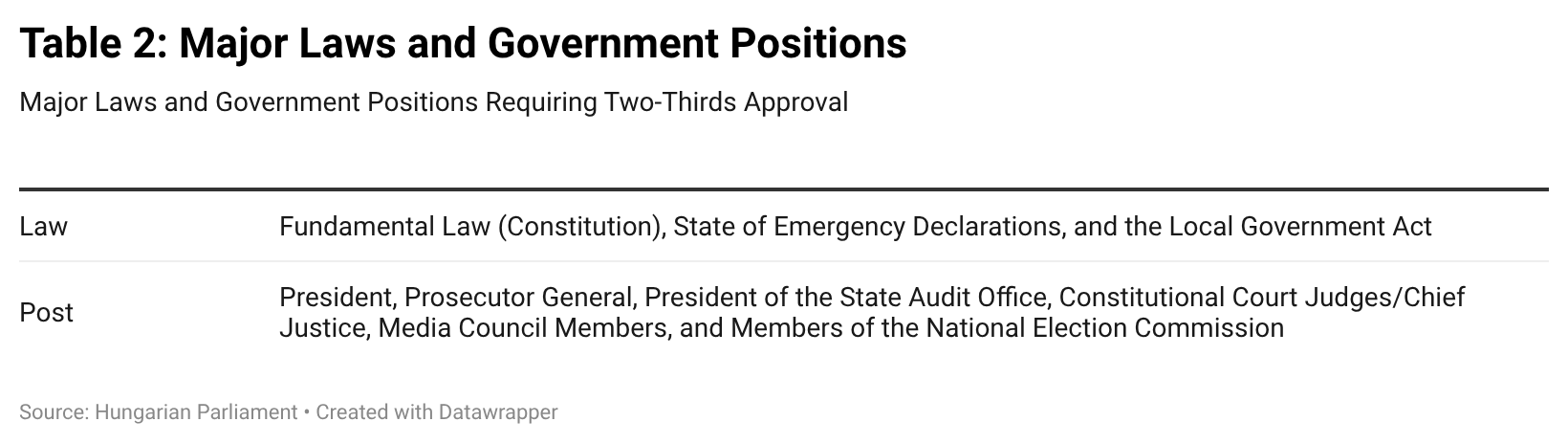
Whether any party secures two-thirds of the seats will have decisive implications for post-election scenarios. As shown in Table 2, Hungary requires two-thirds parliamentary approval not only for constitutional amendments but also for many important laws and appointments to key national institutions.
Possible Scenarios
Three scenarios can be envisioned depending on the number of seats won by the leading party.
Scenario 1: Tisza Majority – Limited Reform
Without a two-thirds majority, the scope of reforms available to Tisza would be significantly constrained. Although policy changes that do not require legal revisions—such as improving relations with the EU or reducing dependence on Russian energy—would remain possible, broader reforms would face institutional barriers.
As Politico Europe has already noted, legislation could be delayed or blocked through presidential vetoes or referrals to the Constitutional Court, where judges sympathetic to Fidesz hold a majority. Replacing the president or constitutional court judges would require a two-thirds majority. Similarly, efforts to address corruption under the Orbán government would be difficult as long as the Fidesz-aligned prosecutor general, another position requiring two-thirds approval to replace, remains in office.
Scenario 2: Fidesz Majority – Reduced Ability to Use Strong Measures
Fidesz has held a two-thirds majority since 2010, enabling sixteen years of institutional transformation. Having already filled key positions with allies, the party has little incentive to replace major officeholders. Many senior officials, including the president (appointed in 2024) and the prosecutor general (appointed in 2025), are early in their terms.
Even if Fidesz secures only a simple majority, it would face fewer constraints than Tisza because existing institutional arrangements favor the ruling party. However, losing a two-thirds majority would restrict further constitutional amendments and emergency powers.
<Related Article>
“Hungary: Media Control and Disinformation” (November 20, 2024)
This report revisits the history of democratic backsliding and the tightening of restrictions on the media under the Orbán government, examining how the Hungarian government gradually strengthened its control over the media.
Scenario 3: Two-Thirds Majority – Free-Hand Governance
If either Tisza or Fidesz secures a two-thirds majority, it would enjoy the same level of governing freedom that Fidesz has exercised in recent years.
In particular, if Tisza achieves this threshold, it could pursue sweeping reforms, including constitutional amendments and replacement of senior officials, as Magyar has pledged in Nyíregyháza on March 23: “If Tisza wins two-thirds of the seats on April 12, we will amend the constitution and remove Viktor Orbán’s puppets who represent mafia interests and foreign powers rather than the Hungarian people”.
A Low-Probability but Possible Deadlock
Although less likely, Hungary’s electoral system could theoretically produce a scenario in which neither major party secures a majority. In that case, the far-right Mi Hazánk could become a pivotal third party if it surpasses the 5 percent threshold.
However, cooperation with Mi Hazánk would be politically difficult for either major party. Although Fidesz has sent signals toward potential cooperation, Mi Hazánk itself denies such intentions. For Tisza, cooperation with a far-right party would likely provoke strong voter backlash. At the Szentendre rally mentioned earlier, when Magyar referenced the possibility of a “Fidesz–Mi Hazánk coalition,” the audience reacted with clear opposition. This scenario would likely result in political stagnation.
A Pivotal Election
In the 2022 election, some observers believed the opposition coalition would run a close race against Fidesz. Instead, Fidesz ultimately secured another two-thirds majority, disappointing many opposition politicians and supporters.
What will happen this time? Will Tisza succeed in bringing about a change of government? If so, will it win only a majority, or a two-thirds supermajority that would give it a free hand? Or will Fidesz manage to maintain power by mobilizing every available advantage?
As the political situation continues to shift rapidly, the final days of Hungary’s 2026 need to be watched closely.
Disclaimer: The views expressed in this IOG Commentary do not necessarily reflect those of the API, the Institute of Geoeconomics (IOG) or any other organizations to which the author belongs.

Research Fellow,
Digital Communications Officer
Yusuke Ishikawa is Research Fellow and Digital Communications Officer at the Institute of Geoeconomics (IOG). His research focuses on European comparative politics, contemporary Hungarian politics, democratic backsliding, disinformation, and anti-corruption. He also serves as External Contributor for Transparency International’s Anti-Corruption Helpdesk, as Associate Research Fellow at the EUROPEUM Institute for European Policy, and as Part-time Lecturer in European Affairs at the Department of Economics and Business Management, Saitama Gakuen University. His publications include “How Opposition Strategies Interact under Electoral Autocracy: Evidence from Hungary’s TISZA Party“, (Politics in Central Europe, 22 (2)), "NGOs, Advocacy, and Anti-Corruption" (In Routledge Handbook of Anti-Corruption Research and Practice, 2025), and A Dangerous Confluence: The Intertwined Crises of Disinformation and Democracies (Institute of Geoeconomics, 2024). He has been featured in national and international media outlets including Japan Times, NHK, Asahi Shimbun, Neue Zürcher Zeitung (NZZ), Handelsblatt, Expresso, and E-International Relations (E-IR). He received his BA in Political Science from Meiji University, MA in Corruption and Governance (with Distinction) from the University of Sussex, and another MA in Political Science from Central European University. He is currently pursuing a PhD in Political Science at Meiji University. Prior to his current roles, he was Research Associate at IOG and API, contributing to the book translation project of Critical Review of the Abe Administration into English and Chinese. Previously, he has worked as Research Assistant for API's CPTPP program and interned with its Fukushima Nuclear Accident and Abe Administration projects. His other experience includes serving as a visiting research fellow at EUEOPEUM Institute, a full-time research intern at Transparency International Hungary, and as a part-time consultant with Transparency International Defence & Security in the UK. [Concurrent Positions] Associate Research Fellow, EUROPEUM Institute for European Policy, Czechia External Contributor Consultant, Anti-Corruption Helpdesk, Transparency International Secretariat (TI-S), Germany Part-time Lecturer, Department of Economics and Business Management, Saitama Gakuen University, Japan
View Profile