
Donald Trump, ‘The Art of the Deal” and the ‘TACO’ myth
One year later — and what a year it’s been — it’s worth asking whether this market-driven TACO narrative describes reality, or merely reflects an assumption embedded in a trading strategy. The issue is not whether markets influence Trump (they clearly do) but how that influence operates and shapes his decisions.
Correlation vs. causation
The appeal of TACO lies in its simplicity, as it appears to capture a pattern repeated often enough to become tradable. Yet, as an explanation of decision-making, it is incomplete. Particularly when applied as a single, market-driven logic across different contexts, this view mistakes correlation for causation and focuses on the most visible moment — the apparent retreat — rather than on the full sequence of bargaining and the final outcome.
Liberation Day itself illustrates both the strengths and limits of the TACO theory. Investors reacted sharply to the tariff announcement, and the Trump administration shifted course, yet policy did not revert to the status quo. A 10% universal tariff remained in place, and the pivot to dealmaking was not a full reversal but a recalibration. Crucially, the episode did not end with the pause; it eventually produced trade frameworks with most major U.S. trading partners, leaving overall tariff levels higher than before. Nor does the timing of the tariff pause establish that Trump’s move to dealmaking was not planned from the outset.
Moreover, the decisive signal appears to have come less from equities than from the bond market, where higher borrowing costs and tighter financial conditions carry more direct macroeconomic and political implications. Markets mattered — but not all mattered equally. Indeed, contemporaneous reporting suggests that the bond market shock did accelerate Trump’s shift to a tariff pause, a move consistent with real-time adjustment within a negotiating strategy rather than a fundamental retreat.
The same dynamics appear in subsequent episodes. In the 2025 China tariff cycle, repeated escalations brought periods of market stress, followed by pauses and partial agreements, yet tariff rates remained significantly above pre-escalation levels. Likewise, in trade negotiations with India, Trump’s 50% tariff threat was reduced to a lower but still elevated 18% settlement. And in the confrontation with Denmark over Greenland, maximalist political demands coincided with market unease before giving way to more limited outcomes that nonetheless shifted the negotiating baseline toward increased U.S. presence or resource access. In these episodes, reactions were notably concentrated in equities and risk assets, with more muted signals from the bond market compared to Liberation Day.
Versions of this “pressure-and-partial-retreat” dynamic also appear in other cases, including Trump’s first-term Mexico tariff threats, the 2018 U.S.-China trade war, more recent pressure campaigns on major U.S. firms, as well as deadline-driven tariff confrontations with U.S. trading partners. Across these cases, what looks like “backing down” is better understood as movement from an initial demand to a more sustainable position — one that still enhances leverage or improves on the pre-crisis status quo. Taken together, they explain why TACO became embedded in market thinking, but they do not on their own explain the logic behind Trump’s behavior.
The Art of the Deal
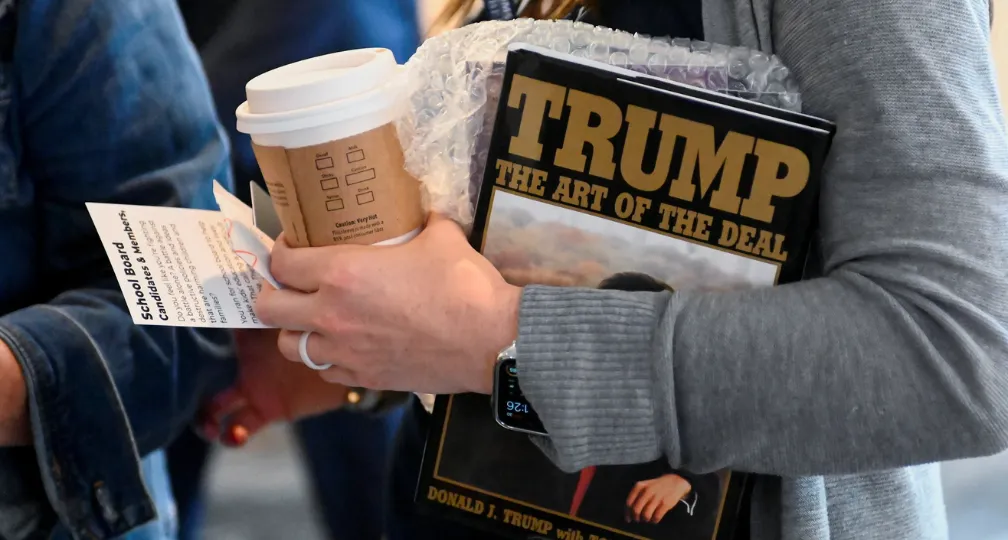
Another, more useful, framework views Trump’s approach through the lens of leverage. His consistent emphasis — dating back to his business career and articulated in his 1987 book “The Art of the Deal” — is not on maintaining stable positions, but on gaining bargaining advantage. Trump typically starts with extreme demands, forces reactions from counterparts (and markets), and then narrows those demands while claiming success. This clarifies why TACO can be misleading. It treats the initial threat as the “real policy,” rather than as an opening bid, and focuses on the path of de-escalation rather than Trump’s negotiating strategy. The relevant question is not whether Trump retreats from a maximal position, but whether the final outcome leaves him in a stronger position than before.
In this context, market volatility is not simply a constraint; it can also be a tool. Once the TACO pattern is widely expected, what appears as market discipline can become a source of leverage. If investors anticipate that Trump will moderate under pressure, they “buy the dip” earlier, reducing downside risk, and, at times, lowering the cost of credibly demonstrating resolve.
Some investors also note a recurring pattern in the timing of Trump’s actions. Major announcements often arrive on Friday after markets close, with reactions unfolding in futures trading before being reassessed over the weekend. Whether intentional or not, this sequence allows time for interpretation, signaling, and negotiation before markets reopen on Monday. It may also create space for a familiar dynamic: sharp declines followed by equally sharp rebounds. This matters because Trump famously treats market performance (especially equity indices) as his political scorecard, and is unusually explicit in presenting such rebounds as evidence of policy success. The surge to record highs following the Liberation Day tariff pause, for instance, was framed as evidence that tariffs were not harmful, reinforcing the political value of the recovery itself.
Markets nevertheless constrain Trump, as they do any democratic leader. However, in some cases the constraint is not financial at all—instead, it is countervailing leverage held by the target. In what is often seen as a prime example of a market-driven TACO, China’s threat to restrict rare earth exports forced the US to adjust its trade position, but the decisive constraint was supply chain leverage rather than market volatility.
Indeed, the limits of the TACO framework become even clearer when the target is an adversary and policy is less easily reversible. When the Iran war began, some investors expected a familiar cycle of escalation followed by de-escalation. That expectation itself shaped early market reactions. Yet unlike tariff threats, the dynamics of a military conflict, including regional security commitments and global energy risks, do not lend themselves to quick or unilateral reversal. In such cases, the assumption that market pressure will produce rapid retreat becomes far less reliable.
TACO ultimately captures a real feature of market behavior: Investors have learned to expect some degree of moderation after sharp escalations. But as a theory of Trump’s decision-making, it is too narrow. It underestimates the role of bargaining leverage, overstates the primacy of equity markets and struggles to explain outcomes where pressure leads not to a full retreat but to a new and often more favorable baseline.
A more accurate assessment is that markets function for Trump as both a constraint and an instrument. They signal when costs are rising, especially through the bond market, and they shape the political environment in which decisions are made — lowering the cost of escalation as expectations of moderation are priced in. Markets do influence Trump; the myth is that downturn fears “always” force capitulation. In that sense, “The Art of the Deal” remains a better guide than TACO.
[Note] This article was posted to the Japan Times on April 14, 2026:
https://www.japantimes.co.jp/commentary/2026/04/14/world/art-of-the-deal-and-taco-myth/
(Photo Credit: Anadolu / Getty Images)

Geoeconomic Briefing
Geoeconomic Briefing is a series featuring researchers at the IOG focused on Japan’s challenges in that field. It also provides analyses of the state of the world and trade risks, as well as technological and industrial structures (Editor-in-chief: Dr. Kazuto Suzuki, Director, Institute of Geoeconomics (IOG); Professor, The University of Tokyo).
Disclaimer: The opinions expressed in this Geoeconomic Briefing do not necessarily reflect those of the International House of Japan, the Institute of Geoeconomics (IOG) or any other organizations to which the author belongs.

Visiting Research Fellow
Andrew Capistrano is a geopolitical risk consultant based in Tokyo, and Director of Research at PTB Global Advisors in Washington, DC, where he specializes in industrial policy, international trade and capital flows, and US-China relations. He is also a visiting scholar at the Waseda Institute of Political Economy and a visiting lecturer at the School of Political Science and Economics, Waseda University. Previously, he worked at the US Embassy’s American Center Japan, and as a research associate at the Rebuild Japan Initiative Foundation/Asia-Pacific Initiative. Dr Capistrano holds a BA from the University of California, Berkeley; an MA in political science (international relations and political economy) from Waseda University; and a PhD in international history from the London School of Economics. His academic work focuses on the diplomatic history of East Asia from the mid-19th to the mid-20th centuries, applying game-theoretic concepts to show how China's economic treaties with the foreign powers created unique bargaining dynamics and cooperation problems. During his doctoral studies he was a research student affiliate at the Suntory and Toyota International Centres for Economics and Related Disciplines (STICERD) in London.
View Profile-
 Can Japan build a defense-startup ecosystem?2026.10.07
 - Economic security in health and medicine through strategic alignment2026.10.06
- National Security and the Stakes of ‘Technology Sovereignty’2026.09.24
- From Racing China to Pacing the AI Frontier2026.09.17
- The Takaichi Administration’s High-Stakes Growth Gamble2026.09.15