

Takaichi’s Twin Challenges: Economic Growth and Security

The administration of Prime Minister Sanae Takaichi has placed a “responsible yet proactive fiscal policy” at the center of its economic agenda, identifying a national growth strategy as its highest priority.....(continues below)
The administration of Prime Minister Sanae Takaichi has placed a “responsible yet proactive fiscal policy” at the center of its economic agenda, identifying a national growth strategy as its highest priority. Takaichi has also emphasized economic security as part of her agenda. Whether she succeeds on these two fronts will go a long way toward defining her prime ministership in 2026.
Less than a month after taking office in October, the Takaichi government established the Japan Growth Strategy Headquarters, chaired by the prime minister and led operationally by Minister of Economic and Fiscal Policy Minoru Kiuchi, who also serves as minister for the growth strategy. Seventeen priority sectors were designated, each overseen by a Cabinet minister — including the defense minister — who is responsible for formulating a sectoral strategy that Kiuchi will consolidate. A council of experts has also been convened to support the Headquarters; this author serves as one of its members.
Takaichi has long stressed the importance of economic security, both since becoming prime minister and before that as minister of state for economic security. It will therefore be useful to examine how the new growth strategy relates to Japan’s economic security ambitions and consider what kind of international position the government may secure as a result.
A defining feature of the Takaichi government’s strategy is its dual emphasis on “crisis-management investment” and “growth investment.” Crisis-management investment refers to forward-leaning measures that strengthen Japan’s ability to address national risks and social vulnerabilities. Traditionally, growth strategies focused on channeling resources into sectors with high economic upside — the so-called winning paths. The new strategy retains this through targeted growth investment in sectors where Japan already holds competitive advantages.
What is most striking, however, is the explicit decision to designate investments in risk mitigation — including national defense — as part of a “growth strategy.” Defense industrial development has historically been discussed within a national security framework rather than an economic one. But the Takaichi strategy frames defense capability as a national growth asset. This reflects the government’s recognition that Japan’s rapidly deteriorating security environment requires a stronger defense industrial base as a form of crisis-management investment.
In her remarks on Nov. 10, Takaichi underscored the creation of new demand through government procurement, including defense procurement, as well as regulatory reforms. She also committed to multiyear budget allocations aimed at giving industry clearer visibility and incentives for investment.
Yet questions remain about whether multiyear commitments for such a wide array of defense technologies and procurement programs are feasible. While space and green-innovation initiatives have benefited from multiyear funds, defense procurement spans too broad a range of technologies for an equivalent fund-based approach. In fact, traditional procurement frameworks may ultimately limit the scale of change.
From an economic security standpoint, two concepts matter most: strategic autonomy and strategic indispensability.
Strategic autonomy involves reducing dependencies on specific countries that create a vulnerability to economic coercion. Among the 17 designated sectors in the growth strategy, areas such as energy and natural resources, digital and cybersecurity, pharmaceuticals as well as advanced medicine and telecommunications remain highly exposed to geoeconomic risks. These correspond to some of the “specified critical products” identified under Japan’s Economic Security Promotion Act — but the growth strategy does not strongly emphasize reducing foreign dependence. In other words, autonomy is not its organizing logic.
Conversely, the strategy closely aligns with strengthening Japan’s strategic indispensability — making the country’s technologies and industries essential to global value chains. Sectors such as content creation, aerospace (including composites and space-debris removal) and advanced semiconductors and AI, led by efforts such as Rapidus’s pursuit of 2-nanometer fabrication, are already areas where Japan can become globally indispensable.
An especially notable inclusion is shipbuilding. Long viewed as a labor-intensive and structurally challenged industry, shipbuilding has gained new relevance as the United States looks to Japan to help compensate for the decline of its own shipbuilding base. While Japan is no longer dominant in liquefied natural gas carriers and other categories, it retains strong capabilities in fuel-efficient vessels and a broad industrial ecosystem that supports ship construction. Japan may not be indispensable to the world across all fronts, but in the context of the U.S.-Japan alliance, shipbuilding holds strategic weight — and strengthening it contributes directly to strategic indispensability.
Overall, the growth strategy touches on indispensability without explicitly elevating it as a core mission while it shows the intention to enhance strategic autonomy remains limited.
International implications
It is unsurprising that the growth strategy does not fully prioritize economic security, since its primary goal is economic revitalization. Yet Japan cannot shield itself from the global consequences of escalating U.S.-China trade frictions, U.S. tariff policies, China’s retaliatory export controls on critical minerals and the systemic distortions caused by China’s “involution” — its cycle of over-competition and overproduction. To translate the growth strategy into sustainable development, Japan must reduce external dependencies and strengthen autonomous capabilities in next-generation sectors such as artificial intelligence and food-related technologies.
The centerpiece of the Takaichi approach, however, is its explicit budgetary commitment to defense — and its categorization of the defense industry as a growth sector. Japan will revise its National Security Strategy and related documents in late 2026 and measures to strengthen defense industry and technology are expected to be included. A critical shift under discussion is the potential elimination of export restrictions under the “Five Categories” of the defense equipment transfer guidelines. Removing these restrictions would allow the export of lethal systems, expanding markets for Japanese defense manufacturers and positioning defense production as a driver of economic growth.
Expectations are rising: Japan is co-developing the Global Combat Air Programme with the U.K. and Italy and pursuing joint production of Mogami-class frigates with Australia. Yet defense exports will not reach the scale of automobiles or semiconductors, and thus cannot single-handedly deliver economic growth.
Instead, the strategic logic appears broader. By strengthening shipbuilding, aerospace and defense industries, Japan aims to deepen ties with allies and partners, enhancing the nation’s role in military strategy and raising its indispensability within coalition security frameworks. This implies a shift in Japan’s economic security philosophy: from a focus on autonomy to a focus on being indispensable to allies, particularly like-minded democracies.
In this sense, the Takaichi growth strategy is not merely about domestic economic expansion. It is a geoeconomic strategy aimed at elevating Japan’s status in the international system — positioning the country as a critical industrial and strategic partner in an era of intensified geopolitical competition.
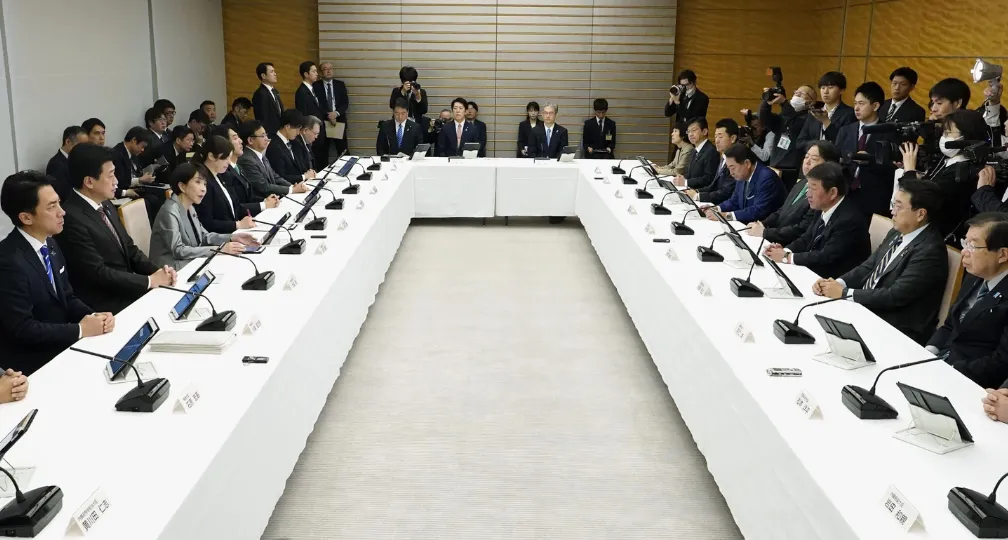
(Photo Credit: Mainichi Shimbun/AFLO)
[Note] This article was posted to the Japan Times on Jan 12, 2026:
https://www.japantimes.co.jp/commentary/2026/01/12/japan/takaichis-twin-challenges/

Geoeconomic Briefing
Geoeconomic Briefing is a series featuring researchers at the IOG focused on Japan’s challenges in that field. It also provides analyses of the state of the world and trade risks, as well as technological and industrial structures (Editor-in-chief: Dr. Kazuto Suzuki, Director, Institute of Geoeconomics (IOG); Professor, The University of Tokyo).

Director & Group Head, Economic Security
Kazuto Suzuki is Professor of Science and Technology Policy at the Graduate School of Public Policy at the University of Tokyo, Japan. He graduated from the Department of International Relations, Ritsumeikan University, and received his Ph.D. from Sussex European Institute, University of Sussex, England. He has worked for the Fondation pour la recherche stratégique in Paris, France as an assistant researcher, as an Associate Professor at the University of Tsukuba from 2000 to 2008, and served as Professor of International Politics at Hokkaido University until 2020. He also spent one year at the School of Public and International Affairs at Princeton University from 2012 to 2013 as a visiting researcher. He served as an expert in the Panel of Experts for Iranian Sanction Committee under the United Nations Security Council from 2013 to July 2015. He has been the President of the Japan Association of International Security and Trade. [Concurrent Position] Professor, Graduate School of Public Policy, The University of Tokyo
View Profile-
 The 2026 Hungarian Parliamentary Elections: Opinion Polls, Seat Projections, and Potential Scenarios2026.04.09
 - How should Japan respond to China’s nuclear threat?2026.04.09
- Takaichi is right to call for a ‘new technology-driven nation’2026.04.07
- The Geopolitics of Ports and Pipelines: The Case of The Strait of Hormuz -The Struggle Over Chokepoints-2026.04.06
-
 India's Semiconductor Moment2026.04.03



 Is the Iran Operation Really About China?2026.03.12
- Orbán in the Public Eye: Anti-Ukraine Argument for Delegitimising Brussels2026.02.04
- India's Rising Gravitational Pull2026.03.06
- War in the Persian Gulf means volatility in the global energy market2026.03.26
- Don’t Count on U.S. Domestic Politics to Constrain Trump on Iran2026.03.27