
Orbán in the Public Eye: Anti-Ukraine Argument for Delegitimising Brussels
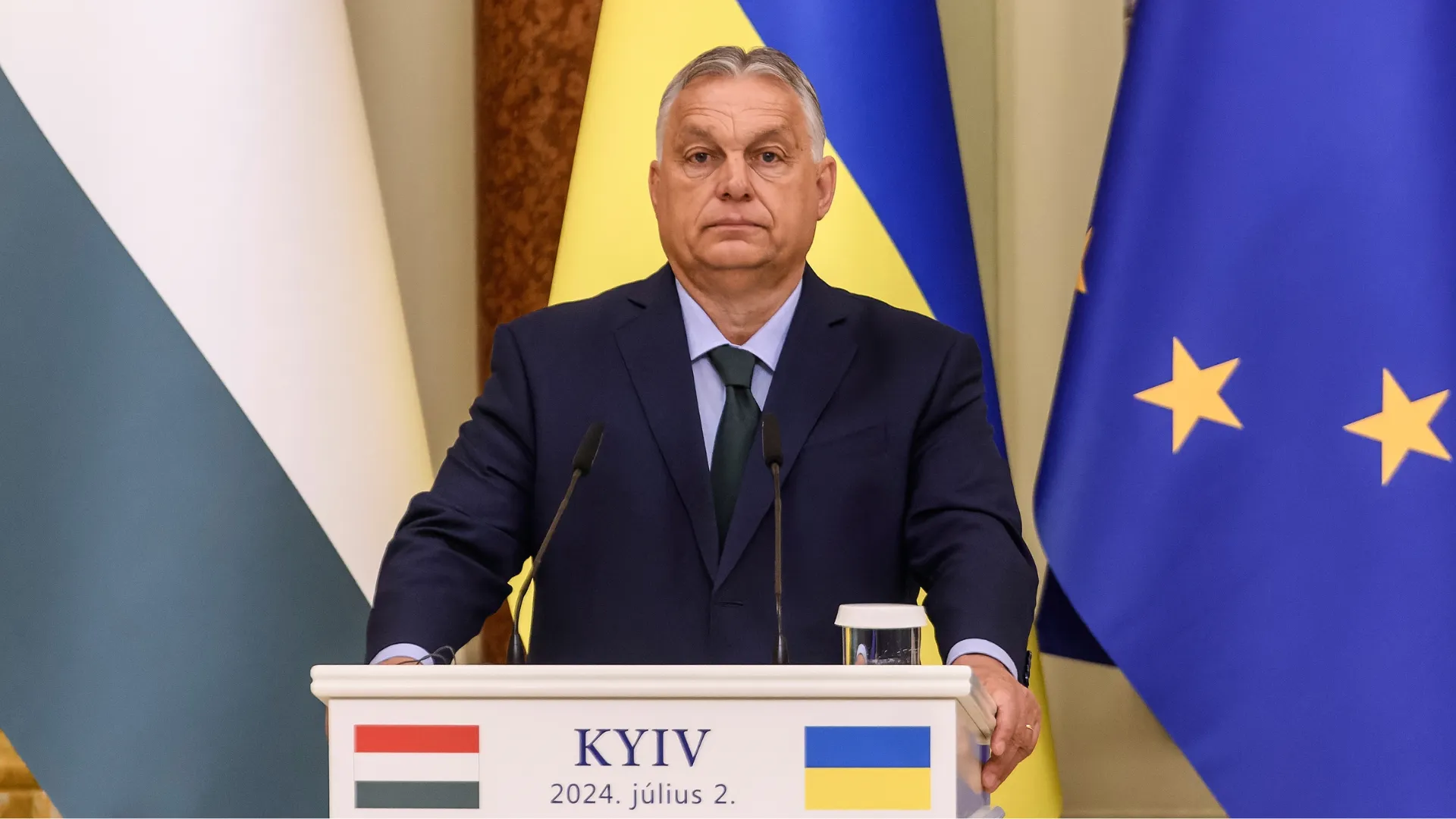
Written by Yusuke Ishikawa and Oszkár Roginer-Hofmeister (EUROPEUM Institute), this paper examines how Ukraine’s prospective EU accession has been turned into a tool of domestic political mobilisation in Hungary. It traces how Viktor Orbán and government communication frame Ukraine as a threat and embed the issue into a broader anti-Brussels narrative built on fears of war, loss of sovereignty, and “foreign values” in the run-up to the 2026 elections.
Introduction
“The Hungarian interest is that we must never, under no circumstances be in one integration with the Ukrainians.”[1]
The attempt to manufacture an image of Ukraine and Zelenskyy, antagonistic towards Hungary and Hungarians has been on the Fidesz communication agenda at least since the parliamentary elections of 2022. Unveiling the results and enumerating whom the Fidesz-KDNP coalition had defeated, Viktor Orbán interconnected – amongst others – the “Brussels bureaucrats” with the “president of Ukraine” already in his victory speech.[2] Received with an applause in 2022, this became a clear trend after Péter Magyar entered the political and communication arena in 2024, and especially in 2025 when it became apparent that he would be Orbán’s main challenger in the upcoming parliamentary elections in April 2026. By mentioning Volodimir Zelenskyy, Péter Magyar and Ursula von der Leyen together[3], linking Ukraine’s EU accession with an already negative image of the EU,[4] and orchestrating a comprehensive public mobilisation strategy alongside a media campaign – the VOKS 2025 –, Hungarian state communication aims to embed a negative sentiment regarding the connection between Brussels and Ukraine into the collective imagination of its voters ahead of the 2026 parliamentary elections.
2025 marks also a turning point in state communication, both in terms of quality and quantity. Unlike in previous decades, when the regime was able to set and control the public discourse in Hungary via its KESMA network of print and online outlets as well as its radio and television output through the MTVA electronic media conglomerate, the party is now struggling not only to initiate topics, but also to keep up with the narratives circulated across the national media landscape. To address this issue, the Hungarian parliament enacted a law that removes the cap on campaign spending,[5] which not only restructures the financial foundation of legacy media but also supports the newly established, regime-related “Fight Club” as well as the “Digital Civic Circles” and a wide array of other initiatives.[6]
With such an infrastructure in place, and with old images (LGBTQ+ lobby, George Soros, migration)[7] less employed in public communication, state propaganda is experimenting with the introduction of new narratives, one of which is inserting Ukraine’s EU accession into the wider campaign against Brussels.
The state nomenclature, along with regime-affiliated columnists and content creators, has been fully mobilized for the April 2026 elections. Among the most prominent figures is Viktor Orbán himself, supported by his communication team. Unlike in previous years, when he appeared only 2-3 times per year in the form of longer speeches and the fortnightly morning interviews on state radio, this year was marked by a series of public appearances, but also in radio and television shows and podcasts. This was accompanied by a high tide of social media content on all his platforms, updated several times daily.
This paper focuses on these interviews, social media content and public addresses by Viktor Orbán. It analyses how he folds the shifting narrative of Ukraine’s EU accession into his generic anti-EU narratives, with a special focus on the values. Accordingly, this paper revolves around the value-oriented arguments of Viktor Orbán, which he claims Ukraine represents. These values are also implied to be unfit for the EU as he views it, but also for the entirety of Europe as a continent of the future. We look into both legacy and social media and how all these fuel Euroscepticism in Hungary on a wider scale.
The initial phase: Ukraine’s EU accession on the international stage
“We stopped the EU accession of Ukraine.”[8]
Ukraine is not a new topic in the Hungarian populist communication apparatus. As Viktor Orbán’s significant surge in interviews, content creation and overall public visibility is nowadays primarily motivated by winning the elections, the utilisation of the topic of Ukraine and its merger into the wider anti-Brussels argument as a paradigmatic public relations tool began before the “presidential pardon-affair” and before he acknowledged Péter Magyar as his contender later on. Moreover, the EU as a threat to national sovereignty surfaced as a narrative already in his first re-election term,[9] when he shifted his rhetoric against Brussels likening it to the Soviet Union.[10] As a well-established trope, the EU as a threat to national sovereignty was then kept constantly in the public eye throughout his campaigns along with other images, such as migration, the gender and left-liberal lobby, George Soros, and others. State communication used them together to ridicule and delegitimise his opponents as servers of foreign powers and to present himself as a preserver of national values.
Integrating Ukraine into this narrative framing emerged as part of Viktor Orbán’s efforts to address a wider, international audience and position himself as a pan-European leader who stands to preserve conservative and patriotic ideals on the continent.[11] Folding Ukraine into this paradigm was only a nuance within his wider rhetoric against EU policies and his slogan to “occupy Brussels”. Nevertheless, despite his efforts to gain international attention – and via his personal connection to Donald Trump even a trans-Atlantic visibility –, with the war dragging on and the pile-up of further domestic scandals,[12] he is more and more using the EU stage to speak back to the domestic audience. In this sense, although planned internationally, the negative image of Ukraine had to be scaled down and adapted for the Hungarian voter. This is visible in the fact that he continued posting and giving interviews in Hungarian and gave less comments in English to global outlets. Therefore, transforming Ukraine’s EU accession into a largely domestic topic, it was gradually connected to the needs and fears of Hungarian citizens.
“A major part of the Hungarian agricultural industry would be completely destroyed by the agricultural actors in Ukraine, if we were to allow them into our market.”[13]
Although this agricultural framing is less visible nowadays, it remains part of the communicational apparatus. Relying mostly on farmers, having its origins in the Ukrainian “grain deal” and used mostly by Andrej Babiš and Robert Fico in Central Europe, it is rather a fading memory across the continent. In 2025, it has been overtaken by the topic of energy security in Hungary and Slovakia, thus playing on another fear of these audiences, but also proving the flexibility and versatility of the topic. It thus remains still a potent narrative, while being directed primarily towards Hungarian voters.
“Ukraine should never be allowed to join an integration that includes Hungary, because within an integration there could be conflicts of interest between Ukraine and Hungary whereby we’d always lose out: they are big, we are small; their territory is huge, ours is smaller”[14]
This effort to involve farmers and investing into their fears by exposing the contrast with the EU accession of Ukraine has often been triangulated with a romanticised image of fair and hard work on one side and an inherently corrupt Ukrainian society on the other. This also ties into Orbán’s often used argument when talking about double standards. This value-based connection, where it is implied that Brussels disregards the contrast between honest labour and unjust profiteering just to have Ukraine within its borders has been often repeated on his social platforms and in his interviews.
“We do not want them to drag us into the war, to ruin our farmers, to turn Europe’s safest country into a mafia nest, and we do not want Hungarians’ money to be sent to them through Brussels.”[15]
Fitting Ukraine’s argument against joining the EU into the anti-migration argument, he also contrasts the safety of Hungary without immigrants (unlike western European states) with a mafia-infested image of Ukraine. Taking this argument even further, he also presents an unverified number and points to a fact that can hardly be quantified, stating that 80% of criminal groups in Hungary are Ukrainian and continuing:[16]
“So they’re operating in a Ukrainian context, they’re Ukrainians, and they’re based in Ukraine. […] It’s not just the traditional forms of mafia that operate over there, but they’re sophisticated, clever, and can build mafia-like networks using modern technology. Ukraine is a dangerous country.”[17]
Since 2022, Viktor Orbán has frequently expressed his opposition to Ukraine joining the EU, arguing that such a move would directly bring war into the EU. Portraying himself and his party as the preservers of the ultimate value of “peace”, Orbán’s communication team puts considerable efforts into presenting Ukraine’s EU accession as an event pushed by Brussels imminently and almost instantaneously. By creating a narrative where the timelines of various stages of the accession process (from starting negotiations, through candidacy status up to full membership) are pushed onto each other and overlap as one, his rhetoric creates the illusion that accepting Ukraine in its current condition into the European Union will happen almost immediately, thus bringing the war directly into the EU with all of its consequences.
“We do not want our children to be sent to the Ukrainian fronts or even to Ukrainian territory in the form of Hungarian troops.”[18]
Creating an image of an instantaneous entry of Ukraine into the European Union and connecting it to existential threats connects this narrative to the present, when this narrative is exclusively used to mobilise domestic voters. Presenting himself as the only force standing between a Hungary where peace, prosperity, family values and national sovereignty are protected, and between Brussels, which will allow Ukraine’s entry into the EU, the regime spent approximately 14.7 billion Hungarian Forints[19] on the VOKS campaign,[20] which also marks the culmination of the party’s anti-Ukraine communication engagement.
The ripe phase: Ukraine as a domestic election tool
“We will not let Brussels force us into accepting Ukraine’s EU membership. This is a huge issue, with widespread implications for our security, economy, and agriculture.”[21]
Figuring Ursula von der Leyen, Manfred Weber and Volodymyr Zelenskyy on the posters with “Don’t let them decide above our heads,” the VOKS 2025 campaign was aimed to reclaim the communication initiative and beyond a merely reactive stance. By focusing on Ukraine’s EU accession, it sought to introduce the topic and saturate public spaces, media output and the digital platforms, thereby mobilising as many Hungarian citizens as possible. It consisted of a traditional and social media campaign building up to the event, the voting itself, which resembled the usual “national consultations” of the past, and the follow-up media campaign which built on the conclusions. Accordingly, Viktor Orbán’s social medial profile also recorded a hyper-production of content.
“If we accept Ukraine into the European Union, we will accept the war among ourselves. If we accept the war, it will result in military service and armed clashes. Then we will have to send soldiers who will go to the front, die and return in coffins from a war that we have nothing to do with. It is not in our interest to take even a single Hungarian to Ukraine and have even one of us die there.”[22]
As winning the elections is now the least certain since coming to power, Viktor Orbán and his communication team are trying to group everything under a common denominator. Scooping into their topics from the past decades the chaotic communication output often blends campaigns from past anti-Brussels, anti-migration, and anti-LGBTQ campaigns. While they still play on emotions and value-based arguments as in previous years, interviews and social media posts often seem to jump from one topic to another. Unlike in the 2010s and the early 2020s, when state communication was coherent, messaging from 2024 and 2025 often seems haphazard despite the enormous quantity of content. Although there is no publicly available data on how adding Ukraine and its EU accession into this series is successful, it most probably attracts some strata of Hungarian society as it remains a significant part of the communication.
“In 2022, 3.7 million Hungarians rejected what Pride promotes: pure gender propaganda. Anyhow, Brussels didn’t care – they ordered Pride anyway, and their allies in Budapest obeyed. This is the prototype. Migration, Ukraine – same script. Without a sovereign government, Hungary would be a puppet on Brussels’ string. We refuse to dance to their tune!”[23]
Lastly, the cost of EU enlargement towards Ukraine is not only portrayed in financial terms, but also in a vision of Europe, which is no longer a Europe of nation-states. While bankrolling Ukraine’s defence capabilities remains part of the repertoire and Orbán rarely misses the opportunity to point out that this only fuels and prolongs the war, he also draws attention to a larger picture. He often says that Ukraine cannot be accepted into the European Union because of its inability to manage its finances.
“Ukraine’s EU membership is the greatest danger today. Their country, which was already dysfunctional and bankrupt before the war, has since been ruined. They need other people’s money.”[24]
“Ukraine is not an independent country. Ukraine is not a sovereign country, Ukraine is financed by us, the West gives it funds, weapons.”[25]
Legacy and social media content production also overflowed when József Sebestyén, a soldier from the Hungarian minority in Ukraine with dual citizenship, allegedly succumbed to the beating during his recruitment. Interconnecting even his death and this tragic event with Ukraine’s inability to join the EU because of “state controlled lawlessness and the complete absence of legal certainty” Viktor Orbán’s content creators produced a series of videos featuring the prime minister himself.[26]
Aside from reaching into deeply individual stories and linking personal tragedies with emotions to make a foreign policy statement, he also tackles the structural problems of enlargement towards Ukraine in his recent interviews. In these, he often implies that this would be detrimental for the EU as he envisions it, because such an accession would not only include a country which will be one of the largest in territory and population. It would also change the dynamics of the EU and change the EU itself as a political entity. In a recent podcast, he outlined this concern in striking detail. When asked by the interviewer, Zsolt Bayer, a notorious supporter of the regime, about Brussel’s “masterplan” and how upon the acceptance of Ukraine “out of turn” into the EU will allow Ukraine to send at least 70 MEPs to the European Parliament, Viktor Orbán implied how this enlargement will be very different from all others.
“If Ukraine is accepted, the process of creating of a United States of Europe will have been finished. Because Ukraine will always be on the side of the United States of Europe, on the side of the Empire, because it cannot exist otherwise. Because it cannot exist as a nation. It is sustained from the Empire of Brussels. It is nowadays also sustained from Western money. So the acceptance of Ukraine – aside from all the horrible things it would cause to Hungary, aside from the war that it will bring with itself into the European Union – actually, it would also conclude the discussion on the future of the sovereignty of nations.”[27]
Presenting it as an ultimate clash of values and an unresolvable impasse between two versions of Europe, an overproduction of content in this direction sheds some light on the demographic Viktor Orbán considers his voters. While speaking to a domestic ideological base, he returned to his role prior to 2024, when he mostly styled himself as a European leader. Turning back to this image, which he usually uses in interviews for international media or events, such as CPAC Hungary or the Tusványos Summer University, he described a world order he – and parties he considers close to him – defends: in his interpretation, including Ukraine in this world order is not an option.
Conclusion
Viktor Orbán’s vision of Ukraine’s prospective EU accession reveals how foreign policy becomes a central tool of domestic power retention and how new elements can be incorporated into an existing Eurosceptic narrative. From 2022 onwards, his rhetoric gradually transformed Ukraine’s membership bid from a distant geopolitical question into a tangible threat to Hungary’s sovereignty, prosperity, and security. Fitting it into his wider anti-Brussels argument and framing Brussels as reckless and Ukraine as corrupt, violent, or economically unsustainable, Orbán merges long-standing anti-EU narratives with new fears of war, migration, and the erosion of national identity and sovereignty.
Recent communication initiatives exemplify this shift, where expensive, multimedia mobilisation is designed not only to gauge opinion but to create it, saturating public space with the image of a Brussels-Kyiv axis plotting to overrun Hungarian interests. By conflating different stages of accession and exaggerating immediate dangers – loss of farmers’ livelihoods, forced conscription, or a “United States of Europe” – Orbán positions himself as the sole defender of peace and independence. Pinning it against the opposition leader Péter Magyar, this strategy reflects both continuity and adaptation. While the anti-Brussels frame has deep roots in Fidesz politics, the Ukrainian issue provides a fresh and emotionally charged vehicle at a time when older mobilising tropes have weakened. In this way, Ukraine’s EU aspirations became less a foreign policy matter than a carefully engineered instrument of electoral survival.
Footnotes
- [1] “Orbán vs. Nógrádi – Milyen lesz az új világrend? – Kimerítő beszélgetés,” posted July 15, 2025, by Patrióta, YouTube, 52 min., 44 sec., https://www.youtube.com/watch?v=uYNwPSy9hxk.
- [2] “Választás 2022 – Orbán Viktor győzelmi beszéde,” posted April 4, 2025, by M1 – Híradó, YouTube, 12 min., 15 sec., https://www.youtube.com/watch?v=l2lCKstcXq8.
- [3] “Zelenszkij kormányváltást akar, Brüsszel dtkosszolgálad akciókra készül Magyarország ellen – jelentePe ki Menczer Tamás,” Híradó, July 1, 2025, https://hirado.hu/belfold/cikk/2025/07/01/zelenszkij-kormanyvaltast-akar-brusszel-dtkosszolgalad-akciokra-keszul-magyarorszag-ellen-jelentePe-ki-menczer-tamas.
- [4] “Zelenszkij kormányváltást akar, Brüsszel dtkosszolgálad akciókra készül Magyarország ellen – jelentePe ki Menczer Tamás,” Mandiner, August 28, 2025, https://mandiner.hu/kulfold/2025/08/megszuleteP-a-terv-igy-vennek-fel-ukrajnat-az-europai-unioba.
- [5] “DöntöP a parlament, a pénz nem számít: zöld út a korlátlan kampányköltésnek,” HVG, June 17, 2025, https://hvg.hu/iPhon/20250617_Zold-ut-a-korlatlan-kampanykoltesnek-ebx.
- [6] Yusuke Ishikawa et al., A Dangerous Confluence: The Intertwined Crises of Disinforma?on and Democracies, (Insdtute of Geoeconomics, 2024), https://insdtuteofgeoeconomics.org/en/research/2024112001-summary/.
- [7] Márton Bene and Zsolt Boda, “Hungary: Crisis as Usual—Populist Governance and the Pandemic”. in Populism and the Politicization of the COVID-19 Crisis in Europe, ed. Giuliano Bobba and Nicolas Hubé (London: Palgrave Macmillan, 2021), 87-100. https://doi.org/10.1007/978-3-030-66011-6_7; Robert Csehi and Edit Zgut, “‘We Won’t Let Brussels Dictate Us’: Eurosceptic Populism in Hungary and Poland,” European Politics and Society 22, no. 1 (January 27, 2020): 53–68, https://doi.org/10.1080/23745118.2020.1717064.
- [8] Fidesz, “Orbán Viktor: megállítoPuk Ukrajna európai uniós csatlakozását!,” Facebook, June 29, 2025, https://www.facebook.com/reel/800308022789501.
- [9] Ian Traynor, “Hungary prime minister hits out at EU interference in nadonal day speech,” The Guardian, March 15, 2025, https://www.theguardian.com/world/2012/mar/15/hungary-prime-minister-orban-eu.
- [10] “Orbán Viktor ünnep beszéde – 2012. március 15.,” posted July 15, 2025, by magyarbelpolidka, YouTube, 27 min., 30 sec., https://www.youtube.com/watch?v=ROUuSxbY_Iw.
- [11] “Farmers protest in Brussels amid EU summit”, DW, February 1, 2025, https://www.dw.com/en/farmers-protest-in-brussels-amid-eu-summit/a-68141511.
- [12] Tóth, Csaba Tibor. “Ha a Szőlő utcai ügyben dsztán láthatnánk, abba nem csak a NER remegne bele.” Mérce, December 3, 2025. https://merce.hu/2025/12/03/ha-a-szolo-utcai-ugyben-dsztan-lathatnank-abba-nem-csak-a-ner-remegne-bele/.
- [13] Balázs Bozzay, “Orbán: The EU shouldn’t even begin discussing Ukraine’s EU accession,” Telex, December 1, 2023. https://telex.hu/english/2023/12/01/orban-the-eu-shouldnt-even-begin-discussing-ukraines-eu-accession.
- [14] Cabinet Office of the Prime Minister, “Interview with Prime Minister Viktor Orbán on the “Patrióta” YouTube Channel,” miniszterelnok.hu, August 12, 2025, https://miniszterelnok.hu/en/interview-with-prime-minister-viktor-orban-on-the-patriota-youtube-channel-2025-08-12/.
- [15] About Hungary, “PM Orbán: Ukraine’s EU membership is the greatest danger today,” Abouthungary.hu, May 19, 2025, https://abouthungary.hu/news-in-brief/pm-orban-ukraine-s-eu-membership-is-the-greatest-danger-today.
- [16] Cabinet Office of the Prime Minister, “Prime Minister Viktor Orbán on the Kossuth Radio programme “Good Morning Hungary,” miniszterelnok.hu, May 30, 2025, https://miniszterelnok.hu/en/prime-minister-viktor-orban-on-the-kossuth-radio-programme-good-morning-hungary-2025-05-30/.
- [17] Ibid.
- [18] About Hungary, “PM Orbán: We do not want our children sent to the Ukrainian front and see them come home in a coffin,” Abouthungary.hu, June 18, 2025, https://abouthungary.hu/news-in-brief/pm-orban-we-do-not-want-our-children-sent-to-the-ukrainian-front-and-see-them-come-home-in-a-coffin.
- [19] Mardn Nagy, “Minden idők legdrágább nemzed konzultációja volt az ukránellenes Voks2025,” Népszava, August 28, 2025, https://nepszava.hu/3292381_minden-idok-legdragabb-nemzed-konzultacioja-volt-az-ukranellenes-voks-2025.
- [20] Magyarország Kormánya, “VOKS2025,” https://kormany.hu/voks2025.
- [21] Viktor Orbán (@PM_ViktorOrban), “We will not let Brussels force us into accepdng Ukraine’s EU membership,” X, April 11, 2025, https://x.com/PM_ViktorOrban/status/1910695646920650976.
- [22] Viktor Orbán, “Ha Ukrajnát felvesszük az Európai Unióba, a háborút is felvesszük magunk közé,” Facebook, June 14, 2025, https://www.facebook.com/orbanviktor/posts/p{id0HsHZby5ER8Ex5a1v9b44GhKwgsPanrckFkUNigUMLyLLuwXTzW1rpMgb4JKeDp2Yl.
- [23] Viktor Orbán (@PM_ViktorOrban), “In 2022, 3.7 million Hungarians rejected what Pride promotes,” X, June 1, 2025, https://x.com/PM_ViktorOrban/status/1939916361750163779.
- [24] About Hungary, “PM Orbán: Ukraine’s EU membership is the greatest danger today,” Abouthungary.hu, May 19, 2025, https://abouthungary.hu/news-in-brief/pm-orban-ukraine-s-eu-membership-is-the-greatest-danger-today.
- [25] “Hungary’s Orban says Ukraine is ‘not sovereign’ as drone dispute deepens,” Reuters, September 30, 2025, https://www.reuters.com/world/hungarys-orban-says-ukraine-is-not-sovereign-drone-row-deepens-2025-09-29/.
- [26] Viktor Orbán, “A mai napon kezdeményeztük Brüsszelben, hogy az Európai Unió emberi jogi szankciós listájára azonnali hatállyal vegyék fel azokat az ukrán vezetőket,” Facebook, July 15, 2025, https://www.facebook.com/reel/724632276951984.
- [27] “Orbán, Bayer, Ambrózy – Pikk Extra,” posted July 15, 2025, by Magyar Nemzet, YouTube, 53 min., 45 sec., https://www.youtube.com/watch?v=wpJwao6UHYM.
(Photo Credit: Shutterstock)

Research Fellow,
Digital Communications Officer
Yusuke Ishikawa is Research Fellow and Digital Communications Officer at Asia Pacific Initiative (API) and Institute of Geoeconomics (IOG). His research focuses on European comparative politics, democratic backsliding, and anti-corruption. He also serves as External Contributor for Transparency International’s Anti-Corruption Helpdesk, as Associate Research Fellow at the EUROPEUM Institute for European Policy, and as Part-time Lecturer in European Affairs at the Department of Economics and Business Management, Saitama Gakuen University. Prior to his current roles, Research Associate at IOG and API, contributing to its translation project of Critical Review of the Abe Administration into English and Chinese. Previously, he has worked as Research Assistant for API's CPTPP program and interned with its Fukushima Nuclear Accident and Abe Administration projects. His other experience includes serving as a visiting research fellow at EUEOPEUM Institute, a full-time research intern at Transparency International Hungary, and as a part-time consultant with Transparency International Defence & Security in the UK. His publications include "NGOs, Advocacy, and Anti-Corruption" (In Routledge Handbook of Anti-Corruption Research and Practice, 2025) and A Dangerous Confluence: The Intertwined Crises of Disinformation and Democracies (Institute of Geoeconomics, 2024). He has been featured in national and international media outlets including Japan Times, NHK, TV Asahi, Neue Zürcher Zeitung (NZZ), Handelsblatt, Expresso, and E-International Relations (E-IR). He received his BA in Political Science from Meiji University, MA in Corruption and Governance (with Distinction) from the University of Sussex, and another MA in Political Science from Central European University. During his BA and MAs, he also acquired teacher’s licenses in social studies in secondary education and a TESOL (Teaching English to Speakers of Other Language) certificate. [Concurrent Positions] Associate Research Fellow, EUROPEUM Institute for European Policy, Czechia External Contributor Consultant, Anti-Corruption Helpdesk, Transparency International Secretariat (TI-S), Germany Part-time Lecturer, Department of Economics and Business Management, Saitama Gakuen University, Japan
View Profile-
 India's Semiconductor Moment2026.04.03
 -
 Redesigning U.S.-Japan security in a ‘two-peer’ nuclear era2026.04.02
 - Don’t Count on U.S. Domestic Politics to Constrain Trump on Iran2026.03.27
- War in the Persian Gulf means volatility in the global energy market2026.03.26
- Is the Iran Operation Really About China?2026.03.12
 Orbán in the Public Eye: Anti-Ukraine Argument for Delegitimising Brussels2026.02.04
- Is the Iran Operation Really About China?2026.03.12
- India's Rising Gravitational Pull2026.03.06
- War in the Persian Gulf means volatility in the global energy market2026.03.26
- The Supreme Court Strikes Down the IEEPA Tariffs: What Happened and What Comes Next?2026.02.27