
The Gaza Ceasefire and the Evolving Strategic Landscape of the Middle East
Background to the Israel–Hamas Ceasefire Agreement
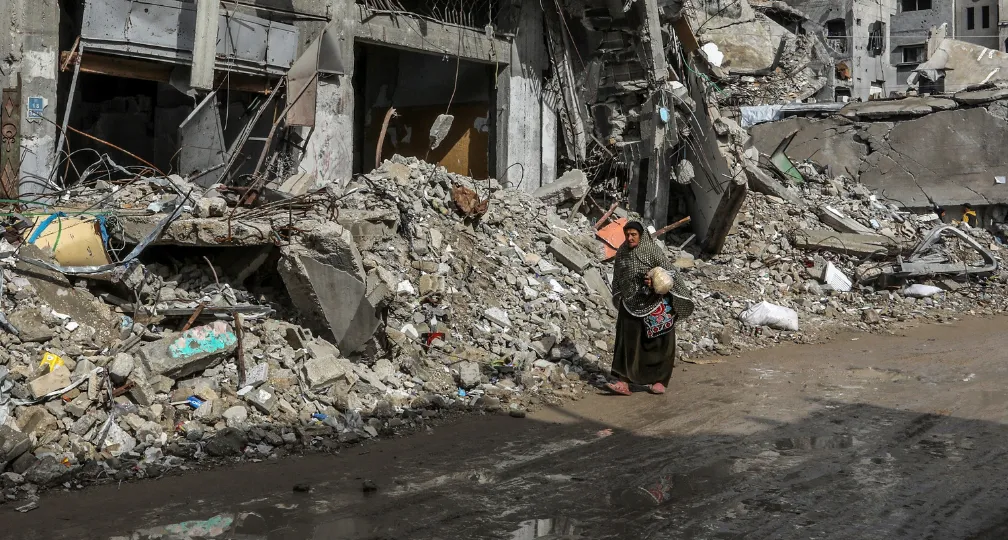
The discussion began by tracing the developments from Hamas’s October 7, 2023 attack to the eventual ceasefire agreement. Although the international community had long demanded a ceasefire, earlier attempts failed to gain traction. Israel repeatedly insisted on the complete destruction of Hamas, yet domestic pressure mounted for a ceasefire in order to secure the release of hostages. The United States also applied growing pressure on Israel, and after gaining leverage through actions such as striking Iranian nuclear facilities, Washington compelled Israel to accept a ceasefire arrangement.
Both panelists then moved on to discuss the tensions emerging within Israel’s governing coalition between Prime Minister Netanyahu and far-right parties. These far-right factions—whose political vision rejects a two-state solution and instead favors the expulsion of Palestinians from Gaza and the West Bank—have grown more assertive since the October 7 attack. Backed by intensified military operations and the de facto occupation of Palestinian-inhabited areas, the two-state framework has become even more difficult to realize.
Although far-right parties remain numerically small in the Knesset, their alliance with the ruling Likud Party grants them outsized influence. Netanyahu, long adept at coalition-building, turned to these far-right parties for the first time in his current government because deteriorating relations with centrist factions left him with no viable alternative for securing a governing majority. The panelists also highlighted the growing political influence of ultra-Orthodox communities—evidenced by government decisions such as exemptions from military service—as a key factor that has facilitated the rise of the far right.
Anti-Netanyahu protests have continued, driven in part by criticism that ongoing military operations undermine efforts to secure the release of hostages. The return of hostages’ bodies to Israel is seen as essential for advancing the first phase of the ceasefire agreement. Ezaki notes that Hamas, for its part, is attempting to locate and return bodies to demonstrate compliance. However, once all hostages have been returned, Israel’s incentive to maintain the ceasefire may diminish, leaving U.S. pressure as the primary force sustaining it.

Israel, the Arab States, and the United States
The discussion also addressed the future of the Abraham Accords, which continue to shape regional politics. Kazakhstan has recently announced its intention to join, and as Ezaki notes, despite the ongoing conflict in Gaza, neither the UAE nor Bahrain has withdrawn—suggesting that Arab states continue to perceive strategic value in the framework. Historically, the accords were facilitated in part by a shared perception of Iran as a common regional threat. However, Ezaki raises concerns that as Iran’s threat appears to be receding and Israeli actions—such as its strike on Doha—risk undermining trust, the foundations of the accords may be weakening. While the United States benefits strategically from closer relations between Israel and Arab states, Israel’s far-right parties frequently disregard U.S. preferences, adding another layer of volatility to the situation.
Israel’s 2026 election is expected to have a significant impact on Middle Eastern politics. Before October 7, Ezaki explained, the Palestinian issue carried relatively little salience in Israeli domestic politics. Since then, criticism of Netanyahu has intensified, although he continues to enjoy strong support among right-wing voters. The extent to which far-right parties can maintain their influence will shape future coalition arrangements, rendering the political environment highly fluid.
Israel’s political system has exhibited considerable fragility; in the two years preceding the current government, the country held five elections, resulting in a succession of short-lived administrations. Netanyahu may ultimately prioritize relations with the United States over his alliance with far-right parties, potentially realigning with centrist factions. Despite being indicted on corruption charges, both panelists agreed that Netanyahu has long demonstrated exceptional political resilience and a keen sensitivity to public sentiment, making it unlikely that he will relinquish power easily.
Future Prospects for a Two-State Solution
At this year’s UN General Assembly, multiple countries recognized Palestinian statehood. Japan signaled that the timing was not yet appropriate but left open the possibility of future recognition. Netanyahu showed little visible concern over these actions. However, since October 7, international criticism of Israel has intensified, and global sentiment increasingly supports addressing the root causes of the conflict by returning to a two-state framework. Whether the United States will actively pursue renewed efforts toward such a solution remains a decisive factor.
Questions were also raised about Europe–Middle East relations. Despite deep economic interdependence, Ezaki argues that the EU remains divided on the Palestinian issue: France and the UK have recognized Palestinian statehood, while Germany—due to historical reasons—remains reluctant to criticize Israel. Japan’s Middle East policy was likewise discussed; while Japan has strengthened relations with Israel since the mid-2010s and maintains a diplomatic balance between Israel and Arab states, some view Tokyo as not sufficiently engaged with regional issues.
(Photo Credit: Anas-Mohammed / Shutterstock)
IOG English Newsletter
Subscribe to the English IOG Newsletter to stay up to date on IOG’s activities across various briefings, op-eds, YouTube videos, podcasts, as well as new publications, events, research activities, and more.
-
 Trump Faces a Reckoning in the Midterms, but it Might Not Matter for Tariffs2026.10.09
 -
 BRICS in India2026.10.09
 - Can Japan build a defense-startup ecosystem?2026.10.07
- Economic security in health and medicine through strategic alignment2026.10.06
-
 Inside Japan’s New Growth Strategy: The Economic Security Implications2026.10.01

 From Racing China to Pacing the AI Frontier2026.09.17
- Sizing Up the New Tariff Wall2026.08.28
- Trump Faces a Reckoning in the Midterms, but it Might Not Matter for Tariffs2026.10.09
 India’s Multi-alignment Play2026.09.11
- Orbán in the Public Eye: Anti-Ukraine Argument for Delegitimising Brussels2026.02.04