
The Iran-U.S. MOU Offers a Reprieve, but Not Relief
The latest regulatory developments on economic security & geoeconomics
By Paul Nadeau, Visiting Research Fellow, Institute of Geoeconomics (IOG)
Iran, United States Agree to MOU on Conflict, Future Negotiations: On June 17, Iran and the United States signed a memorandum of understanding (MOU) to end hostilities for 60 days and create a framework for negotiations on a permanent and more comprehensive peace agreement that addresses Iran’s nuclear program. The agreement includes the gradual return of Iran’s frozen assets and the establishment of a $300 billion private fund (financing is otherwise undefined) to facilitate reconstruction and development in Iran, as well as the eventual removal of all U.S. sanctions “on an agreed upon schedule” and contingent on the outcome of negotiations over Iran’s nuclear program.
The United States removed the naval blockade of Iran following the MOU signing and Iran has agreed to permit toll-free passage through the Strait of Hormuz during the 60-day window. Iran carried out a strike on a Singapore-flagged container ship on June 25 for not following the route designated by Iran but a route set by the United Nations in coordination with the Omani government, which led to a series of reciprocal strikes between Iran and the United States. The U.S. Treasury Department’s Office of Foreign Assets Control (OFAC) issued a general license authorizing the production, sale, delivery, or offloading of crude oil, petrochemical products, or petroleum products of Iranian origin, including transactions involving certain blocked vessels for 60 days (through August 21, 2026) with U.S. dollar-denominated transactions permitted. As of Sunday, June 21, the seven-day moving average of ships passing through the Strait of Hormuz is 13 according to the International Monetary Fund’s Portwatch. The seven-day moving average at this time last year was 104.
U.S. Commerce Department Blocks Access to Anthropic Models: On June 12, U.S. Commerce Secretary Howard Lutnick ordered Anthropic to suspend export of the Mythos and Fable AI models to destinations worldwide and all foreign nationals, wherever located out of concern that the models could be deployed by military intelligence users in China, Russia or other countries of concern. The order is the first use of the authority granted to the U.S. Commerce Department under the 2018 Export Control Reform Act which allows the Department to impose controls on emerging technologies essential to U.S. national security. On June 26, the Trump administration granted Anthropic permission to sell its Mythos 5 model to a list of 100 companies, having determined that “appropriate safeguards” are in place to permit sales to “certain trusted partners”. Earlier this year, the U.S. Defense Department declared Anthropic to be a supply chain risk, a designation usually reserved for foreign adversaries and which requires defense contractors to certify that they will not use Anthropic’s models in their work with the U.S. military. Anthropic’s lawsuit challenging the Defense Department’s decision is ongoing.
EU, UK, Canada Adopt New Sanctions Targeting Russia: On June 15, the European Council adopted a package of additional listings toward 34 individuals and 47 entities for their involvement in Russia’ invasion of Ukraine, particularly targeting Russia’s military-industrial complex, its shadow fleet, information manipulation and interference activities, and the 2024 poisoning of Alexei Navalny. On June 16, the United Kingdom’s Foreign, Commonwealth, and Development Office announced 70 new sanctions targeting Russia’s shadow fleet, military procurement supply chains, and illicit finance networks used to circumvent sanctions. In a separate announcement at the G7 Summit, Canadian Prime Minister Mark Carney announced sanctions targeting 162 individuals, entities, and vessels in a package targeting Russia’s shadow fleet, energy revenues, defense-industrial complex, and disinformation actors.
EU Adopts Sanctions for Interference in Moldova: On June 15, the European Commission imposed restrictive measures against six individuals responsible for actions aimed at destabilizing, undermining, or threatening the sovereignty and independence of Moldova, including actions aimed at subverting its democratic processes.
U.S. Treasury Sanctions Hizballah-Link Group: On June 18, the U.S. Treasury Department’s Office of Foreign Assets Control (OFAC) designated Hizballah-aligned Lebanese officials, as well as members of the previously sanctioned Alaa Hassan Hamieh business network for using their influence to obstruct Lebanon’s peace process and delay the disarmament of Hizballah.
U.S. Treasury Issues License for Venezuela’s Air Carrier: On June 18, the U.S. Treasury Department’s Office of Foreign Assets Control (OFAC) issued a general license authorizing the supply of certain items and services involving Consorcio Venezolano de Industrias Aeronáuticas y Servicios Aéreos, the flag carrier airline of Venezuela.
USTR Opens Investigation into Germany’s Pharmaceutical Policies: On June 18, the Office of the U.S. Trade Representative (USTR) announced that it has opened an investigation under Section 301 into whether Germany’s “persistent underpayment for innovative pharmaceutical products by Germany is unreasonable or discriminatory and burdens or restricts U.S. commerce.” There is a public comment period until August 10 and a hearing will be held on the investigation on September 22. This investigation distinct from the ongoing Section 232 investigation into name-brand pharmaceuticals across a broader set of countries.
U.S. Treasury Sanctions ISIS-Linked Groups: On June 22, the U.S. Treasury Department’s Office of Foreign Assets Control (OFAC) designated three individuals and six entities across Europe, the Middle East, and West Africa for facilitating financial transactions on behalf of the Islamic State of Iraq and Syria (ISIS).
U.S. Sanctions Target Cambodia Scam Centers: On June 23, the U.S. Treasury Department’s Office of Foreign Assets Control (OFAC) sanctioned nine individuals and 26 entities linked to the Prince Group Transnational Criminal Organization, a Cambodian scam center group, including leadership, investors in scam compounds, and front companies. In parallel, the Treasury Department’s Financial Crimes Enforcement Network (FinCEN) proposed amending its October 2025 Huione Group Final Rule to include Cambodia-based H-Pay Service PLC and any successor entity.
U.S. State Sanctions Cuba Groups: On June 23, the Department of State designated entities associated with Cuba’s military-controlled enterprise GAESA, entities involved in exploiting Cuba’s metals and mining sector, and a former Cuban regime official.
U.S. Treasury Sanctions Rwanda’s March 23 Movement: On June 25, the U.S. Department of Treasury’s Office of Foreign Assets Control (OFAC) imposed sanctions on a network working in coordination with the Rwandan-backed March 23 Movement to illegally smuggle minerals from the Democratic Republic of the Congo to Rwanda.
No Extension for Russian Oil Waiver: The U.S. Treasury Department did not publish an extension of the waiver permitting the sale of Russian oil at sea.
Analysis: The Iran-U.S. MOU Offers a Reprieve, but Not Relief
It’s better to agree to end fighting than to continue it, so the announcement of a memorandum of understanding (MOU) to end hostilities between Iran and the United States is welcome. Obviously, there’s a lot that can go wrong, and it’s already been a rocky start for the agreement. Still, it’s important to remember that this MOU is not a treaty but a ceasefire with a framework for future negotiations. A ceasefire is not the same as peace and future negotiations promise nothing until an agreement is confirmed and signed. The ceasefire has already been tested to the point that it’s becoming hard to tell what the MOU has actually accomplished, but both sides seem willing to continue talks – a pattern that will probably hold, stopping short of providing real relief to the global economy and instead offering a series of tentative reprieves.
Each side has claimed victory, but each has their own motivations for the hostilities to end. The Islamic Republic survived the war but should welcome the ceasefire – the American blockade appears to have contributed to 80 percent inflation in Iran while the war in general caused $270 billion in damage. For Iran, the agreement gives them an opportunity to recover while preserving leverage through their nuclear program and ability to restrict shipping through the Strait of Hormuz. For the United States, Trump spoke about the toll that the conflict was taking on the U.S. economy, particularly on inflation which was becoming especially salient in the leadup to what should be a close midterm election with control of both chambers of Congress in the balance.
Yet Americans do not seem to view the end of hostilities with much relief. The chilly reception in Washington comes from all corners: from Democrats who see the deal as no better than Barrack Obama’s 2015 agreement with Iran, the Joint Comprehensive Plan of Action (JCPOA) from which Trump withdrew in 2018, from Republicans who see the deal as too weak and failing to codify what they perceived as a military victory, and from most everyone who see the agreement as a weak resolution to a war of choice they were never consulted on.
The backlash matters not just for the midterm elections, but because it complicates the political calculus for Trump to remain in the agreement. It may explain some of the proposals that Trump has floated for how Iran may use the $300 billion fund, with suggestions that it be restricted to purchasing U.S. farm exports possibly being more for domestic audiences than for the negotiating table (Iran has already rejected that idea of purchasing farm goods). The lifting of primary U.S. sanctions against Iran, as suggested by the MOU, will require the approval of Congress under the 2015 Iran Nuclear Agreement Review Act which was passed following the JCPOA. Trump has stated that the final agreement will be sent to Congress for its approval – a step not taken by Obama with the JCPOA which left the door open to its collapse, but will give Congress an effective veto on any final agreement.
Even if Trump ended the conflict to provide economic relief, the economic impact of the MOU will evolve slowly and is tied to the safety of passage through the Strait of Hormuz. The closure has impacts on everything from gas to fertilizer to medical equipment to semiconductor production to the coloring of potato chip bags and beyond. The existing backlog of 500 ships trapped in the Gulf will be released slowly and the Strait will need to be cleared of mines or other obstacles. Many shippers will want to wait to see how the MOU holds and the final agreement’s terms for passage before restarting normal transits, especially after Iran’s missile strike on a container ship that followed an “unauthorized” route close to the Omani coast (though one permitted by the UN), avoiding Iranian-sanctioned routes. If so, this would make the attacks a deliberate and coercive effort to enforce its control of the Strait and revealing that the MOU did not exactly agree to reopen the Strait but seems to tacitly accede to Iranian control. For that reason, insurers will almost certainly incorporate a risk premium for ships transiting the Strait for the foreseeable future. Navigating the waivers issued by the U.S. Treasury Department to purchase Iranian oil is not necessarily straightforward either as purchasers will need to ensure compliance before making transactions. The Treasury Department will likely need to issue a fact sheet to provide clarity to firms on compliance with the new rules and waivers to help them avoid unintended violations.
All this adds further delays and greater uncertainty, which in turn means economic relief may be slow in coming. Some analysts expect that the impact of lower shipping rates won’t be felt until after the midterm elections in November and supply chain backlogs are expected to last roughly as long. Morgan Stanley and Goldman Sachs have projected a price of $80 per barrel in Q4 of 2026, while Citi projects $70 per barrel – less than the $100 per barrel expected while the war was ongoing, but still more expensive than roughly $60 per barrel when the war began.
Beyond the United States, global economic resiliency will continue to be tested. While the conflict certainly created an energy and economic crisis, particularly in the Indo-Pacific, it was not as bad as many expected, largely due to the ability of the region’s economies to draw on oil reserves. On one hand, this may reassure leaders that maintaining or expanding their petroleum reserves, recognizing that no actor benefits for too long from blocking a chokepoint and avoiding a more comprehensive turn toward renewable energy or new sources of fossil fuels like Russia or the United States or coal. On the other hand, leaders may see the crisis as a signal to avoid overreliance on energy sources that rely on particular – and geopolitically volatile – chokepoints and look to expand their sources of energy. It seems both possibilities are in play so far: emergency measures are already being rolled back in some countries, but imports and installations of solar panels surged during the crisis and several ASEAN states are giving renewed consideration to nuclear energy and other alternative energy sources. In a perverse sense, continued tension over the Strait of Hormuz may continue to focus minds on energy diversification, but more than a crisis is needed for Indo-Pacific states to address structural issues like regulatory frameworks and undersized energy grids.
Ultimately, the MOU will probably put guardrails on the conflict but not completely end it. Trump’s ambitions for an eventual agreement are expansive but as incomprehensive and contradictory as the various reasons he used to justify beginning the war in the first place. While the idea of a comprehensive reproachment between Iran and the United States may be welcome, each side’s mutual suspicion of the other makes the pathway to such a relationship unlikely. Two wars in the space of a year, both in the midst of negotiations have left Iran with the impression that talks are only a cover for military action, while the United States remains profoundly suspicious of Iran’s nuclear ambitions, its threat to Israel, its violence towards domestic protestors, and its entire political system.
The most likely scenario looks a lot like the past four months, with occasional strikes, negotiations, and rolling deadlines with furtive but fragile agreements. The question of restoring passage through the Strait of Hormuz – and the question of broader relief for the global economy – will depend on the terms Iran demands for passage going forward and the kind of pressure that can be brought to bear upon them to maintain freedom of navigation. Whatever the answer to those questions will be, a return to the open transit that preceded the war seems impossible – another sign that the once free and open global economy is no longer free but becoming more expensive.
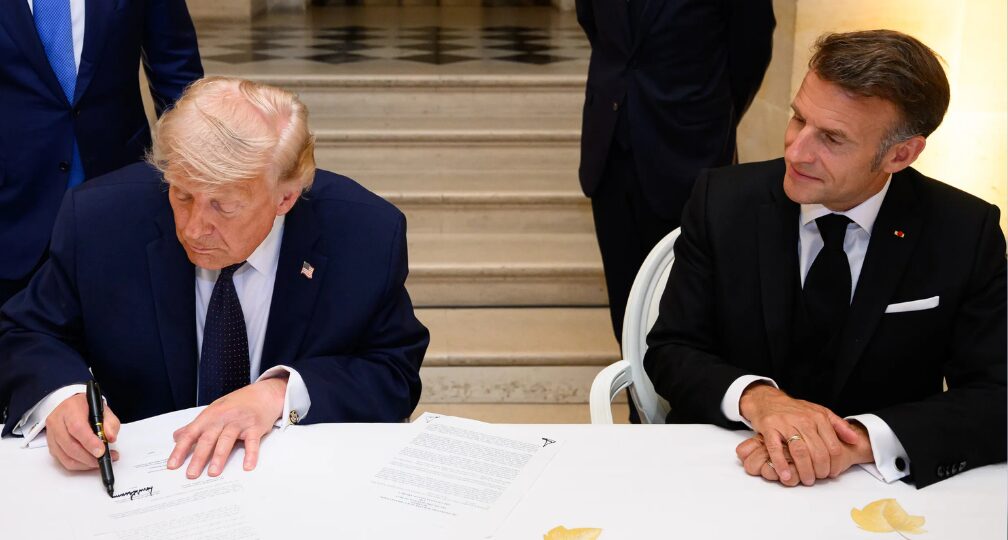
Photo Credit: (WhiteHouse.gov)
Disclaimer: The views expressed in this IOG Economic Intelligence Report do not necessarily reflect
those of the API, the Institute of Geoeconomics (IOG) or any other organizations to which the author belongs.
IOG English Newsletter
Subscribe to the English IOG Newsletter to stay up to date on IOG’s activities across various briefings, op-eds, YouTube videos, podcasts, as well as new publications, events, research activities, and more.

Visiting Research Fellow
Paul Nadeau is an adjunct assistant professor at Temple University's Japan campus, co-founder & editor of Tokyo Review, and an adjunct fellow with the Scholl Chair in International Business at the Center for Strategic and International Studies (CSIS). He was previously a private secretary with the Japanese Diet and as a member of the foreign affairs and trade staff of Senator Olympia Snowe. He holds a B.A. from the George Washington University, an M.A. in law and diplomacy from the Fletcher School at Tufts University, and a PhD from the University of Tokyo's Graduate School of Public Policy. His research focuses on the intersection of domestic and international politics, with specific focuses on political partisanship and international trade policy. His commentary has appeared on BBC News, New York Times, Nikkei Asian Review, Japan Times, and more.
View Profile-
 Connecting Europe and the Indo-Pacific: Why Japan and Germany Need Stronger Space Security Cooperation2026.10.20
 - China’s Calculus Behind the State Visit to the U.S.: Different Visions of “Stability”2026.10.16
- Trump Faces a Reckoning in the Midterms, but it Might Not Matter for Tariffs2026.10.09
-
 BRICS in India2026.10.09
 - Can Japan build a defense-startup ecosystem?2026.10.07