
China’s Rare Earth Export Controls: “International Rules” Orientation and the Avant-Garde Use of Security Exceptions

Introduction
In recent years, China’s export controls—particularly measures concerning rare earths—have moved beyond the conventional domain of trade policy and become policy instruments deployed strategically within the framework of international rules. Although China is often viewed as a disruptor of the existing order, it does not simply resist that order from the outside: in reality, it displays a distinctly Chinese “international rules” orientation, constructing advantage from within the system through interpretation and operational practice. Export controls, including those covering rare earths, have been situated along this same trajectory. The 2026 dual-use export measures targeting Japan mark a turning point in this mode of operation, as the technique of forcing security considerations into trade rules has become conspicuously overt.
This paper examines China’s rare earth export measures from the perspective of the international trade regime. After first clarifying the relationship between China’s orientation toward “international rules” and institutional operation, it considers the place of security exceptions and their implications, considering recent developments, including measures directed at Japan.
China’s “International Rules” Orientation
China is frequently cast as a disruptor of the “rules-based international order,” but the reality is considerably more complex. Indeed, China has in many respects adapted itself to the existing order by participating in international institutions and by undergoing “socialization,” that is, learning modes of conduct from within those institutions.[1] From around 2010 onward, as its national power expanded, China shifted from being a mere follower to becoming an actor involved in rule-making. Even then, however, its approach was not to negate the institutions themselves, but to interpret and operate existing frameworks in ways favorable to its own interests and to exercise influence “from within.”[2] This posture is also evident in China’s practice of positioning the United Nations at the core of the international order and deepening its engagement through specialized UN agencies across a range of fields, including the United Nations Educational, Scientific and Cultural Organization (UNESCO) in education[3] and the World Health Organization (WHO) in health.[4] Behind this lies a recognition that the existing order has supported China’s development and the expansion of its influence. There is also likely an instrumental motive: to preserve the framework itself while securing greater initiative in its operation.
In the trade domain, China has consistently emphasized the existing multilateral trading system centered on the World Trade Organization (WTO) and has presented itself as acting within that framework. President Xi Jinping has repeatedly stressed China’s active participation in maintaining and reforming the WTO system, positioning that system as a foundation for external opening and development.[5] Yet China’s practice is not limited to simple compliance with norms. It is characterized by the securing of policy space through the interpretation of rules and the operation of exception clauses. In other words, rather than fully internalizing the spirit of the regime, China tends to use the regime within the bounds of what is unlikely to result in defeat in a dispute, and to pursue modes of operation that favor its own interests.[6]
The evolution of China’s approach to rare earth export controls should be examined in this context. Two decisive catalysts shifted these export controls from “blatant restrictions” to “management that maintains control within the system”: the supply disruption to Japan around 2010, and China’s defeats in the WTO dispute settlement system between 2012 and 2014. This process can be understood as an effort to redesign the effectiveness of control while adapting to the environment of international rules. While China complied with the WTO rulings, it drew several lessons from its defeats. First, because measures that single out a specific country run afoul of the principle of non-discrimination, China learned that a “non-targeted” design, formally applicable to all destination countries, is institutionally preferable. Second, because direct instruments such as quotas and tariffs carry a high risk of being found unlawful, China moved toward more indirect methods that leave room for discretion, such as application and licensing systems and end-use reviews. Third, the case demonstrated the limits of invoking environmental and resource-conservation exceptions as the grounds for export restrictions, prompting China to consider security as an alternative basis for justification. Against this backdrop, China proceeded to refine policy tools for export controls, including those related to rare earths.[7]
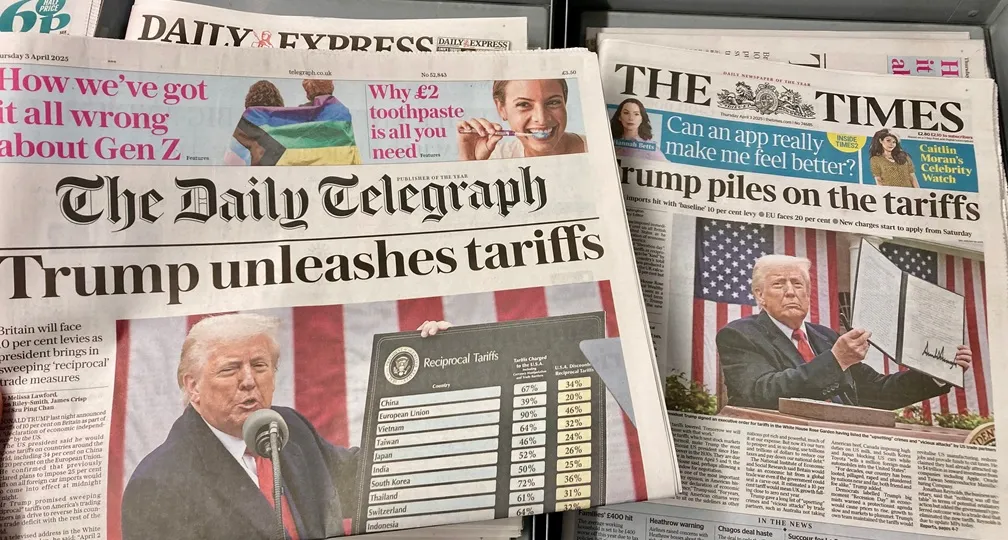
Rare earth export controls constitute an exceptionally powerful geoeconomic instrument for China, yet they are also a “double-edged sword” with substantial repercussions for international markets and for China’s own industries. For this reason, China could not seek control simply by halting supply, it also had to craft an external appearance that would not lead to defeat even if challenged at the WTO. It therefore proceeded cautiously. However, the additional tariff measures imposed by the Trump administration in April 2025 moved China away from this restrained posture. While managing institutional risk, China chose to strike back against the United States by activating the rare earth instrument.
Rare Earth-Related Export Controls Introduced in 2025
In this context, the strengthening of export controls in April 2025 on seven medium and heavy rare earth elements can be seen as the distilled form of an institutional design informed by the lessons of past WTO disputes. First, the scope of application was not limited to the United States; it took a non-targeted form extending worldwide, including to Japan. Second, the regulatory method was not a quota or embargo but an export-license application system. Exports remain formally possible, but they must pass through application and review procedures, allowing China to control supply volumes and distribution through their operation. By adjusting approval rates, review periods, end-use conditions, and other parameters, the system preserves room for imposing substantive constraints from within the institutional framework. Third, the justification foregrounds the security exception. Compared with environmental or resource conservation, security involves more ambiguous standards of judgment and is more difficult to turn into a clear international legal dispute. Thus, even if a dispute arises, China retains room to defend the measure on the basis of exception clauses under WTO agreements. In this sense, China’s current measures are designed with a strong awareness of the need “not to lose” in litigation.
Table 1: The Seventeen Rare Earth Elements
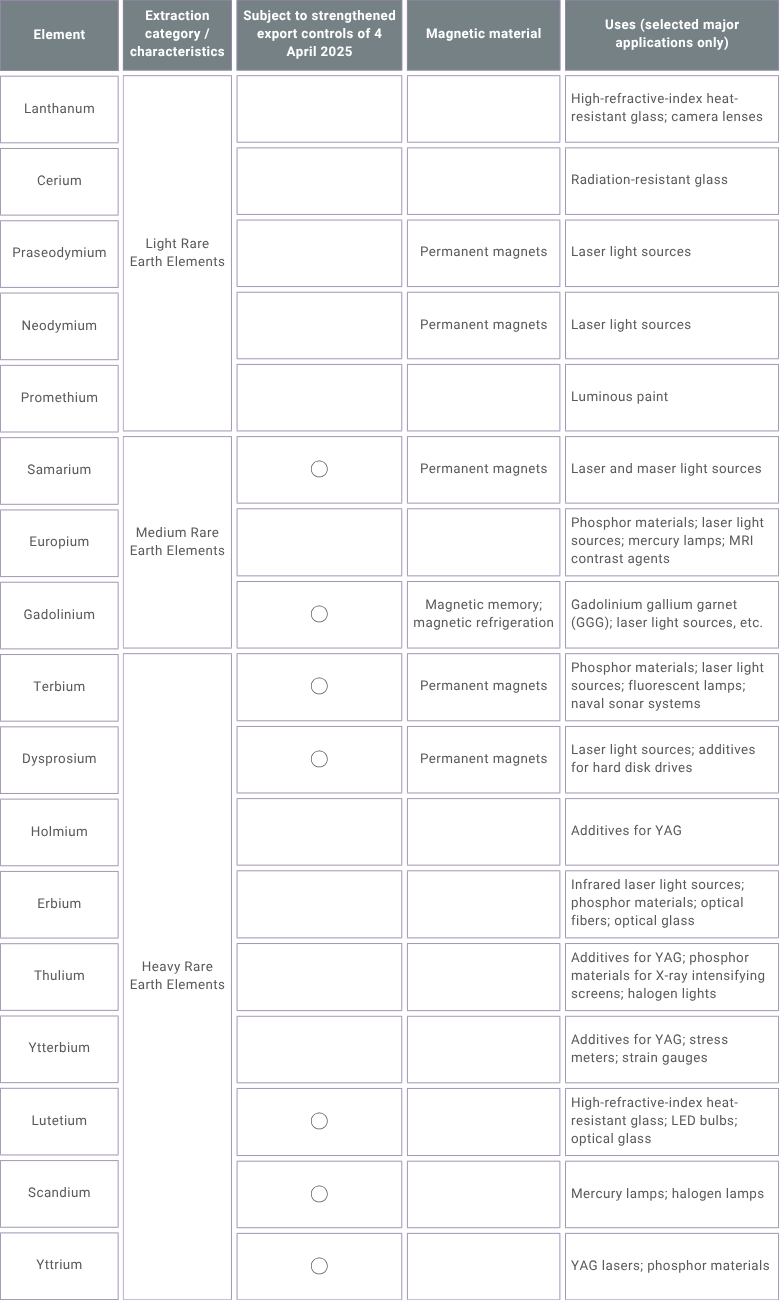
Source: Adopted from Shota Oda, “Trends in China’s Strengthening of Controls over Rare Earths,” Metals Resources Seminar, 31 July 2025, JOGMEC.
Strengthening of Export Measures Against Japan
In 2026, China has raised the intensity of its export controls against Japan by making them more concrete institutionally and more explicit in terms of their targets. The premise was Prime Minister Sanae Takaichi’s Diet statement in November 2025 concerning a Taiwan contingency and a “survival-threatening situation,” which China appears to have regarded as a serious security signal. In response, measures against Japan, including travel restrictions, were strengthened in stages, and in 2026 the operation of China’s export-control regime unfolded in a manner that placed Japan clearly within its scope.
At the core of the system is the tightening of controls on dual-use items. The Ministry of Commerce of China (MOFCOM) Announcement No. 1 of 2026 comprehensively prohibited exports to Japanese military users and for military end uses, as well as to “any end user or end use that contributes to the enhancement of military capabilities.” Furthermore, through Announcements No. 11 and No. 12 issued in February of the same year, twenty Japanese companies and other entities were, for the first time, added respectively to the Export Control List (a de facto embargo list) and to the Watch List. The former imposes a comprehensive prohibition on export, re-export, and domestic transfer; the latter, on the grounds of uncertainty regarding end use, requires the submission of risk-assessment reports and pledges, and extends review periods.[8] Although these are formally entity-specific measures, in substance they increase uncertainty and friction costs across transactions with Japan as a whole. A researcher at a think tank affiliated with MOFCOM describes the January 6 announcement as a broad “principle” and the February 24 announcements as “substantive” controls that identify specific targets, together forming a two-tiered system of management and control.[9]
These measures against Japan moved beyond a non-targeted licensing system and into a country- and end-use-specific targeted embargo. As a result, China has exposed itself to the potential risk of disputes over the WTO obligation of non-discrimination in relation to its measures against Japan. Nevertheless, the announcements invoke the “maintenance of national security and interests,” and the Chinese government has repeatedly described the measures as “lawful.”
Table 2: Measures Against Japan Issued through MOFCOM Announcements of 24 February
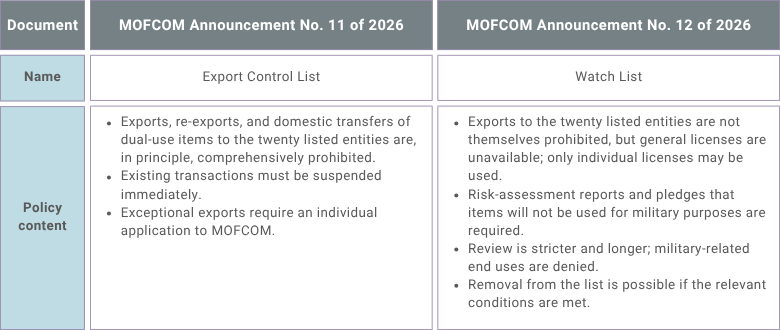
Source: Made by the author based on the MOFCOM website.
Around the same time as the strengthening of export measures against Japan, China gradually constructed a narrative that framed Japan as a security threat. The starting point was the Takaichi’s November 2025 statement; thereafter, Chinese media and commentaries intensified their criticism of Japan in the context of historical perceptions and deviations from the postwar order.[10] In 2026, this narrative underwent a qualitative change after the Communist Party of China’s official newspaper, the People’s Daily, introduced the concept of “new-type militarism” on January 9.[11] It redefined Japan’s actions not as accidental deviations, but as a continuous and tangible threat to the postwar international order. This concept is not merely rhetorical. By framing concerns about Japan’s remilitarization and putative nuclear ambitions as security issues, China appears to be seeking to explain its export measures against Japan concerning dual-use items, including rare earths, as exceptions to free trade under the logic of “defending national security” and fulfilling international non-proliferation obligations.
Nevertheless, the use of such security exceptions is not without constraint. Although WTO rules afford members a degree of discretion, recent dispute settlement practice has tended to interpret strictly the requirement of war or a comparable “emergency in international relations.”[12] Prior WTO dispute-settlement cases concerning security exceptions have also been understood to require more than mere political tension or value-based disagreement; rather, they require circumstances approaching a breakdown in relations or armed conflict.[13] China itself has criticized U.S. sanctions against China as an “abuse of security,” and any unlimited expansion of exceptions therefore entails the risk of undermining the coherence of China’s own position.
Having said that, how far the WTO can intrude into such politically sensitive matters is a separate question. Security exceptions are intrinsically tied to sovereign judgment, and there are institutional limits to the capacity of dispute-settlement bodies to reject fully a state’s own perception of security. Whether China’s reasoning will ultimately be accepted remains uncertain. At the same time, the institutional framework does not necessarily imply immediate defeat for China; rather, it may generate prolonged litigation and an expansion of grey-zone practices.
Prospects
External measures concerning rare earths may expand and become more refined in the future. Rare earths are, in the first place, a powerful bargaining instrument, but excessive use can accelerate the formation of alternative supply networks and erode China’s own advantage; they are therefore a double-edged sword. Even within China, there are signs of concern that supply dominance could be destabilized over the long term as a result of technology spillovers and policy competition, with the rise of Australia’s Lynas often cited as an example.[14] Even so, insofar as efforts by Japan and its allies to reduce dependence on China remain limited in the short term, China has an incentive to use the card while its advantage persists. Indeed, the entity-list measures of February 2026 enable a mode of operation that combines pressure and relief through the addition and removal of targets. It is therefore possible that China will continue to exert pressure on Japan through the expansion and contraction of such lists, centered on defense-related fields.
Regrettably, it will be difficult for these countries to escape dependence on China for rare earths—especially heavy rare earths—within the short span of several years. By contrast, China may have an incentive to exercise this card during the window in which its advantage is still maintained. The measures against Japan in the form of the February 26 entity list indicate that pressure through a similar framework could continue. On the one hand, if developments in Japan’s defense-related sectors arise that do not align with China’s preferences, China may gradually expand the scope of affected items to include rare earth-related products. On the other hand, by implying the possibility of removal from the list, China may create a structure in which targeted companies are forced to take what amounts to a de facto loyalty test.
Overall, this case is a paradigmatic example of geoeconomic risk in which politics and economics are deeply intertwined. The export measures against Japan covering dual-use items, including rare earth-related products, exceed the bounds of traditional trade policy and are being operated across institutions, narratives, and the international environment. While the export-control tightening related to rare earths in April 2025, undertaken against the backdrop of tensions with the United States, formally maintained the frameworks of being “non-targeted” and “application-based,” China’s dual-use export restrictions against Japan from 2026 crossed those boundaries and shifted toward foregrounding the application of security exceptions. Moreover, in April 2026, MOFCOM also added seven EU companies to the Export Control List, citing, among other reasons, their past involvement in arms sales to Taiwan.[15] In this way, China is displaying a tendency to link the “Taiwan issue” to security and to categorize its economic coercion as an exception to free trade.
Such practices surrounding rare earth export controls are inherently shaped by the subjective judgments of the parties concerned. Precisely for this reason, it is important for Japan and China to manage divergent perceptions and restrain any further destabilization of relations through direct bilateral communication. At a time when political and bureaucratic channels face difficulties, the importance of multi-layered dialogue involving the business sector and private think tanks has become greater than ever.
(Photo Credit: Shutterstock)
Disclaimer: The views expressed in this IOG Commentary do not necessarily reflect those of the Institute of Geoeconomics (IOG) or any other organizations to which the author belongs.
footnote
- [1] Johnston, A.I., Social States: China in International Institutions, 1980-2000 (Princeton: Princeton University Press, 2008).
- [2] Weiss, J.C. and Wallace, J.L., “Domestic Politics, China’s Rise, and the Future of the Liberal International Order,” International Organization 75(2) (2021), 635-664.
- [3] Doi, Kenichi, “Global education governance ‘with Chinese characteristics’: Multilateralism in the ‘New Era’,” Compare: A Journal of Comparative and International Education (2023).
- [4] 土居健市「中国のグローバル保健ガバナンスへの参画と国際社会への含意に関する研究」城山英明編著:WHO 検証・改革の動向把握及び我が国の戦略的・効果的な介入に資する総合的研究報告書 (pp. 151-159). 厚生労働科学研究特別事業. 2022.4
- [5] 新华社. 习近平在中共中央政治局第八次集体学习时强调 积极参与世界贸易组织改革 提高驾驭高水平对外开放能力[EB/OL]. (2023-09-27). https://www.qstheory.cn/yaowen/2023-09/27/c_1129889592.htm. 习近平. 发挥亚太引领作用 共促世界发展繁荣:在亚太经合组织工商领导人峰会上的书面演讲[EB/OL]. (2025-10-31). https://www.mfa.gov.cn/web/ziliao_674904/zyjh_674906/202510/t20251031_11744903.shtml.
- [6] 森永輔「中国がデュアルユース品の輸出規制を転換―背景に中国式の国際ルール志向」『日経ビジネス』2026年3月13日、日経BP、https://business.nikkei.com/atcl/gen/19/00179/030900318/。
- [7] 土居健市「レアアースの地経学:中国の国際供給支配と『ルール志向型』輸出管理への変遷」『CISTECジャーナル』, No.222 (2026年1月号)、2026年。森永輔「中国デュアルユース品の輸出規制転換――『無差別』から『日本狙い』へ」『日経ビジネス』2026年3月12日、日経BP、https://business.nikkei.com/atcl/gen/19/00179/030900317/。
- [8] 大川 信太郎「中国におけるレアアース輸出管理等の動向と実務上の影響」『海外投融資』2026.
- [9] 田伊霖. 依法坚决遏制日本“再军事化”野心[N]. 光明日报, 2026‑03‑18(12).
- [10] 加茂具樹(2026)「『新型軍国主義』はいかに形成されたのか――2025年末から2026年春にかけての『人民日報』対日批判の分析」霞山会、2026年4月20日 https://www.kazankai.org/media/cl/a2224、2026年4月22日最終アクセス。
- [11] 钟声. “新型军国主义”将把日本再次引向深渊[N]. 人民日报, 2026-01-09(003). 本記事の日本語版は人民日報ネット版の日本語ウェブサイトからも閲覧可能。「『新型軍国主義』は日本を再び深淵へ導く」人民網日本語版,2026年1月9日.https://j.people.com.cn/n3/2026/0109/c94474-20412488.html 2026年4月24日最終アクセス。
- [12] WTO規則を構成するGATTで「安全保障例外」を規定する第21条。
- [13] 渡邉真理子・加茂具樹・川島富士雄・川瀬剛志「中国のCPTPP参加意思表明の背景に関する考察(改訂版)」RIETI『Policy Discussion Paper Series』21-P-016、2021年9月。https://www.rieti.go.jp/jp/publications/pdp/21p016.pdf
- [14] 陈占恒. 中国稀土战略的反思:技术外溢、政策博弈与Lynas崛起的启示[EB/OL]. 稀土产业研究 (微信公众号), 2026-04-23. https://mp.weixin.qq.com/s/nd4GI6UeE5Hfp4Vz5931fw.
- [15] 中华人民共和国商务部. 商务部新闻发言人就将7家欧盟实体列入出口管制管控名单答记者问[EB/OL]. (2026-04-24)[2026-05-07]. https://www.mofcom.gov.cn/xwfb/xwfyrth/art/2026/art_bc53fd7837ae481cb8f790976b3cf7e4.html.

Senior Research Fellow
Senior Research Fellow of the China Group at the Institute of Geoeconomics (IOG). Doi specializes in China and the world (geoeconomic issues, such as development finance and emerging technologies), and global governance in the social development sectors, including education and health. He graduated from the University of Kitakyushu with a B.A. in International Relations (Contemporary China Studies) and a Master of Public Policy from the University of Tokyo. Doi joined the Japan International Cooperation Agency (JICA) in 2008, where he worked on the implementation of the Japanese government’s foreign aid to China at the JICA Beijing Office and conducted financial investments in economic and social infrastructure, sovereign credit risk analysis and research on China’s development cooperation with the Global South at the Africa Department. In 2018, he began his doctoral studies in the Department of Education Economics at Peking University in China, where he received his PhD in Public Policy in 2022. Doi served as a senior researcher and advisor at Diinsider Co., Ltd, a China-based international development consultancy, and as an adjunct researcher at the Center for the Study of International Cooperation in Education, Waseda University, before being appointed to his current position in August 2024. His research has been published in books by international publishers, including Routledge and Springer Nature, as well as in international peer-reviewed journals such as Development Policy Review, Educational Review, Higher Education Research & Development, Public Health Action, and Compare. [Concurrent Positions] Adjunct Researcher, Center for the Study of International Cooperation in Education, Waseda University, Japan. (2023-Present) Visiting Lecturer, Department of International Business and Management, Kanagawa University, Japan. (2025-2026).
View Profile-
 Rebalancing Bilateral Trade or Reordering Global Production?2026.10.23
 - Connecting Europe and the Indo-Pacific: Why Japan and Germany Need Stronger Space Security Cooperation2026.10.20
- China’s Calculus Behind the State Visit to the U.S.: Different Visions of “Stability”2026.10.16
- Trump Faces a Reckoning in the Midterms, but it Might Not Matter for Tariffs2026.10.09
-
 BRICS in India2026.10.09