

Do Humanoids Dream of “The Chinese Dream”?
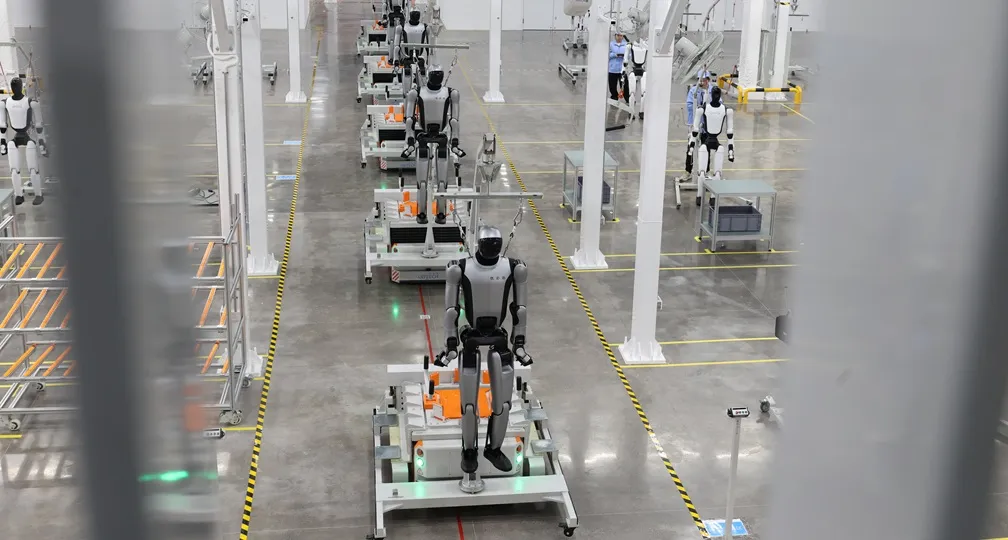
China reportedly accounted for roughly 90% of global humanoid robot production in 2025. This year, the Chinese government has begun promoting robots, AI, and innovative drug development as the “new new three” export drivers, succeeding the “new three” of solar photovoltaics, electric vehicles (EVs), and lithium-ion batteries. This reflects Beijing’s growing confidence in its robotics industry. Why has China become such a prominent player in robotics, and what strategic objectives lie behind the government’s push? Focusing particularly on humanoids, this article examines China’s robotics industrial policies and considers how Japan should respond to Chinese robots.
A Sense of Crisis over a Weak Domestic Robotics Industry
Although China now expresses considerable confidence in its robotics capabilities, its policies originally grew out of a strong sense of crisis over the failure of its domestic robotics industry to develop. In 2006, the government issued the National Medium- and Long-Term Program for Science and Technology Development (2006–2020), seeking to foster robotics technologies. Yet robots did not feature in the Five-Year Plans that followed, and the industry made little progress. China overtook Japan in 2013 to become the world’s largest robot market, but roughly 80% of the robots used in China in 2015 were imported from Japan, Europe, or the United States. Some Chinese scholars lamented that China remained a weak player in robot manufacturing.
China’s robotics industrial policy began in earnest around 2015. The Made in China 2025 initiative explicitly identified robotics as a priority sector, setting objectives that included actively promoting the deployment of service robots and developing core technologies such as robot components. At the same time, numerous local governments formulated plans for robotics industry development and introduced research-and-development subsidies and preferential tax treatment. These measures encouraged companies and universities to enter the sector. Unitree Robotics, a global seller of humanoids around the world, was founded in 2016, while Deep Robotics, a leading supplier of quadruped robots in China, was established in 2017. Chinese firms also sought to acquire advanced technologies from abroad, as exemplified by Midea Group’s acquisition of German robot manufacturer KUKA in 2016.
With its working-age population expected to decline, developing the robotics industry and promoting robot adoption are also important for sustaining China’s economic growth. In 2021, the government issued a Five-Year Plan for the Development of the Robotics Industry, followed in 2023 by the Guiding Opinions on the Innovative Development of Humanoid Robots. Alongside these policy initiatives, the government has continued to provide financial support, including tax incentives. Its 2025 government work report identified embodied AI as one of the industries of the future, underscoring Beijing’s increasingly strong commitment to developing industries that make use of robots.
Humanoids and the “Chinese Dream”
China’s focus on robotics reflects its leaders’ belief that the world is experiencing a new industrial revolution—the Fourth Industrial Revolution—driven by AI, presenting an opportunity for China to lead in cutting-edge technologies. Since taking office, President Xi Jinping has emphasized the importance of gaining a lead in emerging fields through innovation at moments of major transformation. This ambition is captured by the Chinese expression wan dao chao che, or “overtaking on a curve”: moving into the lead at a turning point in society or technology.
In previous industrial revolutions, countries that led in the advanced technologies of their time, such as steam engines and computers, also assumed leading positions in the world. Recent advances in physical AI are expanding what humanoids can do . Their humanlike form may also make them relatively easy to integrate into society, and they have possibilities to profoundly reshape industries and social life. By rapidly establishing global leadership in an emerging field such as humanoid robotics, China seeks to stand alongside the United States as a major power and realize the “Chinese Dream” of the great rejuvenation of the Chinese nation.
China’s ambitions for the future international order are also evident in its efforts to lead the development of international standards for humanoid technologies. Recently, China took on a coordinating role in discussions at the International Organization for Standardization (ISO) concerning ISO 26264-1, the first technical standard for humanoid robots. By having domestic technical standards reflected in international standards, China aims to gain a more advantageous position in global markets.
The Dreams Invested in Humanoid Robots
As a manufacturing powerhouse, China likely sees humanoid robots as a sector in which it has a clear path to success. Its dense industrial clusters and extensive supply chains across manufacturing industries allow it to produce goods efficiently at relatively low cost. Technologies developed in internationally competitive industries, including drones and EVs, can also be applied to humanoids. Training physical AI requires vast quantities of data on bodily movement and the operation of machinery on factory floors—resources that China possesses in abundance.
Demand has long been a bottleneck for the development of the robotics industry. China is seeking to overcome this constraint by combining robots with other sectors to create new services and stimulate demand, thereby accelerating practical adoption. In 2015, the government launched its “Internet Plus” initiative to connect the internet with other industries and generate new businesses. Numerous innovations emerged in this policy environment, including ByteDance’s short-video app Douyin in 2016 and Meituan’s food-delivery business in 2017. The government subsequently introduced “Robot Plus” in 2023 and “AI Plus” in 2024, encouraging the integration of robotics and AI with other industries and their deployment in real-world settings.
Widespread humanoid adoption could also help fulfill another longstanding aspiration of the Chinese economy: upgrading its industrial structure. Spillover effects could also support the growth of new industries and services, including robot-control software, maintenance and insurance. The military significance of humanoids is equally difficult to overlook. Military operations involving robots, including drones, are fundamentally changing the nature of warfare. Humanoid robotics can therefore be regarded as a key industry in China’s pursuit of the “Chinese Dream.”
Japan’s Strategic Challenges
Nevertheless, considerable obstacles remain before robots can help fulfill the “Chinese Dream.” Although China is strong in humanoids, Western manufacturers remain dominant in industrial robots used to automate manufacturing processes, especially precision assembly. Chinese manufacturers’ share of this market stood at only around 30% in 2024. Competition in humanoids has also begun to take on the characteristics of neijuan, or excessive, self-defeating competition, with more than 140 companies participating in the sector by 2025. An executive meeting of the State Council in October this year stressed the importance of high-quality data and better links between supply and demand in implementing the AI Plus initiative.
Furthermore, as Eiki Tagami, a senior visiting research fellow at the Institute of Geoeconomics, has pointed out, China still depends heavily on Japan, Europe, and the United States for many of the sophisticated components and materials used in robots. Training with foundation models and access to NVIDIA’s most advanced semiconductors are important for developing physical AI, but China faces restrictions on access to these technologies.
Even so, China will likely continue investing in humanoids and expanding their real-world deployment. As happened with EVs and solar photovoltaics, Chinese humanoids could improve rapidly in performance and come to dominate international markets. Japan should seek to benefit economically from developments in China while working through public-private cooperation to preserve its competitive advantages in areas such as industrial robotics. Japan also needs to create such environment that can facilitate practical deployment in the society to generate demand for robots.
Economic security considerations are essential when Japan makes use of Chinese robots, as illustrated by the United States’ decision to ban imports of humanoids on national security grounds. Chinese robots are already being adopted in Japan, but users must pay close attention to their applications and the handling of data, and use selectively by distinguishing between cases in which Chinese-made robots are appropriate and those in which alternatives should be used. Japan thus faces a dual challenge: harnessing the “dream” China sees in robotics to support its own economic growth, while deciding carefully when to use Chinese robots and when to choose other options.
(Photo Credit: China News Service / Gettyimages)
Disclaimer: The opinions expressed in this Geoeconomic Briefing do not necessarily reflect those of the International House of Japan, the Institute of Geoeconomics (IOG) or any other organizations to which the author belongs.

Visiting Senior Research Fellow
MACHIDA Hotaka is a visiting senior research fellow in Institute of Geoeconomics at International House of Japan. He joined the Institute in October, 2022. Prior to leaving his role in government, he served as a career diplomat in Japan’s Ministry of Foreign Affairs from 2001 to 2022, focusing on Japan-China relations. He studied at Nanjing University in China and Harvard University in the United States, followed by working at Embassy of Japan in China as second secretary from 2006-2008. After that, he was posted in China-Mongolia division in the Ministry and completed the negotiations with China over the issues of launching the “High-Level Consultation on Maritime Affairs” as well as finalizing the “Maritime Search and Rescue (SAR)” agreement. He also worked in Status of Forces Agreement (SOFA) division in the North America Bureau in the Ministry leading the negotiations with the US on SOFA-related issues. He was counsellor in the Permanent Mission of Japan to the United Nations (2017-2020) and Embassy of Japan in China (2020-2022) covering the Security Council reform and Japan-China economic relations respectively. He holds a M.A from the Graduate School of Arts and Science at Harvard University, and a Bachelor from Law Faculty at Tokyo University.
View Profile-
 China’s rare-earth success offers lessons in economic security2026.11.02
- Do Humanoids Dream of "The Chinese Dream"?2026.10.30
- What Doraemon can teach Canada about resilience2026.10.27
- The key to Japan’s growth strategy: ‘Proactive’ economic security2026.10.27
- Rebalancing Bilateral Trade or Reordering Global Production?2026.10.23



 Trump Faces a Reckoning in the Midterms, but it Might Not Matter for Tariffs2026.10.09
 Japan and India: Historic Strategic Convergence2026.07.07
- BRICS in India2026.10.09
- Orbán in the Public Eye: Anti-Ukraine Argument for Delegitimising Brussels2026.02.04
- Why Pax Silica Is About More Than AI Chips2026.07.15