
Lessons for Japan from Russia’s war in Ukraine
[Author: Yuichi Yoshida, LEAP Fellow]]
With a mandate after its Feb. 8 election victory, the government of Prime Minister Sanae Takaichi will likely accelerate its planned revisions to Japan’s core national-security strategies. ...(continues below)
With a mandate after its Feb. 8 election victory, the government of Prime Minister Sanae Takaichi will likely accelerate its planned revisions to Japan’s core national-security strategies. It has already identified two priorities: mass deployment of unmanned systems and the ability to sustain a prolonged war.
These priorities reflect strategic foresight. Whether Japan can serve as a reliable “unmanned systems hub” for its allies and like-minded partners will help shape stability in the Indo-Pacific and beyond.
This shift reflects lessons from Russia’s war in Ukraine, where drones are ubiquitous and millions of low-cost commercial and attack systems have been expended. Industrial-scale production and resilient resupply networks have proven decisive in sustaining combat power.
If conflict erupts in East Asia, the United States would fight to defend its allies. Japan, as the frontline ally, would need to host prepositioned U.S. equipment and maintain supply networks capable of operating under wartime conditions.
Taking on the role of an unmanned systems hub would mean Japan working with companies from the U.S., South Korea and Taiwan to develop, manufacture, stockpile and surge-supply drones and related components. Such a hub would function as a forward logistics anchor for deterrence by denial and wartime sustainment, enabling rapid and flexible delivery of unmanned capabilities in a crisis.
At present, Japan lacks clear quantitative goals comparable to those of South Korea, which plans to double its military drone fleet within two years, or Taiwan, which aims to establish an annual production capacity of 180,000 units by 2028. Japan’s strengths lie primarily in high-end intelligence, surveillance and reconnaissance unmanned aerial vehicles, leaving major gaps in low-cost, high-volume systems. The question is whether Japan can realistically evolve into a true unmanned systems hub.
Three issues are central: balancing government intervention with market competition; structuring cooperation between Japanese and foreign firms; and managing the quality-quantity trade-off through software and allied interoperability.
Government as strategic buyer
Japan’s unmanned systems industrial base remains fragile. The Ministry of Economy, Trade and Industry has warned of risks stemming from reliance on foreign platforms, particularly the dominance of China’s DJI Technology, which controls an estimated 70% to 80% of the global commercial drone market. Left to market forces alone, Japanese firms are unlikely to achieve the scale or cost structure required to mass-produce affordable drones, especially given limited civilian demand in areas such as infrastructure inspection and disaster response.
To build wartime-relevant capacity, the government must act as a strategic buyer, issuing clear, long-term procurement signals that justify private investment. That means setting explicit quantity targets derived from operational concepts; using multiyear contracts to guarantee predictable demand; bundling procurement with research and development support; stockpiling critical components; partnering with Ukrainian firms that have combat experience; and investing in startups.
Producing tens of thousands of drones — and maintaining surge capacity during conflict — will not happen without deliberate state intervention. At the same time, Japan should expand civilian applications by easing regulations and standardizing platforms to stimulate demand and lower unit costs.
Beyond a Japan-only model
A purely domestic industrial model is unrealistic. Producing a wide range of systems at scale — from expendable commercial drones for base defense to sophisticated long-range strike platforms relevant to a Taiwan contingency — cannot be accomplished quickly by Japanese industry alone.
The core issue is not whether every platform is manufactured exclusively by Japanese companies, but whether unmanned systems can be produced and supplied reliably in wartime. Yet allies and partners have their own domestic production imperatives driven by defense industrial policy and economic security concerns, making it politically difficult to shift manufacturing overseas.
From a deterrence perspective, however, forward production capacity in Japan serves shared interests. A Japan-based hub would strengthen regional denial capabilities and provide a dispersed, resilient supply point in crisis. Tokyo should intensify diplomatic and industrial outreach to partner governments and firms to position Japan as a shared production and logistics node.
One viable model would encourage U.S., South Korean and Taiwanese companies to invest and manufacture in Japan, while Japanese firms supply critical components, software and subsystems. Over time, Japan could move from reliance on imported platforms to licensed domestic production and joint development, reducing exposure to Chinese airframes and components. The central challenge is speed: how quickly Japan can expand production capacity while ensuring platforms are interoperable across allied forces.
Software and survivability
As unmanned systems assume more diverse roles, software will be decisive for scaling production and integrating platforms across allied militaries. Control software and operating systems are key to automating surveillance, tracking and swarm operations and to integrating manned and unmanned assets.
The traditional approach relies on task-specific artificial intelligence models tailored to each platform or mission. Advances in general-purpose “foundation models,” however, make it possible to build more universal frameworks for autonomous decision-making and control. That shift could reduce dependence on platform-specific designs and facilitate mass production across varied systems.
Japanese firms have often been reluctant to disclose internal software specifications, limiting collaboration and shared architectures. That approach is increasingly untenable. Japan must also prepare for electronic warfare. Resilient autonomy through edge AI — embedding artificial intelligence directly on the drone so it can navigate, process sensor data and avoid threats even if communications are jammed — will be essential.
In this context, equipping allied unmanned systems manufactured in Japan with standardized foundation-model software may be more realistic and more advantageous than relying solely on proprietary Japanese systems. As platform diversity expands, Japan will need a flexible development and production regime that integrates domestic and foreign hardware and software, enabling rapid fielding, seamless interoperability and continuous upgrades.
Becoming a true unmanned systems hub will not be easy. Japan must address the balance between state direction and market competition, reconcile domestic industrial ambitions with allied cooperation and embrace more open, software-driven architectures. Each challenge is directly tied to industrial viability and operational credibility.
Yet none can be avoided if Japan intends to establish a wartime-resilient production base and play a central role in sustaining allied operations in East Asia. Waning confidence in sustained U.S. engagement has made deterrence by denial and durable warfighting capacity more urgent.
Whether or not Tokyo formally adopts the label of an “unmanned systems hub,” it should engage in sustained debate about the roles it can and should play — in unmanned systems and beyond — to build a more resilient and credible security architecture in the Indo-Pacific.
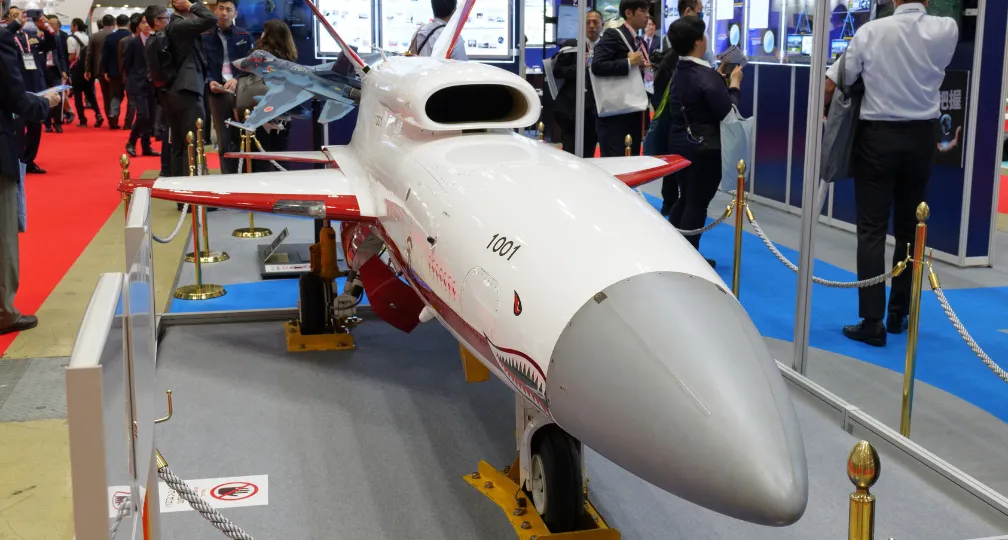
(Photo Credit: AFLO)
[Note] This article was posted to the Japan Times on Mar 2, 2026:
https://www.japantimes.co.jp/commentary/2026/03/02/japan/russia-ukraine-war-lessons-for-japan/

Geoeconomic Briefing
Geoeconomic Briefing is a series featuring researchers at the IOG focused on Japan’s challenges in that field. It also provides analyses of the state of the world and trade risks, as well as technological and industrial structures (Editor-in-chief: Dr. Kazuto Suzuki, Director, Institute of Geoeconomics (IOG); Professor, The University of Tokyo).
Disclaimer: The opinions expressed in this Geoeconomic Briefing do not necessarily reflect those of the International House of Japan, the Institute of Geoeconomics (IOG) or any other organizations to which the author belongs.
-
 Rebalancing Bilateral Trade or Reordering Global Production?2026.10.23
 - Connecting Europe and the Indo-Pacific: Why Japan and Germany Need Stronger Space Security Cooperation2026.10.20
- China’s Calculus Behind the State Visit to the U.S.: Different Visions of “Stability”2026.10.16
- Trump Faces a Reckoning in the Midterms, but it Might Not Matter for Tariffs2026.10.09
-
 BRICS in India2026.10.09