
Trump Is Rebuilding His Tariff Wall – Will the Courts Knock Down this One As Well?
The latest regulatory developments on economic security & geoeconomics
By Paul Nadeau, Visiting Research Fellow, Institute of Geoeconomics (IOG)
U.S. Imposes Blockade of Hormuz: On April 12, U.S. President Donald Trump announced that the U.S. Navy would enforce a blockade of the Strait of Hormuz, blocking ships from passing through the Strait in order to undermine Iran’s own efforts to control passage. The Strait’s status remains in question amidst ongoing negotiations between Iran and the United States, and Trump has said that the blockade will remain until negotiations have concluded.
U.S. Treasury Secretary Begins Operation Economic Fury: The U.S. Treasury Department appears to have begun an intensified effort to increase economic pressure on Iran, referred to as “Operation Economic Fury”, including secondary sanctions on banks and other entities that deal with Iran. As part of the Operation, on April 14, the Treasury Department shared a list of banks with the governments of China, Hong Kong, Oman, and the United Arab Emirates identifying banks that have allowed “illicit” Iranian financial activity. The following day, the Treasury Department’s Office of Foreign Assets Control (OFAC) announced sanctions on more than two dozen individuals, vessels, and companies operating within the network of Iranian oil shipping magnate Mohammad Hossein Shamkhani, son of recently-assassinated Ali Shamkani who served as secretary of the Supreme National Security Council of Iran. The sanctions also target a Hizballah financier and three companies linked to a money laundering scheme involving the sale of Iranian oil in exchange for Venezuelan gold under the regime of Nicolas Maduro. On April 17, OFAC announced it had designated seven Iraqi militia commanders responsible for planning, directing, and executing attacks against U.S. personnel, facilities, and interests in Iraq.
Trump Tariffs Pharmaceuticals: On April 2, the Trump administration announced tariffs of up to 100 percent on branded pharmaceuticals and pharmaceutical ingredient imports into the United States under Section 232 of the Trade Expansion Act of 1962 which allows the president to impose tariffs in response to national security concerns. Generic drugs will be exempted from tariffs for at least one year. Pharmaceutical firms may be exempted from tariffs if they reach a pricing agreement with the White House that includes commitments to onshore production in the United States and would see a 20 percent tariff imposed that increases to 100 percent in four years. Large companies have 120 days to reach such an agreement while smaller companies have 180 days. Countries that have struck trade agreements with the Trump administration will also receive a lower tariff rate.
Steel, Aluminum, Copper Tariff Calculations Revised: On April 2, the Trump administration issued an executive proclamation overhauling the Section 232 tariff regime for aluminum, steel, and copper and their derivative products effective April 6. Previously, tariffs were calculated from the value of the metal content while nonmental content was calculated from the IEEPA tariff rate. Tariffs will now be applied under a four-tiered structure where goods made almost or entirely from tariffed metals are subject to a 50 percent tariff rate of the full value of the product rather than only the metal content, certain derivative articles made “substantially” of tariffed metals are subject to a 25 percent rate, certain metal-intensive industrial equipment and electrical grid equipment are subject to a temporary reduced 15 percent tariff-rate “cap”, and the remainder will be exempted from tariffs (applicable tiers are determined by the codes in the Harmonized Tariff Schedule). 10 percent tariffs imposed under Section 122 will still apply to the nonmental content of products.
U.S. Opens Online IEEPA Tariff Refund System: U.S. Customs and Border Protection opened its online system on April 20 for companies seeking refunds for tariffs paid under the now-invalidated tariffs imposed under the International Economic Emergency Powers Act (IEEPA). The system, called the Consolidated Administration and Processing of Entries (CAPE), will be rolled out in phases, with Phase 1 opening on April 20 and limited to certain unliquidated entries and certain entries within 80 days of liquidation (“liquidation” refers to whether the bookkeeping entries for tariffs paid have been formally closed, or liquidated, or remain open, or unliquidated), with future phases covering more complex cases. Filing is only open to the importer of record or an authorized customs broker.
Swiss Sanction Iranians for Human Rights Violations: On April 14, the Swiss Federal Department of Foreign Affairs added eight Iranian government officials, as well as three associated entities, to its sanctions list for their involvement in serious human rights violations in Iran.
U.S. Treasury Department Issues Licenses on Commerce with Venezuela: On April 14, the U.S. Treasury Department issued two general licenses authorizing commercial-related negotiations of contingent contracts with the government of Venezuela as well as financial services transactions involving certain Venezuelan banks and certain individuals connected to the government of Venezuela.
Sanctions Exemptions for Iranian, Russian Oil Will Expire: The U.S. Treasury Department confirmed it would not renew waivers of sanctions on Iranian or Russian oil at sea as it had in March as a measure to relieve pressure on energy supplies following the closure of the Strait of Hormuz. The Treasury Department has threatened to sanction buyers of Iranian oil and sent letters to China, Hong Kong, the UAE, and Oman identifying banks that have allowed Iranian illicit activity, warning them that they may face punitive U.S. measures.
Analysis: Trump Is Rebuilding His Tariff Wall – Will the Courts Knock Down this One As Well?
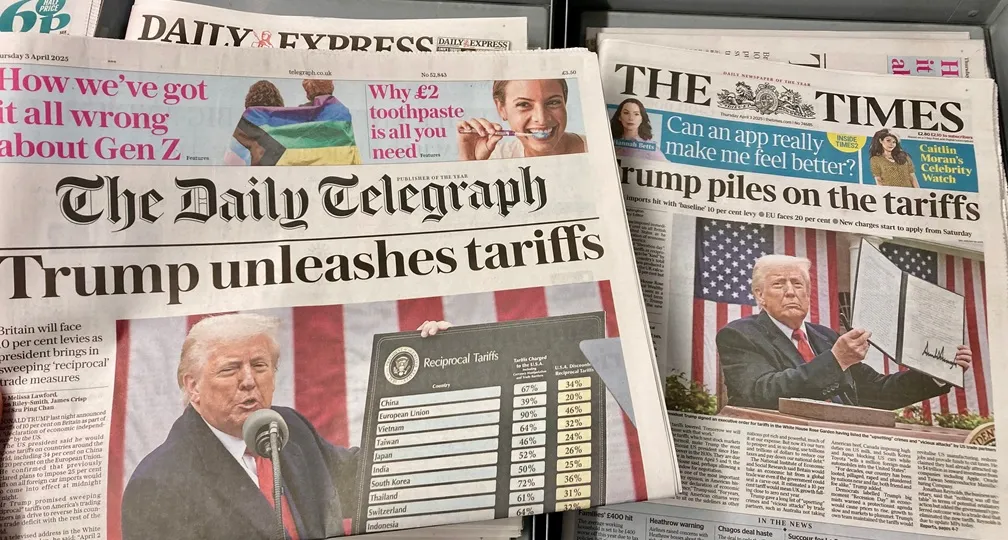
April 2 marked the anniversary of “Liberation Day” when the Trump administration announced its initial tariff wall and which was ultimately knocked down in large part by the Supreme Court in February. As expected, the Trump administration almost immediately began rebuilding the wall, beginning with 10 percent tariffs imposed under Section 122 and with more tariffs on the way. And in what might seem like a rerun of 2025, lawsuits were brought against those tariffs, and the specialist Court of International Trade (CIT) appears skeptical of the administration’s argument in support of its tariffs, possibly setting the stage for the Supreme Court to weigh in once again. So will the new tariff wall come down like the last one?
To understand the new tariff wall’s legal prospects, it’s worth revisiting the fate of the last one that was erected under the International Economic Emergency Powers Act (IEEPA), where the Court ruled against the Trump administration on interpretation of terms rather than the substance of the action. Importantly, the Supreme Court didn’t dispute the nature of the emergencies that were declared – in fact, it left them in place – and instead ruled against the tariffs on the basis of how the Trump administration interpreted IEEPA, principally that the original legislation never explicitly authorized tariffs and the administration could not infer that authority in the absence of explicit authorization.
The Supreme Court’s decision in the IEEPA case is more or less consistent with how the courts have historically decided cases regarding executive authority, ruling on interpretation of the law, but deferring to the Executive Branch on the substance, and federal circuit courts particularly have deferred to the government on tariff issues over the last few years. In other words, courts are more likely to push back on process or legal interpretations rather than getting into substantive arguments with the Executive Branch about whether trade deficits should be considered a national emergency or whether auto imports are truly a national security threat. Executive Branch agencies are considered to be the “experts” on such topics, and courts will rarely feel qualified to push back against the people who have conducted the investigations and drafted the reports.
That doesn’t mean that there won’t be legal challenges. The first challenge relates to Section 122 of the Trade Act of 1974, which allows the president to impose tariffs of up to 15 percent for 150 days in response to a balance of payments deficit (more specifically, “fundamental international payments problems” and “large and serious United States balance-of-payments deficits”). This is the statute that the Trump administration turned to after the Supreme Court ruled against the IEEPA tariffs and which are now in place until July 24 unless Congress votes to extend the tariffs. It’s the easiest to build a case against because the conditions for the implementation of Section 122 tariffs don’t exist – the United States has a trade deficit, but not a balance of payments deficit. In fact, economists will point out that it’s not even possible to have a balance of payments deficit under a system of floating exchange rates (the original legislation was written for the Bretton Woods system when the U.S. dollar was pegged to the gold standard).
On April 10, the CIT heard oral arguments in a case brought by a combination of state governments and small businesses seeking to overturn the Section 122 tariffs and seemed receptive to their arguments, but a decision might be a moot point for the future of the tariff wall. It took roughly ten months for the legal challenges to the IEEPA tariffs to reach a final decision at the Supreme Court, and since it’s difficult to imagine Congress voting to extend the tariffs beyond their July 24 expiration date, it’s possible, even likely that the Section 122 tariffs expire before the courts can issue a determination on whether they can stand or must be removed (the outcome of the court cases may not be completely moot, however, given that business who paid Section 122 tariffs while they were in force may in line for refunds).
Other tariff authorities will probably face their own legal challenges, but their outcome is more complicated. Filling the gap once Section 122 expires at the end of July would be tariffs under Section 301 of the Trade Act of 1974, which allows the president to impose tariffs in response to unfair trade practices. The Office of the U.S. Trade Representative (USTR) announced a series of investigations into industrial overcapacity issues with 16 countries and into failure to protect against imports made with forced labor against 60 countries shortly after the announcement of Section 122 tariffs. The investigations seem to be an attempt by the Trump administration to simply rebuild the IEEPA tariff wall, and observers expect that the various investigations into unfair trade practices will surreptitiously recommend tariff rates on countries at or close to tariff levels under IEEPA. While Section 301 is a long-established and well-used tool by successive U.S. administrations, stretching the findings of those investigations may open them up to legal challenges.
Beyond the specific details of the investigations, there’s also the fact that the original legislation establishing Section 301 tariffs didn’t design it to form a permanent tariff wall but to be a temporary measure, building leverage with a particular country to make them address the unfair trade practice in question, and then dropped again once the issue had been addressed. In this case, if a country were to hypothetically address fully the industrial overcapacity or forced labor issues in the USTR report, the letter of the law would stipulate that the tariffs should be consequentially withdrawn. It’s possible that the investigations create conditions that are impossible for any country to meet, thereby leaving them in force, but it seems safe to assume that this approach would invite its own legal challenges.
There are other ways that the tariff wall may be challenged. One of the reasons the Supreme Court struck down the IEEPA tariffs was the “major questions doctrine”, a principle of legal interpretation where issues of major political or economic significance may not be delegated by Congress to the Executive Branch without clear and explicit congressional authorization. That might imply that any tariff effort that seeks to bring in revenue similar to that of the IEEPA tariffs may face legal challenges on similar grounds. Also the process of “downstreaming” tariffs, or applying tariffs to derivative products of tariffed goods, could possibly get the courts to confront the administration on substance – while courts tend to almost always defer to the Executive Branch on national security issues for the reasons explained above, actions like extending lumber tariffs to kitchen cabinets and bathroom vanities may force questions of how far national security concerns can go.
The tools are in place to rebuild the tariff wall, but the legal questions are there too. It will be a long time before there’s clarity on how the courts will decide, but the only safe prediction at this point is that the only clear winners will be the trade lawyers.
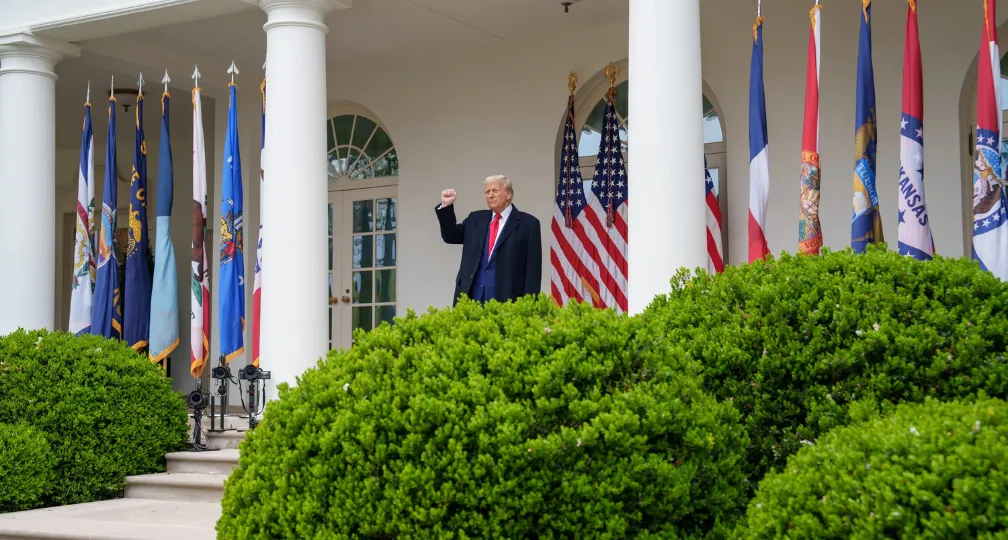
(Photo: WhiteHouse.gov)
Disclaimer: The views expressed in this IOG Economic Intelligence Report do not necessarily reflect
those of the API, the Institute of Geoeconomics (IOG) or any other organizations to which the author belongs.
IOG English Newsletter
Subscribe to the English IOG Newsletter to stay up to date on IOG’s activities across various briefings, op-eds, YouTube videos, podcasts, as well as new publications, events, research activities, and more.

Visiting Research Fellow
Paul Nadeau is an adjunct assistant professor at Temple University's Japan campus, co-founder & editor of Tokyo Review, and an adjunct fellow with the Scholl Chair in International Business at the Center for Strategic and International Studies (CSIS). He was previously a private secretary with the Japanese Diet and as a member of the foreign affairs and trade staff of Senator Olympia Snowe. He holds a B.A. from the George Washington University, an M.A. in law and diplomacy from the Fletcher School at Tufts University, and a PhD from the University of Tokyo's Graduate School of Public Policy. His research focuses on the intersection of domestic and international politics, with specific focuses on political partisanship and international trade policy. His commentary has appeared on BBC News, New York Times, Nikkei Asian Review, Japan Times, and more.
View Profile-
 Rebalancing Bilateral Trade or Reordering Global Production?2026.10.23
 - Connecting Europe and the Indo-Pacific: Why Japan and Germany Need Stronger Space Security Cooperation2026.10.20
- China’s Calculus Behind the State Visit to the U.S.: Different Visions of “Stability”2026.10.16
- Trump Faces a Reckoning in the Midterms, but it Might Not Matter for Tariffs2026.10.09
-
 BRICS in India2026.10.09