
Geoeconomic Connectivity Index – user guide
What is the Geoeconomic Connectivity Index?
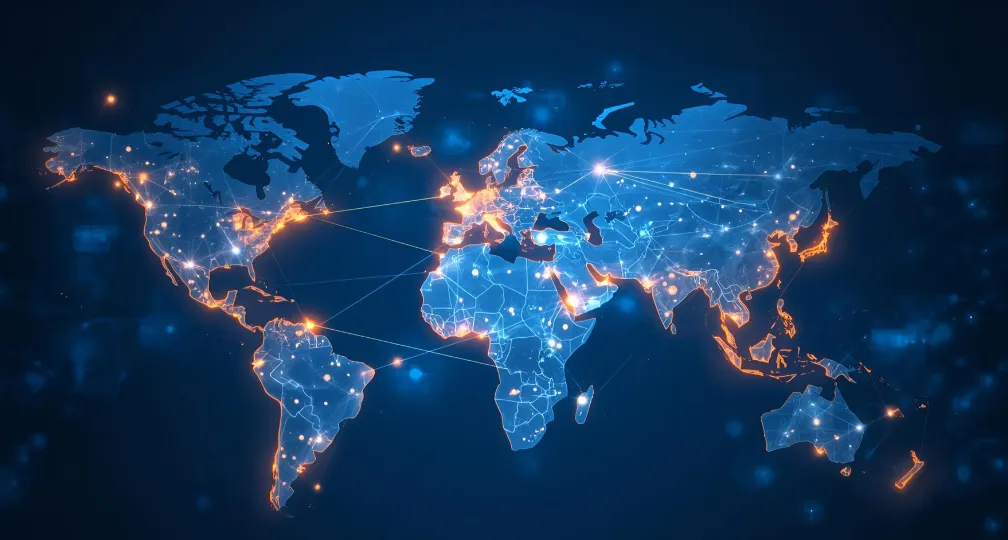
The Geoeconomic Connectivity Index measures the extent to which a country is economically linked and integrated into global markets through its trade activity and its structural embeddedness in global trade relationships.
Rather than relying on a single indicator, the index brings together four components that capture both policy-based and outcome-based dimensions of trade connectivity:
・Applied MFN Tariff
・Trade Openness
・Number of Active FTAs and PTAs
・Tariff Trend
Taken together, these indicators provide an overview of how structurally open, institutionally connected, and effectively accessible a country’s trade regime is.
Traditional measures such as trade dependency focus on the scale of trade flows—for example, the share of exports or imports in GDP—and primarily capture exposure to trade. By contrast, the Geoeconomic Connectivity Index captures how trade relationships are structured, incorporating tariffs, institutional agreements, and trade intensity to reflect how market access is organized and mediated.
How the index can help
The trade connectivity index is designed for those in the public or private sectors interested in changes in trade openness, institutional trade integration, and the broader structure of market access.
Trade connectivity is not only a question of volume. It also reflects how market access is structured, how open a trade regime is under multilateral rules, and how far access is mediated through institutional arrangements such as free trade agreements.
The Geoeconomic Connectivity Index is designed to help users compare countries consistently across these dimensions, offering a clearer picture of how countries are embedded in global trade networks, while also capturing recent directional changes in trade policy.
How to use the index
The index can be used in several ways.
・It allows users to compare countries across a common framework of trade connectivity.
・It helps distinguish between different components of connectivity, including baseline tariff openness, realized trade integration, and institutionalized market access through FTAs and PTAs.
・It incorporates tariff trends as a bounded adjustment, allowing recent shifts in trade policy direction to be reflected without overwhelming the structural features of the index.
The maps and sub-indices are intended to provide multiple entry points for interpretation. Users may begin with the overall index and then examine the individual components to better understand what is driving a country’s position.
Key Concept: Geoeconomic Indispensability
A central interpretive concept behind the index is geoeconomic indispensability. This refers to the extent to which access to a country’s market is structurally valuable and difficult to substitute, based on how costly, policy-mediated, and institutionally conditioned that access is.
From this perspective, countries that are highly connected are not simply open. In some cases, access to their markets may be increasingly mediated through agreements, institutions, or selective policy structures that make that access more valuable and harder to replace, or even becoming a critical node in global economic relations
The index therefore does not only provide a picture of trade connectivity. It also helps illuminate differences in long-run trade embeddedness and the conditions under which market access may become more strategically significant.
Key Concept: Strategic Selectivity
The index also includes complementary indicators of strategic selectivity.
While the Geoeconomic Connectivity Index captures the overall structural embeddedness of countries in global trade, it does not by itself reflect sectoral differentiation in market access. In practice, however, trade policy is often selective, especially in sectors considered economically or geopolitically strategic.
To capture this dimension, the analysis includes additional indicators based on tariff peaks and tariff deviations from national averages within predefined strategic sectors. These indicators help show the extent to which countries concentrate trade restrictiveness in specific sectors, even when their overall trade connectivity remains high.
Strategic selectivity should therefore be considered as a lens for interpretation rather than a core pillar of the Geoeconomic Connectivity Index itself.
Strategic sectors covered
The strategic selectivity section focuses on five broad sector groups:
・Advanced Digital Technologies
・Critical Raw Materials
・Energy and Climate Technologies
・Health and Biotechnology
・Advanced Industrial Manufacturing
These sectors are treated as strategic because they share features such as systemic importance in value chains, low short-term substitutability, high entry barriers, supply concentration, and strong technological spillovers.
Interpreting the results
Variation in the final index should be interpreted primarily as reflecting differences in long-run trade embeddedness. Recent tariff liberalization or tightening introduces directional variation, but only as a bounded adjustment.
For this reason, the overall index is best read together with its sub-indices. The component scores help clarify whether a country’s position is driven more by baseline trade openness, actual integration into global trade flows, institutionalized connectivity through agreements, or recent changes in tariff policy.
The strategic selectivity indicators provide an additional perspective by showing whether strategic sectors are protected at levels above or below the national average.
Methodology and further details
For users interested in the theoretical foundations and methodology of the index, additional materials are available via the PDF file below or on a separate page. These explain the construction of the sub-indices, the standardization of variables, the interpretation of each component, and the methodology used for the strategic selectivity indicators.




Visiting Research Fellow
Paul Nadeau is an adjunct assistant professor at Temple University's Japan campus, co-founder & editor of Tokyo Review, and an adjunct fellow with the Scholl Chair in International Business at the Center for Strategic and International Studies (CSIS). He was previously a private secretary with the Japanese Diet and as a member of the foreign affairs and trade staff of Senator Olympia Snowe. He holds a B.A. from the George Washington University, an M.A. in law and diplomacy from the Fletcher School at Tufts University, and a PhD from the University of Tokyo's Graduate School of Public Policy. His research focuses on the intersection of domestic and international politics, with specific focuses on political partisanship and international trade policy. His commentary has appeared on BBC News, New York Times, Nikkei Asian Review, Japan Times, and more.
View ProfileResearch Assistant
Letizia Suera is a Research Assistant with the Economic Security Group at the Institute of Geoeconomics (IOG) and a Capacity Building Associate at the Asian Development Bank Institute (ADBI). Her research focuses on international trade governance, geoeconomics, development cooperation, and regional integration. She has professional experience in trade compliance and sanctions advisory, the organization of international conferences, and institutional and bilateral relations at the Italian Chamber of Commerce in Canada. Her research and publications have examined the weaponization of renewable and nuclear energy technologies through trade controls, the challenges associated with Least Developed Countries’ graduation, and EU-Asia Pacific cooperation on climate and energy. Letizia holds a Master’s degree in Political Economy from the University of Amsterdam, where her thesis analyzed the effects of Asia-Pacific Least Developed Countries’ graduation on recipients of the EU’s Generalized Scheme of Preferences Everything But Arms (EBA) Initiative. She earned a Bachelor’s degree in Philosophy, International Studies, and Economics from Ca’ Foscari University of Venice, and pursued part of her undergraduate studies at Sciences Po Paris and Université de Montréal.
View ProfileVisiting Research Fellow
Andrew Capistrano is a geopolitical risk consultant based in Tokyo, and Director of Research at PTB Global Advisors in Washington, DC, where he specializes in industrial policy, international trade and capital flows, and US-China relations. He is also a visiting scholar at the Waseda Institute of Political Economy and a visiting lecturer at the School of Political Science and Economics, Waseda University. Previously, he worked at the US Embassy’s American Center Japan, and as a research associate at the Rebuild Japan Initiative Foundation/Asia-Pacific Initiative. Dr Capistrano holds a BA from the University of California, Berkeley; an MA in political science (international relations and political economy) from Waseda University; and a PhD in international history from the London School of Economics. His academic work focuses on the diplomatic history of East Asia from the mid-19th to the mid-20th centuries, applying game-theoretic concepts to show how China's economic treaties with the foreign powers created unique bargaining dynamics and cooperation problems. During his doctoral studies he was a research student affiliate at the Suntory and Toyota International Centres for Economics and Related Disciplines (STICERD) in London.
View ProfileResearch Fellow,
Digital Communications Officer
Yusuke Ishikawa is Research Fellow and Digital Communications Officer at the Institute of Geoeconomics (IOG). His research focuses on European comparative politics, contemporary Hungarian politics, democratic backsliding, disinformation, and anti-corruption. He also serves as External Contributor for Transparency International’s Anti-Corruption Helpdesk, as Associate Research Fellow at the EUROPEUM Institute for European Policy, and as Part-time Lecturer in European Affairs at the Department of Economics and Business Management, Saitama Gakuen University. His publications include “How Opposition Strategies Interact under Electoral Autocracy: Evidence from Hungary’s TISZA Party“, (Politics in Central Europe, 22 (2)), "NGOs, Advocacy, and Anti-Corruption" (In Routledge Handbook of Anti-Corruption Research and Practice, 2025), and A Dangerous Confluence: The Intertwined Crises of Disinformation and Democracies (Institute of Geoeconomics, 2024). He has been featured in national and international media outlets including Japan Times, NHK, Asahi Shimbun, Neue Zürcher Zeitung (NZZ), Handelsblatt, Expresso, and E-International Relations (E-IR). He received his BA in Political Science from Meiji University, MA in Corruption and Governance (with Distinction) from the University of Sussex, and another MA in Political Science from Central European University. He is currently pursuing a PhD in Political Science at Meiji University. Prior to his current roles, he was Research Associate at IOG and API, contributing to the book translation project of Critical Review of the Abe Administration into English and Chinese. Previously, he has worked as Research Assistant for API's CPTPP program and interned with its Fukushima Nuclear Accident and Abe Administration projects. His other experience includes serving as a visiting research fellow at EUEOPEUM Institute, a full-time research intern at Transparency International Hungary, and as a part-time consultant with Transparency International Defence & Security in the UK. [Concurrent Positions] Associate Research Fellow, EUROPEUM Institute for European Policy, Czechia External Contributor Consultant, Anti-Corruption Helpdesk, Transparency International Secretariat (TI-S), Germany Part-time Lecturer, Department of Economics and Business Management, Saitama Gakuen University, Japan
View Profile-
 Can Japan build a defense-startup ecosystem?2026.10.07
 - Economic security in health and medicine through strategic alignment2026.10.06
- National Security and the Stakes of ‘Technology Sovereignty’2026.09.24
- From Racing China to Pacing the AI Frontier2026.09.17
- The Takaichi Administration’s High-Stakes Growth Gamble2026.09.15