
U.S. Naval Strategy and Implications for Japan’s Defense
Introduction
As Japan prepares to revise its three strategic documents at the end of this year, a central question is how to build credible deterrence against China. Deterrence rests on resolve, capability, and effective signaling—but “capability” is not simply a matter of force size. Rather, it depends equally on force composition and operational concepts suited to the strategic environment.
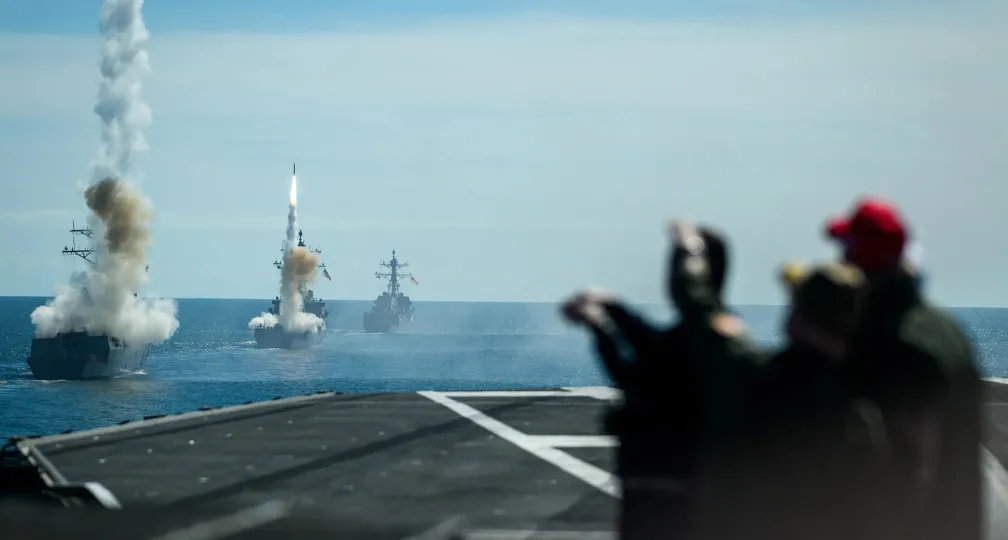
In this regard, a military optimized for geographically bounded defense differs fundamentally from one designed for global expeditionary operations. The latter—typified by the U.S. military—cannot specialize in a single theater and is shaped by global priorities set by political leadership. For instance, under the second Trump administration, Washington has prioritized Western Hemisphere defense over deterrence in East Asia, codifying this shift in the new strategic documents roughly one year into its term. This raises critical questions, namely: how is this reprioritization reshaping U.S. deterrence against China, and what does it mean for Japan? This paper examines these issues through the lens of the U.S. Navy.
The U.S. Navy Since the “Rebalance”
Following the Obama administration’s “rebalance” to the Asia-Pacific, three major trends have defined U.S. naval strategy.
First, there has been a geographic shift in force posture from the Middle East to the Western Pacific. During the War on Terror, naval forces were heavily committed to supporting ground operations in the Middle East, but after 2011 attention gradually pivoted toward the Western Pacific in response to China’s rise.
Second, a conceptual shift from “power projection” to “sea control” has occurred. In the post-Cold War era, the U.S. Navy emphasized projecting power ashore. This logic informed the Air-Sea Battle concept developed jointly with the Air Force in 2009, which envisaged strikes against key targets on the Chinese mainland. However, concerns over escalation risks and the inadequacy of the concept in addressing China’s maritime expansion led to a reassessment. By the mid-2010s, emphasis shifted toward securing sea control—ensuring freedom of action for U.S. forces while denying the same to adversaries. This approach evolved into a “maritime pressure strategy,” applying continuous pressure along the first island chain in peacetime and seeking air and maritime superiority in conflict.
Third, there was a shift in emphasis from concentrated to distributed firepower. Traditionally, U.S. naval firepower was centered on aircraft carrier strike groups. However, the vulnerability of such high-value assets—especially in the face of China’s anti-access/area-denial (A2/AD) capabilities—prompted a move toward dispersion. This included greater reliance on nuclear-powered submarines and enhanced strike capabilities for surface combatants. The concept of “Distributed Lethality,” introduced in 2015, sought to expand offensive capabilities across a wider range of platforms. This broader framework was later institutionalized as “Distributed Maritime Operations,” particularly emphasized under the Biden administration.
Dispersion also addressed the detectability problem: concentrated formations are easier to identify and target. Expanding the fleet with mid-sized platforms—such as Arleigh Burke-class destroyers, Constellation-class frigates, and large unmanned vessels—enabled operations across a wider area, complicating adversary targeting.
Strategic Reversal Under the Second Trump Administration
This trajectory has shifted under the second Trump administration, symbolized by the “Golden Fleet” concept announced in December 2025, the proposed Trump-class guided missile battleship, and the February 2026 release of the U.S. Navy Fighting Instructions. Together, these indicators signal a departure from the previous emphasis on a Western Pacific focus, sea control, and dispersion.
The new framework is built on two layers: fleet design and operational concepts. The fleet is divided into a “general-purpose force”—comprising manned platforms capable of sustained expeditionary operations—and a “tailored offset,” centered on modular, rapidly deployable unmanned systems designed for high-intensity contingencies such as a Taiwan scenario. These components can be combined into a “tailored force,” optimizing the balance between survivability, flexibility, and firepower.
Operationally, the concept emphasizes persistent global deployment centered on carrier strike groups, reflecting a renewed focus on global power projection rather than theater-specific deterrence.
At the heart of the Golden Fleet is the Trump-class battleship, a 30,000 to 40,000-ton platform designed for long-range strike, power projection, and integrated air and missile defense. Envisioned as a partial substitute for carriers, it represents a shift toward large, heavily armed platforms. Senior naval leaders have suggested that when conflict arises, future presidents will ask not only “Where is the carrier?” but also “Where is the battleship?”—underscoring the battleship’s role of power projection tools.
Overall, U.S. naval strategy is moving from a Western Pacific focus toward global operations, from sea control back to power projection, and from distributed to more concentrated firepower.
Three interrelated factors underpin this shift. First, the demands of peacetime operations mean the Navy is uniquely suited for rapid, sustained deployment without host-nation consent, making it a preferred instrument of presidential power. Frequent operational commitments across multiple theaters naturally broaden its focus beyond East Asia.
Second, the relative ease of operating against adversaries lacking advanced A2/AD capabilities has altered the strategic calculus. Against such opponents, power projection is effective and carries lower escalation risks, particularly when nuclear weapons are not involved.
Third, that being said, there is a growing demand for longer-range and higher-capacity missile systems even when dealing with non-peer adversaries. Medium-sized platforms face limitations in payload capacity, prompting a return to larger platforms capable of carrying more weapons.
Implications for Deterrence Against China
These changes in the fleet raise serious concerns about the effectiveness of U.S. deterrence against China.
A shift toward global operations risks diluting readiness in the Western Pacific. Senior naval leadership has acknowledged that expanded commitments—combined with high operational tempo—have strained the fleet. Operations in regions such as the Middle East have consumed significant missile inventories, potentially weakening initial response capabilities in a Taiwan contingency.
The renewed emphasis on power projection also carries escalation risks. Strikes against the Chinese mainland remain inherently escalatory, especially as China expands its tactical nuclear capabilities. Meanwhile, China’s growing naval and undersea capabilities—projected to include around 40 nuclear submarines by 2035—underscore the increasing importance of sea control.
The return to large platforms and concentrated firepower is also problematic. While larger ships enable greater missile capacity, competing with China on sheer firepower is not a viable strategy. China has rapidly expanded its vertical launch system (VLS) capacity, doubling it between 2019 and 2023, while U.S. capacity has declined. Even the introduction of battleships is unlikely to reverse this trend.
Instead, survivability through dispersion and stealth—complicating enemy’s detection and targeting—offers a more effective approach. Large platforms, by contrast, present attractive targets.
Moreover, the Trump-class battleship entails significant technological, financial, and political risks. U.S. naval shipbuilding programs have faced persistent delays and cost overruns since the end of the Cold War. A failure of this flagship program could result in lost time and missed opportunities to strengthen deterrence.
Implications for Japan
For Japan, these developments are deeply consequential. While Tokyo cannot easily influence U.S. naval strategy, it must adapt to these changes.
If the U.S. Navy’s focus shifts globally, the Self-Defense Forces (SDF) must assume a greater role in the Western Pacific. Strengthening defense along the first island chain, including the Nansei Islands,should be allocated more resources.
At the same time, Japan must fill potential gaps in deterrence. This requires enhancing denial capabilities across maritime, undersea, and air domains to prevent Chinese forces from advancing into the Western Pacific. If deterrence fails, Japan must also be prepared to restore sea control—potentially over extended periods and with greater operational autonomy.
Given the threat posed by China’s long-range missiles, Japan should emphasize distributed operations using numerous smaller, high-capability platforms. This approach contrasts with the U.S. shift toward larger, concentrated assets and may offer greater resilience in contested environments.
Historically, U.S. naval strategy served as a key reference model for Japan. However, as U.S. priorities evolve, Japan must develop its own operational concepts and force structure tailored to its specific strategic environment.
The evolving direction of U.S. naval strategy presents both challenges and opportunities for Japan. As Washington rebalances its global commitments, Tokyo must reassess its own role in regional deterrence. The upcoming revision of Japan’s strategic documents will be a critical test of whether these changing realities are fully recognized—and whether Japan can adapt accordingly to maintain credible deterrence in an increasingly uncertain security environment.
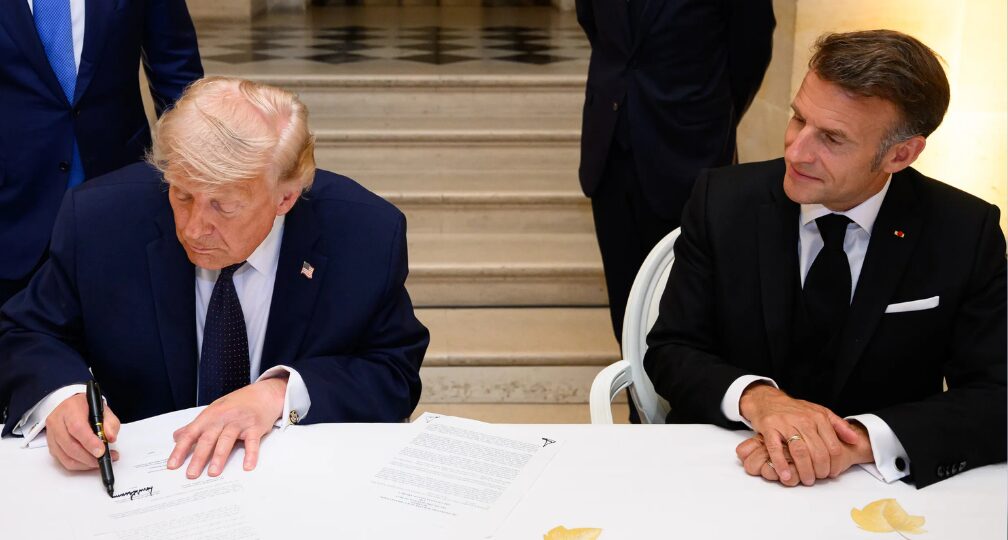
(Photo Credit: WhiteHouse.gov)
Geoeconomic Briefing
Geoeconomic Briefing is a series featuring researchers at the IOG focused on Japan’s challenges in that field. It also provides analyses of the state of the world and trade risks, as well as technological and industrial structures (Editor-in-chief: Dr. Kazuto Suzuki, Director, Institute of Geoeconomics (IOG); Professor, The University of Tokyo).

Research Fellow
Rintaro Inoue is a Research Fellow at the Institute of Geoeconomics, International House of Japan, and a PhD student at Keio University. His research focuses on alliance network in the Indo-Pacific and strategic studies. He holds a B.A. and M.A. in Law from Keio University.
View Profile-
 China’s Rare Earth Export Controls: “International Rules” Orientation and the Avant-Garde Use of Security Exceptions2026.07.03
 - The Iran-U.S. MOU Offers a Reprieve, but Not Relief2026.07.02
- Japan’s manufacturing sector and the race for physical AI2026.06.26
-
 Strategy Amidst Weaponized Economics2026.06.26
 - Japan lays the groundwork for submarine cable resilience2026.06.25



 Sovereign AI After Fugu: From Vertical Dominance to Horizontal Resilience2026.06.24
- European Industry and the “Second China Shock”2026.06.19
- Order from Chaos: Introducing the Geoeconomic Connectivity Index2026.06.05
- China’s Rare Earth Export Controls: “International Rules” Orientation and the Avant-Garde Use of Security Exceptions2026.07.03
- The Iran-U.S. MOU Offers a Reprieve, but Not Relief2026.07.02