
Between the WTO and Decoupling: US-China Managed Interdependence
The latest regulatory developments on economic security & geoeconomics
By Paul Nadeau, Visiting Research Fellow, Institute of Geoeconomics (IOG)
U.S. Temporarily Renews Russian Oil Waiver: On April 17, the Trump administration renewed a waiver allowing countries to purchase sanctioned Russian oil at sea which expired on May 17, but was extended for a further 30 days by U.S. Treasury Secretary Scott Bessent on May 18 after initially saying that the waiver would not be extended. The renewal is part of U.S. efforts to relieve pressure on oil markets amidst the disruption in the Strait of Hormuz.
Treasury Department Sanctions Colombians Involved in Sudan Conflict: On April 17, the U.S. Treasury Department’s Office of Foreign Assets Control (OFAC) imposed sanctions on five individuals and entities involved in recruiting and deploying former Colombian military personnel to Sudan to fight on behalf of the Rapid Support Forces.
Commerce Department Asks Companies to Halt Tools Shipments to PRC Chipmaker: The U.S. Commerce Department sent letters to multiple chip equipment companies ordering them to halt shipments of certain tools to Hua Hong, China’s second largest chipmaker. The move is part of U.S. efforts to safeguard advanced technologies developed in the United States on national security grounds.
EU Sanctions Russian Disinformation Outlet and Foundation: On April 21, the European Council sanctioned Euromore, an unofficial pro-Kremlin media outlet and a state-backed foundation involved in Russian disinformation activities. Restrictive measures are also imposed on the Foundation for the Support and Protection of the Rights of Compatriots Living Abroad (Pravfond).
EU, U.S. Sign MOU on Critical Minerals: On April 23, the European Union and the United States announced the signing of a memorandum of understanding on a partnership on producing and securing critical minerals. On the following day the two sides announced an action plan to coordinate trade policies on critical minerals to address “nonmarket policies and practices” that have distorted critical mineral supply chains. Proposed measures include border-adjusted price floors, technical and regulatory cooperation, harmonized standards for mining, processing, recycling, or trade in critical minerals, cooperation in stockpiling, investment promotion and screening cooperation, and coordinated rapid responses to prevent disruptions and crises.
EU Adopts 20th Sanctions Package against Russia: On April 23, the European Union adopted its 20th sanctions package against Russia following its invasion of Ukraine in February 2022. The current action targets 120 entities, individuals, and vessels across industries including energy, technology, financial services, and military production. The package also lays the groundwork for a future maritime services ban on Russian crude oil and petroleum products.
Treasury Department Sanctions Individuals Connected to Mexican Cartel: On April 23, the U.S. Treasury Department’s Office of Foreign Assets Control (OFAC) sanctioned 23 individuals and entities that are part of a transnational synthetic opioid procurement network with ties to the Mexico-based Sinaloa Cartel, a designated Foreign Terrorist Organization.
Treasury Department Sanctions Cambodian Scam Centers: On April 23, the U.S. Treasury Department’s Office of Foreign Assets Control (OFAC) designated Kok An, a Cambodian senator who controls scam compounds throughout the country, as well as 28 individuals and entities in his network for defrauding individuals of millions of dollars. Concurrently, the U.S. Justice Department announced a series of coordinated actions against Southeast Asian criminal organizations operating scam centers that have defrauded individuals.
U.S. Broadens Sanctions on Cuba: On May 1, Donald Trump signed an executive order broadening U.S. sanctions against the Cuban government to counter regime corruption and human rights violations, as well as to address national security threats related to Cuba’s ties to U.S. adversaries. On May 7, the U.S. State Department sanctioned a Cuban military-controlled umbrella enterprise, its executive president, and a Cuban-Canadian mining joint venture for benefiting the Cuban regime.
UK Sanctions Individuals Involved with Supplying Drones to Russia: On May 5, the United Kingdom’s Foreign, Commonwealth, and Development Office sanctioned 35 individuals and entities involved in either supplying drone components and other critical military goods to Russia, or in deceptively recruiting foreign migrants to fight on the frontlines of the war in Ukraine.
Court of International Trade Rules against Trump’s Latest Tariffs: On May 7, the U.S. Court of International Trade (CIT) ruled that Trump’s 10 percent tariffs imposed under Section 122 of the Trade Act of 1974 were imposed illegally. The Court determined that the enacting legislation in 1974 was not intended to allow presidents to use tariffs to address a trade deficit, as the Trump administration has attempted, but to address a more complete balance of payments deficit, of which the trade deficit is a component part. The CIT blocked the Trump administration from collecting Section 122 tariffs from two of the private sector tariffs for now but stopped short of granting nationwide relief after ruling that some of the state governments in the lawsuit did not have standing. The Trump administration has already appealed the CIT decision to the Federal Circuit Court.
Australia, UK Expand Sanctions on Iran: On May 11, the United Kingdom’s Foreign, Commonwealth, and Development Office designated 12 individuals and companies, targeting those involved in illicit finance flows that enable the Iranian regime to pursue destabilizing action across the Middle East as well as criminal proxies who act on behalf of the Iranian state. On May 12, Australia’s government sanctioned seven individuals and four entities in Iran involved in the regime’s ongoing oppression of its people and destabilization of the region.
Canada, EU, UK Sanction Russia Over Human Rights Violations against Ukrainian Children: On May 11, the United Kingdom’s Foreign, Commonwealth, and Development Office sanctioned 85 individuals and entities involved in the forced deportation, indoctrination, and militarization of Ukrainian children, alongside those driving Russia’s information warfare campaigns. The European Council sanctioned 16 individuals and seven entities involved in Russia’s unlawful deportation, transfer, assimilation, and pro-Russian indoctrination of Ukrainian children. Global Affairs Canada sanctioned 23 individuals and five entities involved in Russia’s human rights violations against Ukrainian children.
U.S. Judge Blocks Trump Sanctions on ICC Judge: On May 13, U.S. District Court Judge Richard Leon temporarily blocked U.S. sanctions against UN Human Rights Council Special Rapporteur Francesca Albanese. The sanctions, issued on June 9, 2025, were issued by the U.S. Department of State in response to her “efforts to prompt (International Criminal Court) action against U.S. and Israeli officials, companies, and executives” and barred her from entering the U.S. and banking there. Judge Leon found that Albanese’s status as a noncitizen living outside the United States does not undercut her protections under the First Amendment of the U.S. Constitution, finding that the Trump administration sought to regulate her speech because of the “idea or message expressed”.
Commerce Department Approves Nvidia Chip Sales to China: On May 14, the U.S. Commerce Department cleared ten Chinese firms, including Alibaba, Tencent, ByteDance, JD.com, and others, to purchase Nvidia’s H200 chip, the firm’s second most powerful chip. Buyers are permitted to buy directly from Nvidia or indirectly from approved intermediaries, including Foxconn and Lenovo, as well as others that have not yet been named. No sales have been confirmed so far, and the United States would receive 25 percent of the sales revenue under a previous agreement negotiated by Donald Trump.
Economic Fury Updates: The U.S. Treasury Department announced the following updates under the Economy Fury campaign of maximum economic pressure against Iran as part of wider U.S. efforts against the country:
・On April 17, the U.S. Treasury Department’s Office of Foreign Assets Control (OFAC) designated seven Iran-aligned Iraqi militia commanders responsible for planning, directing, and executing attacks against U.S. personnel, facilities, and interests in Iraq.
・On April 21, OFAC announced sanctions 14 individuals, entities, and aircraft based in Iran, Türkiye, and the UAE for their involvement in procuring or transporting weapons or weapons components on behalf of the Iranian regime.
・On April 24, OFAC sanctioned a China-based independent teapot refinery for its role in supporting Iran’s oil economy, as well as almost 40 shipping firms and vessels that operate as part of Iran’s shadow fleet. OFAC concurrently alerted financial institutions to the sanctions risks associated with independent teapot oil refineries in China, primarily in Shandong Province, given their continued role in importing and refining Iranian crude oil.
・On April 28, OFAC designated 35 entities and individuals that oversee Iran’s shadow banking architecture, facilitating the movement of the equivalent of tens of billions of dollars tied to sanctions evasion and Iran’s sponsorship of terrorism.
・On May 1, OFAC designated three Iranian foreign currency exchange houses and their associated front companies as part of ongoing efforts to disrupt the Iranian regime’s financial lifelines that sustain its war effort.
・Also on May 1, OFAC issued an alert regarding the sanctions risks of making toll payments to, or soliciting guarantees from, the Iranian regime for safe passage through the Strait of Hormuz.
・On May 7, OFAC sanctioned Iraq’s deputy minister of oil for facilitating the diversion of oil to be sold for the benefit of the Iranian regime and its proxy militias in Iraq, along with several senior leaders of Iran-aligned terrorist militias and affiliated oil companies.
・On May 8, OFAC targeted 10 individuals and companies based in several jurisdictions across the Middle East, Asia, and Eastern Europe that are enabling efforts by Iran’s military to secure weapons and raw materials used in Iranian UAVs and ballistic missiles.
・On May 11, OFAC designated 12 individuals and entities for their roles in enabling Iran’s Islamic Revolutionary Guard Corps (IRGC)’s sale and shipment of Iranian oil to China.
・On May 11, thee U.S. Treasury Department’s Financial Crimes Enforcement Network (FinCEN) issued an alert to help financial institutions identify and stop funding streams and procurement networks supporting Iran’s IRGC.
Analysis: Between the WTO and Decoupling: US-China Managed Interdependence
By Andrew Capistrano, Visiting Research Fellow, Institute of Geoeconomics (IOG)
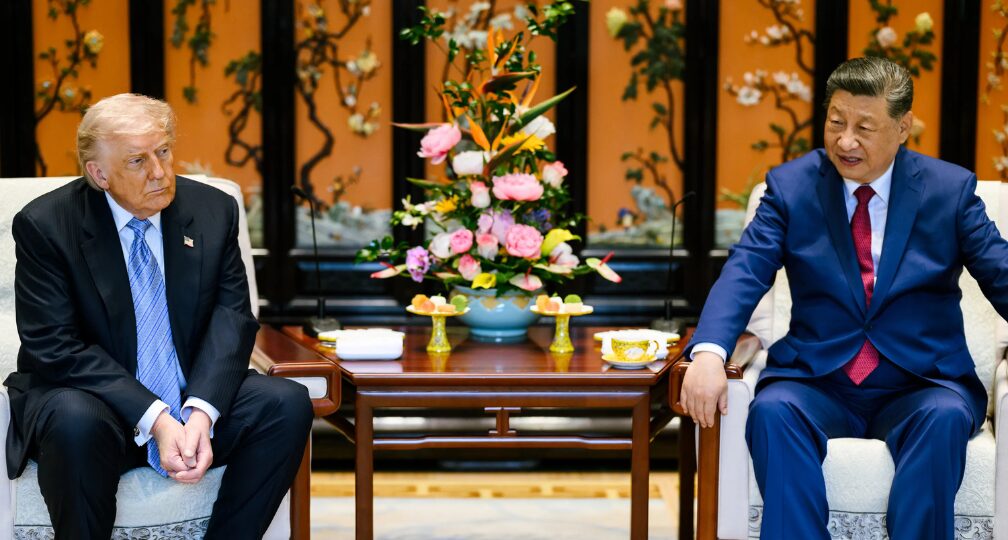
President Trump’s visit to Beijing and meeting with Xi Jinping last week did not produce a grand reset in US-China relations. There were signs of progress—including agricultural purchases, commercial deals, and a more stable economic channel—but the lack of deliverables shows there was no transformative settlement of the strategic rivalry between the world’s two largest economies. The more important development might therefore lie in the institutional proposals confirmed at the summit: a US-China “Board of Trade” and a complementary “Board of Investment”. These mechanisms remain preliminary in operational terms, with their mandate, authority, and procedures still unclear. Yet they may point toward a deeper shift in the international trading system: a move from WTO-style universalism and open-ended integration toward a more managed and politically supervised form of interdependence.
In the post-summit fact sheet, the White House described these two bodies as the “cornerstone” of the agreement and said the two leaders had “chartered” new institutions to optimize the bilateral economic relationship. China’s language was more restrained, referring instead to a “trade council” and an “investment council”, but suggested these councils would allow the two sides to “address their respective concerns in trade and investment cooperation”.
The Board of Trade proposal appears to have taken shape between the October 2025 Trump-Xi meeting in South Korea and the March 2026 Paris discussions among USTR Jamieson Greer, Treasury Secretary Scott Bessent, and Chinese Vice Premier He Lifeng. According to the White House, the Board of Trade’s basic purpose is to allow the US and Chinese governments to identify non-sensitive goods and manage bilateral trade, even as strategic competition intensifies. The basic direction is clear, even if the details remain incomplete: tariff reduction, agricultural market access, aircraft purchases, and other non-sensitive commercial flows are being placed inside a managed framework; while advanced chips, military-relevant technologies, and other security-sensitive sectors remain outside ordinary trade bargaining.
This makes the Board of Trade significant even if the initial economic package is modest. It would not be a free-trade agreement in miniature; in fact, its logic is almost the opposite. Rather than assuming that trade should be liberalized broadly unless specifically restricted, it would ask which parts of the bilateral trade relationship can still be preserved under conditions of geopolitical rivalry. That signals a possible US shift away from trying to change China’s economic system as part of a “great rebalancing”, and toward managing trade with China as it is. Such an interpretation should not be overstated, but it identifies the core of the conceptual shift: trade is no longer treated as a neutral sphere governed mainly by universal rules, but as a field to be sorted according to strategic sensitivity.
During the Beijing trip, Bessent hinted at a similar Board of Investment for non-sensitive areas, based on his pre-summit meeting with Vice Premier He. The White House later confirmed that this Board will provide a government-to-government forum for discussing investment-related issues. It remains less developed than the Board of Trade, but conceptually it may be just as relevant. If the Board of Trade sorts goods, the Board of Investment sorts capital. It would apply the same logic of selective permission to investment flows: Chinese capital may be welcome where it supports non-sensitive economic activity, but not where it raises national-security, technological, data, infrastructure, or strategic-dependence concerns.
That matters because investment commitments have become a central feature of Trump’s economic diplomacy. His trade deals with allies and partnerships with capital-rich Gulf states have often involved promised investment into US industry, infrastructure, energy, manufacturing, and technology ecosystems. A Board of Investment would extend that transactional logic to China, but under much tighter security constraints—and would operate in the shadow of CFIUS, which Bessent chairs. In this sense, the Board of Investment would pre-structure the boundary between acceptable commercial investment and strategic penetration by Chinese state-controlled capital.
The two Boards are therefore best understood together. In practice, trade and capital flows are two sides of the same geoeconomic relationship. Trade deficits and surpluses are mirrored by financial flows, while investment decisions shape future production networks, supply-chain dependence, and market access. A mechanism that governs goods without addressing capital would manage only the surface of the relationship, but a mechanism that also addresses investment begins to shape the underlying structure of interdependence itself. This is why the Board of Investment should not be treated as a secondary add-on. It extends the logic of managed trade from present commercial exchange to the future organization of production.
Since Greer played a key role in developing the Board of Trade, its logic can be interpreted alongside his broader critique of the WTO order. In his August 2025 essay “Why We Remade the Global Order”, Greer argued that the existing WTO-dominated order is “untenable and unsustainable”. He presented the postwar trading system as having moved from a more measured bargain into a phase of global hyper-integration, particularly through the Uruguay Round and the creation of the WTO. For Greer, the problem was not multilateral tariff reduction. It was the assumption that universal rules, market access, and deeper integration could discipline incompatible economic systems while preserving American industrial strength and national security.
The Board of Trade proposal appears to be a bilateral application of that critique, while the Board of Investment extends the same logic to capital flows. If the WTO order assumed that integration would gradually discipline national economic systems, these new mechanisms assume the opposite: that the US and Chinese systems will remain different, and that trade and investment must therefore be sorted, limited, and politically managed. This is a major conceptual departure—systemic difference is treated less as a transitional problem to be solved, than as a permanent condition to be managed.
Yet the issue is broader than China’s non-convergence with “liberal” economics. The WTO system also rested on an implicit expectation that major economies would not systematically use trade, industrial, investment, and currency policy to shift adjustment costs onto others. That premise has been weakening on both sides. China’s production-heavy growth model has long relied on industrial upgrading, state support, export competitiveness, and the external absorption of surplus capacity. And under Trump, the US is now also using tariffs, industrial policy, investment screening, and possibly currency policy as instruments of national strategy. Managed trade emerges when major powers no longer treat economic policy as separable from geopolitical advantage.
At the same time, neither side is ready for full economic decoupling. For the US, the Board of Trade appears to offer a way to separate non-sensitive commerce from strategic rivalry: restricting strategic dependencies while preserving politically useful exports in agriculture, energy, aircraft, and other sectors linked to domestic production and employment. In any case, it will be many years before US supply chains can be “nearshored”, its economy reindustrialized, or its dependence on Chinese rare earths mitigated. For China, the appeal may lie more in predictability: a dedicated channel to reduce tariff volatility, preserve access to parts of the US market, and bargain with the US from a position of relative equality. China still needs access to external markets, selected technologies, capital channels, and stable trade conditions so it can weather its current economic problems and advance domestic upgrading, strategic autonomy, and high-technology investment under the 15th Five-Year Plan. For both sides, economic security does not yet mean full economic separation; for now, incentive structures point to reducing vulnerability while preserving selected channels of exchange.
Therefore, the absence of a “grand bargain” at the Trump-Xi summit is itself revealing. The bargaining space for any wide-ranging or concrete outcome may not have existed. Instead, Washington and Beijing were merely looking for ways to stabilize selected parts of the economic relationship—not resolve their strategic rivalry—while each pursues its own economic security strategy. In this context, the two Boards (or councils) might serve as stabilization mechanisms by allowing either side to “outsource” future trade or investment disagreements to these fora, avoiding hard or politically sensitive decisions, although the members may be appointed by the American and Chinese governments. Yet if the Boards clarify the direction of bilateral ties, they also reveal the difficulty of the task: managed interdependence is easier to declare than to operationalize, especially when both sides have different incentives, different terminology, and different views of what counts as “strategic”.
Moreover, managed interdependence is not risk-free. “Non-sensitive” sounds clear in theory, but in practice the boundary will be politically contested. A consumer good may depend on a strategic supply chain, and a logistics investment may appear commercial while raising data, infrastructure, or security concerns. Managed trade also requires product lists, tariff adjustments, compliance monitoring, and continuing political negotiation, all of which can become opaque, transactional, and vulnerable to lobbying. Nor is Chinese acceptance guaranteed. China may welcome predictability and tariff relief, but it is unlikely to accept a framework that simply ratifies American definitions of “strategic” and “non-strategic” exchange. The different terminology used by the two sides already points to that ambiguity: Washington calls them “Boards” and emphasizes their role as the “cornerstone” of a new economic arrangement, while Beijing calls them “councils” and frames them more narrowly around tariff reduction, market access, and reciprocal concerns.
The proposed Boards should therefore be seen as early instruments indicating the direction of travel for bilateral economic ties. They do not amount to a new grand bargain, are currently ambiguous, and may never become powerful institutions. But they reveal a search for mechanisms suited to a world between WTO universalism and full decoupling. The emerging logic is not liberal integration, because trade and investment are increasingly filtered through economic security concerns, nor is it economic separation, because both governments still want selected forms of exchange. It is instead a form of “managed interdependence”: exchange without trust, or commerce without convergence.
(Photo: WhiteHouse.gov)
Disclaimer: The views expressed in this IOG Economic Intelligence Report do not necessarily reflect
those of the API, the Institute of Geoeconomics (IOG) or any other organizations to which the author belongs.
API/IOG English Newsletter
Edited by Paul Nadeau, the newsletter will monthly keep up to date on geoeconomic agenda, IOG Intelligencce report, geoeconomics briefings, IOG geoeconomic insights, new publications, events, research activities, media coverage, and more.


Visiting Research Fellow
Andrew Capistrano is a geopolitical risk consultant based in Tokyo, and Director of Research at PTB Global Advisors in Washington, DC, where he specializes in industrial policy, international trade and capital flows, and US-China relations. He is also a visiting scholar at the Waseda Institute of Political Economy and a visiting lecturer at the School of Political Science and Economics, Waseda University. Previously, he worked at the US Embassy’s American Center Japan, and as a research associate at the Rebuild Japan Initiative Foundation/Asia-Pacific Initiative. Dr Capistrano holds a BA from the University of California, Berkeley; an MA in political science (international relations and political economy) from Waseda University; and a PhD in international history from the London School of Economics. His academic work focuses on the diplomatic history of East Asia from the mid-19th to the mid-20th centuries, applying game-theoretic concepts to show how China's economic treaties with the foreign powers created unique bargaining dynamics and cooperation problems. During his doctoral studies he was a research student affiliate at the Suntory and Toyota International Centres for Economics and Related Disciplines (STICERD) in London.
View ProfileVisiting Research Fellow
Paul Nadeau is an adjunct assistant professor at Temple University's Japan campus, co-founder & editor of Tokyo Review, and an adjunct fellow with the Scholl Chair in International Business at the Center for Strategic and International Studies (CSIS). He was previously a private secretary with the Japanese Diet and as a member of the foreign affairs and trade staff of Senator Olympia Snowe. He holds a B.A. from the George Washington University, an M.A. in law and diplomacy from the Fletcher School at Tufts University, and a PhD from the University of Tokyo's Graduate School of Public Policy. His research focuses on the intersection of domestic and international politics, with specific focuses on political partisanship and international trade policy. His commentary has appeared on BBC News, New York Times, Nikkei Asian Review, Japan Times, and more.
View Profile-
 Can Germany become a reliable pillar of European security?2026.07.23
 - Sustained Denial and Strategic Depth: Policy Recommendations for Japan’s Next Strategic Documents2026.07.21
- As shared values shift, what's next for U.S.-Japan relations?2026.07.17
- Why Pax Silica Is About More Than AI Chips2026.07.15
- The Case for Underground Defense: Japan's Military Lessons from the Iran War2026.07.14
 Why Pax Silica Is About More Than AI Chips2026.07.15
- China’s Rare Earth Export Controls: “International Rules” Orientation and the Avant-Garde Use of Security Exceptions2026.07.03
- The Iran-U.S. MOU Offers a Reprieve, but Not Relief2026.07.02
 Japan and India: Historic Strategic Convergence2026.07.07
- Sovereign AI After Fugu: From Vertical Dominance to Horizontal Resilience2026.06.24