
The Takaichi Administration’s High-Stakes Growth Gamble

One of the great challenges of long-term economic planning in a democracy is the election cycle. The political competition that gives democracy its strength can also make it difficult to sustain policy over decades.
Japan’s new Growth Strategy, the centerpiece of the Takaichi administration’s economic and industrial policy, looks ahead to fiscal 2040. It will have to survive multiple administrations to achieve its central goal: strengthening Japan’s economy and national security. Its ambitions therefore warrant examination from an economic security perspective.
The Growth Strategy designates 17 strategic sectors, including semiconductors, AI and defense. Within those sectors, it identifies 62 priority technologies and products. For each, it sets out a public-private investment roadmap covering current conditions and challenges, pathways to success, targets, necessary measures and required budgets. It also identifies eight cross-cutting areas, including technological capability and human-resource development.
At first glance, the strategy may look like a collection of requests from individual ministries. But it contains several distinctive and compelling features.
First, it distinguishes between “crisis-management investment” and “growth investment.” The former is intended to strengthen resilience against Japan’s vulnerabilities and risks; the latter is intended to develop industries on which other countries will come to depend. In other words, the strategy seeks to strengthen strategic autonomy through crisis-management investment and strategic indispensability through growth investment.
Second, AI and semiconductors occupy a central position, but the goal is not simply to promote those industries. The strategy aims to use AI to upgrade the other 16 sectors and the eight cross-cutting areas, revitalizing Japanese industry as a whole.
Some sectors, such as shipbuilding, ports and logistics, are not high-growth industries. But that is precisely why they may have significant room to regain competitiveness through AI-enabled systems and physical AI that can ease difficult working conditions. Those upgraded industries could then be exported as packages of smart systems and equipment, contributing to Japan’s strategic indispensability.
Third, the 17 sectors span different stages of technological development. Quantum communications and fusion energy remain in the research and development stage. Unmanned aerial vehicles and next-generation solar cells, including perovskites, are in demonstration. Port cargo-handling machinery and satellites are moving toward commercialization and mass production. By bringing technologies at different stages together, the strategy seeks to create a long enough time horizon to sustain continuous growth.
Auto industry?
Some may find it surprising that automobiles, the backbone of Japanese manufacturing, are not among the 17 strategic sectors. From an economic security and growth perspective, however, that decision is significant.
The automobile industry already attracts substantial private investment, suggesting that the government does not need to intervene through fiscal spending in the same way it does in other sectors. China, by contrast, has promoted electric vehicles through government policy and facilitated autonomous-driving demonstrations through regulatory changes. Regulatory reform, however, is not a central feature of Japan’s Growth Strategy.
Automobiles also do not fit neatly into the strategy’s logic of autonomy and indispensability. Japan clearly needs to develop technologies such as autonomous driving and consider whether it can maintain independent capabilities in them. But automobiles are subject to intense international competition, making strategic indispensability difficult to establish. Japan is also not heavily dependent on other countries for automobiles. These factors likely explain their exclusion.
Autonomy
Economic security is often presented as a trade-off with economic efficiency. Governments want to avoid dependence on particular countries, while companies seeking efficiency naturally concentrate procurement among the most competitive suppliers. Governments have responded by building stockpiles and encouraging supply-chain diversification.
The Growth Strategy proposes a different approach: use public-private investment roadmaps and fiscal incentives to strengthen autonomy and indispensability in strategic sectors.
The defense industry illustrates the approach. The government is funding research and development while expanding procurement through higher defense spending and easing export constraints by replacing the five categories under the Three Principles on Transfer of Defense Equipment and Technology. By signaling the scale of future government procurement, it can increase predictability, expand potential markets and reduce uncertainty for private investment in production capacity.
Shipbuilding provides another example. The roadmap calls for support for highly profitable LNG carriers while encouraging restructuring in an industry that contains many small and midsize companies by international standards. The objective is to induce private investment and improve competitiveness.
In this sense, the Growth Strategy uses fiscal spending as leverage to revitalize industries, strengthen sector-wide autonomy and encourage greater strategic indispensability through private investment.
Challenges
The strategy, however, is not guaranteed to succeed.
The first challenge is continuity. The strategy was developed under Prime Minister Takaichi’s leadership, but it remains unclear whether it will survive Cabinet reshuffles or changes of government. It looks ahead to fiscal 2040, meaning multiple administrations are likely to inherit responsibility for carrying it forward.
China offers a stark contrast. Its authoritarian political system allows industrial policy to continue even when profitability is secondary. In democratic Japan, sustaining a strategy over decades will require broad public debate and support.
The second challenge is fiscal capacity. The strategy depends heavily on government spending at a time when Japan already carries a large public debt burden and long-term government bond yields are rising.
Materials presented to the Growth Strategy Council estimate that, if the strategy succeeds, the ratio of public debt and related liabilities to GDP could decline from more than 190% today to about 170% by fiscal 2040. If the strategy fails and the status quo continues, the ratio could approach 200%.
The Growth Strategy’s ultimate purpose is to strengthen Japan’s national power. Its two central ideas — mobilizing private capital through proactive fiscal spending and strengthening autonomy and indispensability through crisis-management and growth investment — are therefore closely connected.
If they succeed, Japan could use public spending to mobilize private investment, rebuild industrial capacity and reduce strategic vulnerabilities. If they fail, Japan could be left with a heavier debt burden without having achieved greater national strength.
From the standpoint of economic security and fiscal policy, the Growth Strategy is thus a high-risk experiment in national survival. In a world where economic interdependence has increasingly become a source of strategic vulnerability, Japan appears to have few alternatives but to pursue it — while accepting substantial fiscal and political risk.
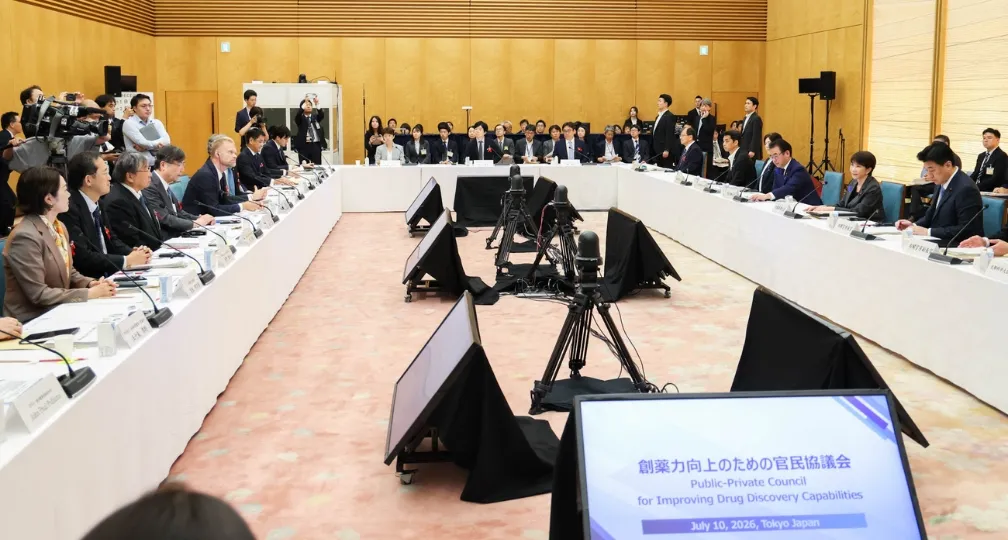
(Photo Credit: Mainichi Newspapers/ Aflo)
[Note] This article was posted to the Japan Times on September 14, 2026:
https://www.japantimes.co.jp/commentary/2026/09/14/japan/japans-economic-growth-gamble/

Geoeconomic Briefing
Geoeconomic Briefing is a series featuring researchers at the IOG focused on Japan’s challenges in that field. It also provides analyses of the state of the world and trade risks, as well as technological and industrial structures (Editor-in-chief: Dr. Kazuto Suzuki, Director, Institute of Geoeconomics (IOG); Professor, The University of Tokyo).
Disclaimer: The opinions expressed in this Geoeconomic Briefing do not necessarily reflect those of the International House of Japan, the Institute of Geoeconomics (IOG) or any other organizations to which the author belongs.

Director & Group Head, Economic Security
Kazuto Suzuki is Professor of Science and Technology Policy at the Graduate School of Public Policy at the University of Tokyo, Japan. He graduated from the Department of International Relations, Ritsumeikan University, and received his Ph.D. from Sussex European Institute, University of Sussex, England. He has worked for the Fondation pour la recherche stratégique in Paris, France as an assistant researcher, as an Associate Professor at the University of Tsukuba from 2000 to 2008, and served as Professor of International Politics at Hokkaido University until 2020. He also spent one year at the School of Public and International Affairs at Princeton University from 2012 to 2013 as a visiting researcher. He served as an expert in the Panel of Experts for Iranian Sanction Committee under the United Nations Security Council from 2013 to July 2015. He has been the President of the Japan Association of International Security and Trade. [Concurrent Position] Professor, Graduate School of Public Policy, The University of Tokyo
View Profile-
 Rebalancing Bilateral Trade or Reordering Global Production?2026.10.23
 - Connecting Europe and the Indo-Pacific: Why Japan and Germany Need Stronger Space Security Cooperation2026.10.20
- China’s Calculus Behind the State Visit to the U.S.: Different Visions of “Stability”2026.10.16
- Trump Faces a Reckoning in the Midterms, but it Might Not Matter for Tariffs2026.10.09
-
 BRICS in India2026.10.09