
China’s Calculus Behind the State Visit to the U.S.: Different Visions of “Stability”
Symbolism Stands Out in the Visit
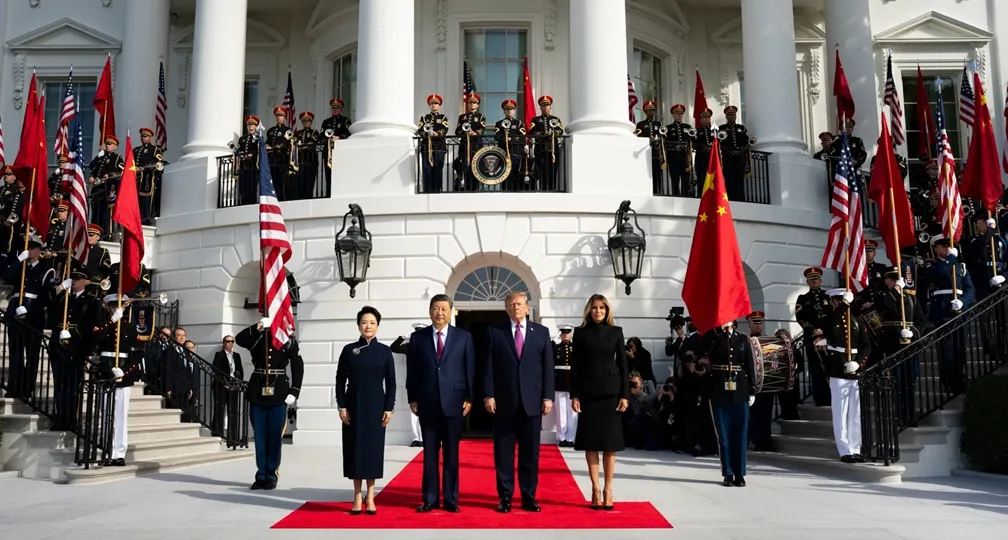
Chinese President Xi Jinping paid a state visit to the United States from September 23 to 25, his first in 11 years. The visit came just over four months after President Donald Trump’s trip to China in May. President Trump and First Lady Melania Trump greeted Xi and his wife at the airport, and a welcoming ceremony was held at the White House the following day. The first lady also took the lead in preparations for the state dinner. Each of these gestures underscored the significance Washington attached to the visit.
Ahead of the Trump-Xi talks, Scott Kennedy of the Center for Strategic and International Studies (CSIS) described the summit in an essay titled “Too Big and Too Small to Fail” as both “too important to fail” and, given the low expectations surrounding it, unlikely to be judged a failure. His assessment was that both countries wanted to avoid a deterioration in relations, while neither was prepared to make major breakthroughs on the most difficult issues.
Judging from the outcomes announced after the visit, Kennedy’s assessment proved broadly accurate. The two sides expanded channels for dialogue and produced selective, practical results on trade, but they remain far from resolving the fundamental economic and security disputes between them.
On September 25 local time, the White House released a fact sheet outlining the outcomes of the visit. The following day, China’s Ministry of Foreign Affairs issued its own document setting out “eight outcomes and areas of consensus.” The two sides agreed to build what they called a “constructive relationship of strategic stability,” while also addressing trade consultations, dialogue on artificial intelligence, counternarcotics cooperation, and Iran. Yet the wording and emphasis of their respective statements differed. On September 28, China’s Ministry of Commerce provided further details on the trade and investment council, the list of products eligible for preferential tariff treatment, and the extension of the trade truce. While “stability” may be a shared objective, it appears the two sides have different ideas about what they hope to gain—and what they are prepared to concede.
Those differences were also evident in the way history was invoked. Both outcome documents noted that the United States and China had fought as allies during World War II. At the state dinner, Xi also said that the two countries had jointly resisted “Japanese militarist aggressors.” The U.S. fact sheet, immediately after referring to wartime cooperation, stated that the forward deployment of U.S. forces in the postwar era had helped sustain a “free and open Indo-Pacific” (FOIP) and contributed to American prosperity. In other words, the U.S. document acknowledged wartime cooperation with China while simultaneously underscoring America’s continuing role in the region. Even amid the symbolism of a shared World War II experience, Washington made explicit—in its own words—that the United States has remained militarily engaged in the region throughout the postwar period.
The Gap in Practice
Turning from the ceremonial aspects of the visit to the economic and technological discussions reveals both the scope of the agreements and the differences in how the two governments presented them. The U.S. side announced that the Trade Council and Investment Council first envisioned in May had been activated. Under the Trade Council, the two sides reportedly agreed to recommend more favorable tariff treatment for roughly $30 billion worth of non-sensitive goods from each country. The U.S. statement also referred to a working group on agricultural market access, Chinese imports of U.S. coal in 2027 and 2028, and shortages of critical minerals, including rare earths. The Investment Council, meanwhile, was described as a forum for discussing investment opportunities and barriers and as a channel for addressing commercially significant issues. China also announced that a jointly led agricultural working group under its Ministry of Commerce and the Office of the U.S. Trade Representative would hold its first meeting before the end of the year, and that the two sides had reached consensus in principle on financial services. On coal, the U.S. side stated that China would import more than 10 million metric tons of U.S. coal in each of 2027 and 2028. However, the Chinese side included coal among the products eligible for tariff reductions but did not specify any volume.
China’s eight-point document referred to the mechanism and implementation of the Trade Council, as well as reciprocal tariff reductions covering roughly $30 billion in imports on each side. It did not, however, identify the products concerned or mention the Investment Council. Later the same day, Foreign Minister Wang Yi’s summary of the U.S. visit explicitly referred to the establishment of both the Investment Council and the agricultural working group. A September 28 announcement by the Ministry of Commerce likewise confirmed the establishment of the Investment Council and regular dialogue under it. The U.S. statement described the tariff measure as an agreement on recommendations for preferential treatment. China’s eight-point document, by contrast, referred to an “arrangement” to reduce tariffs. The amount and general direction were the same, but the two sides differed in how they characterized the stage of implementation. The Ministry of Commerce subsequently published product lists covering approximately $30 billion on each side, together with a framework under which reciprocal additional tariffs would be removed on more than 90 percent of the covered items and most-favored-nation rates would apply. Domestic procedures in both countries still need to be completed before the tariff reductions take effect. On the Investment Council, the U.S. side said it would address commercially significant investment issues, while the Chinese side stressed that discussions would proceed in accordance with each country’s laws and regulations. Neither side indicated any relaxation of national security reviews for individual investment cases.
There is still no jointly issued document setting out a common understanding on the duration of the “trade truce.” Treasury Secretary Scott Bessent said that the truce—first reached during economic and trade talks in Kuala Lumpur in October 2025 and subsequently confirmed at the leaders’ meeting later that month in Busan—would be extended by two months, from November 10 to January 10, 2027. China’s eight-point document did not specify the length of the extension, but a September 28 Ministry of Commerce statement said negotiations would continue on the basis of an extension through January 10, 2027, with the two sides seeking a further extension before the end of the year. The White House fact sheet made no mention of extending the truce at all.
Ahead of the summit, some observers had expected China to seek a longer extension, while the United States was thought to favor a shorter period in order to assess implementation. At least for now, no framework has emerged for containing trade frictions over a longer horizon. Even as both governments seek to project stability in the relationship, they continue to set short deadlines in the economic sphere and use them as leverage against one another.
The effects of this “trade truce” extend well beyond bilateral U.S.-China commerce. China’s export controls on rare earths and other materials, tightened in response to U.S. tariff measures, are designed to apply not only to exports to the United States but also to shipments to other countries, including Japan. China has also had export-control measures targeting Japan in place since the beginning of the year. If retaliatory exchanges between Washington and Beijing intensify again, the consequences will spread to production and supply chains in third countries as well. If the current truce is extended by only two months, Japanese industry will therefore have little choice but to factor the uncertainty beyond that deadline into its planning.
Artificial intelligence was also one of the major topics at the summit. Xi said that although the United States and China compete with one another, they can also cooperate in certain areas as well. He called on the two countries to discuss both the benefits and risks of AI, prevent its misuse, and ensure that humans remain in control. The two sides announced the creation of an AI dialogue, with the next meeting scheduled for November, as well as a communication channel for AI-related incidents. A mechanism that allows the two governments to communicate in the event of an accident or serious malfunction has clear value. Yet the scope of incidents covered and the procedures to be followed have not been specified, and building a system that can function reliably during a crisis will depend on future negotiations.
There is, however, no agreement to slow the pace of AI development. For China, AI is both a technology whose risks must be managed and a tool for strengthening industrial and national security competitiveness. Even as dialogue proceeds, China is likely to continue developing AI infrastructure, including power supply and data center networks, while accelerating the deployment of AI technologies across the economy and society. Discussions over AI risk management and competition over AI capabilities will therefore proceed in parallel.
China Seeks to Leverage “Stability” Through Summit Diplomacy
China has emphasized the visit as an achievement of “leader-level diplomacy,” presenting the personal relationship between the two presidents as a driving force in U.S.-China relations. Xi announced that China would invite 100,000 young Americans to visit the country over the next five years; he also announced that two pandas would be loaned to Zoo Atlanta. These exchanges are concrete initiatives in their own right, but they also serve a domestic political purpose: portraying Xi as a leader welcomed by the United States and taking the initiative in improving bilateral ties.
At the same time, China’s leadership is unlikely to believe that a good relationship with President Trump alone will fundamentally alter Washington’s long-term China policy. In his summary of the U.S. visit, Foreign Minister Wang Yi cited the establishment of the Trade Council and Investment Council among the outcomes and said they would help stabilize bilateral economic and trade relations, bolster market confidence, and benefit businesses and ordinary citizens in both countries as well as the global economy. He then criticized “certain forces” in the United States for expanding the concept of national security, putting pressure on Chinese companies, and restricting Chinese investment in the United States. By placing leader-level diplomacy front and center, Beijing may also be seeking to emphasize the benefits of economic cooperation while pushing back against the bipartisan hard-line views on China that remain influential in Congress and elsewhere in Washington. China may also see the current U.S. administration as an opportunity to capitalize on President Trump’s transactional approach and press for an easing of restrictions on Chinese investment.
The principles underlying the newly agreed “constructive relationship of strategic stability” are expressed in Chinese as “respect, fairness, and equality,” while the English formulation is “respect, fairness, and reciprocity.” The Chinese term, duideng (对等), rendered as “equality” corresponds linguistically to “reciprocity”—the Chinese term for what the United States calls “reciprocal tariffs,” for example, is “duideng guanshui(对等关税)”, literally “equal tariffs.” Yet Beijing’s choice of wording in this case appears to place particular emphasis on the idea that major powers should treat each other as equals. The U.S. (President Trump) use of “reciprocity”, by contrast, carries a more transactional implication: what each side gives and receives in return. This is more than a semantic distinction. China seeks recognition and respect from the United States as an “equal” major power, while Washington is looking for tangible outcomes from negotiations. The different expectations the two sides attach to the same set of principles reveal the divergent visions underlying their shared pursuit of “stability.”
Taiwan was not included in either side’s outcome document. Even so, Xi used the summit to urge the United States to maintain its opposition to “Taiwan independence” and to handle the Taiwan issue with caution. No change in U.S. policy was agreed at the summit, and a roughly $14 billion package of arms sales to Taiwan still awaits a decision by the U.S. administration. If approval continues to be delayed, the result would remain favorable to Beijing even without any explicit concession in the language of the agreements. The two leaders are expected to have further opportunities for contact at APEC and the G20, and Beijing is likely to repeat similar warnings over Taiwan.
As China moves toward next year’s Communist Party Congress, a stable relationship with the United States will carry domestic political importance for Xi’s leadership. A sharp deterioration in U.S.-China relations could bring not only economic damage through trade and technology restrictions but also heightened security tensions, potentially adding to domestic economic and political uncertainty. Yet the stability China seeks is not intended to bring strategic competition with the United States to an end.
What, then, lies beyond this “stability”? Behind the atmosphere of cordiality remains deep-seated distrust of America’s ability to control access to critical technologies. Even after the United States permitted some exports of NVIDIA’s H200 chips to China, Beijing continued to restrict purchases. NVIDIA itself has disclosed that it has been unable to sell all of the products for which it received export licenses. China’s response reflects its determination to pursue greater technological self-reliance and reduce its exposure to technological chokepoints controlled by the United States.
China is seeking to stabilize relations with the United States while continuing to advance science and technology, strengthen its economic and military capabilities, and expand its international influence. The United States, for its part, seeks to avoid a crisis while demanding tangible returns from China. A good relationship between the two leaders does not mean that strategic competition between their countries will end. For Beijing, the state visit can therefore be understood as an exercise in summit diplomacy designed to secure limited practical gains while postponing resolution of the deeper disputes and preserving the time and room needed to continue competing with the United States. In that sense, China appears to have made effective use of the elaborate diplomatic stage favored by President Trump: emphasizing mutual respect and equality between major powers, meeting the modest expectations set before the summit, and buying itself some breathing room for the near term.
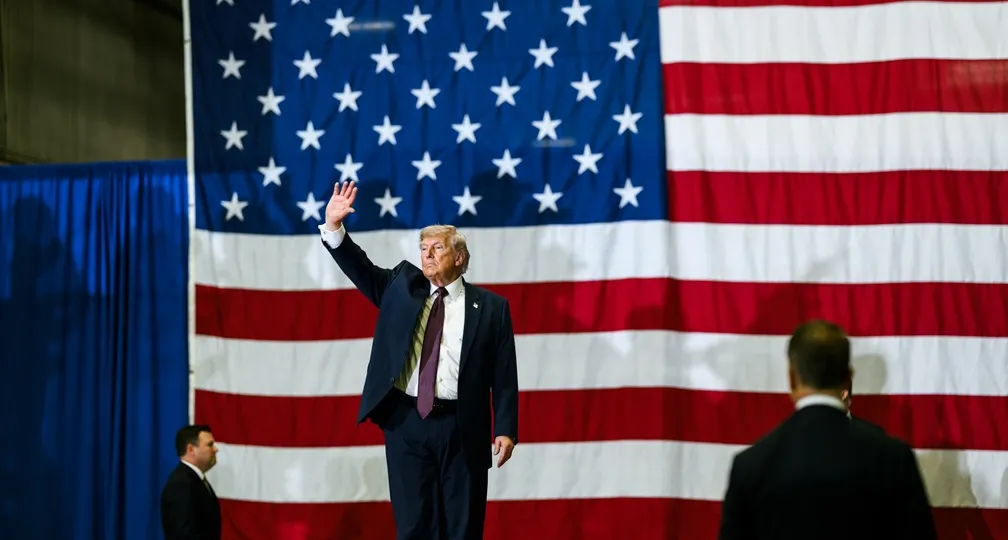
(Photo Credit: WhiteHouse.gov)
Disclaimer: The views expressed in this IOG Commentary do not necessarily reflect those of the Institute of Geoeconomics (IOG) or any other organizations to which the author belongs.

Senior Research Fellow
Senior Research Fellow of the China Group at the Institute of Geoeconomics (IOG). Doi specializes in China and the world (geoeconomic issues, such as development finance and emerging technologies), and global governance in the social development sectors, including education and health. He graduated from the University of Kitakyushu with a B.A. in International Relations (Contemporary China Studies) and a Master of Public Policy from the University of Tokyo. Doi joined the Japan International Cooperation Agency (JICA) in 2008, where he worked on the implementation of the Japanese government’s foreign aid to China at the JICA Beijing Office and conducted financial investments in economic and social infrastructure, sovereign credit risk analysis and research on China’s development cooperation with the Global South at the Africa Department. In 2018, he began his doctoral studies in the Department of Education Economics at Peking University in China, where he received his PhD in Public Policy in 2022. Doi served as a senior researcher and advisor at Diinsider Co., Ltd, a China-based international development consultancy, and as an adjunct researcher at the Center for the Study of International Cooperation in Education, Waseda University, before being appointed to his current position in August 2024. His research has been published in books by international publishers, including Routledge and Springer Nature, as well as in international peer-reviewed journals such as Development Policy Review, Educational Review, Higher Education Research & Development, Public Health Action, and Compare. [Concurrent Positions] Adjunct Researcher, Center for the Study of International Cooperation in Education, Waseda University, Japan. (2023-Present) Visiting Lecturer, Department of International Business and Management, Kanagawa University, Japan. (2025-2026).
View Profile- China’s Calculus Behind the State Visit to the U.S.: Different Visions of “Stability”2026.10.16
-
 Trump Faces a Reckoning in the Midterms, but it Might Not Matter for Tariffs2026.10.09
 -
 BRICS in India2026.10.09
 - Can Japan build a defense-startup ecosystem?2026.10.07
- Economic security in health and medicine through strategic alignment2026.10.06