
Will Chinese AI build a global advantage?
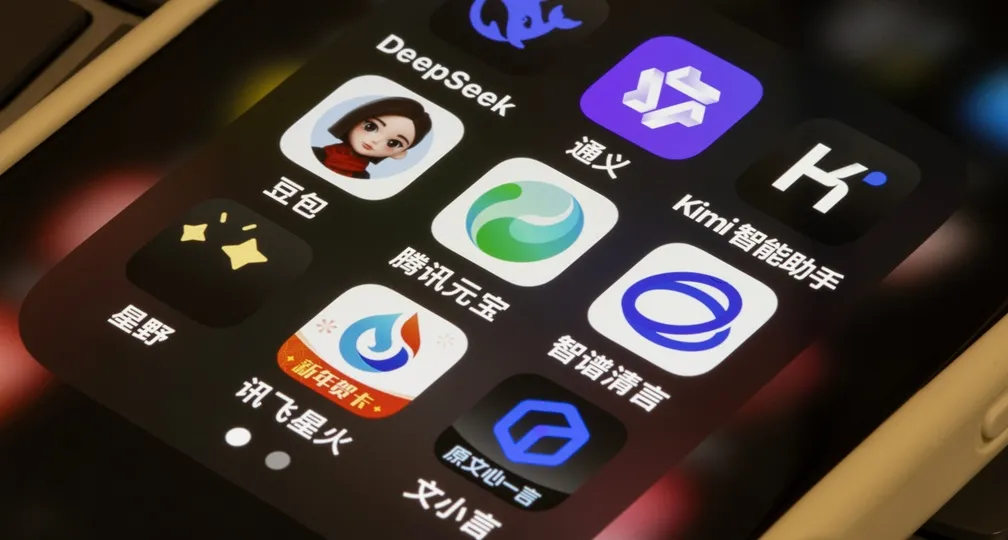
Artificial intelligence has become a central arena of U.S.-China competition, spanning semiconductors, energy, communications and manufacturing. China’s leaders regard AI as a “strategic technology driving scientific and technological revolution and industrial transformation.”
In April 2025, President Xi Jinping called for technological self-reliance and application-oriented development. China aims not only to develop domestic AI models but also to improve them through deployment in manufacturing and government administration.
The United States retains advantages in frontier models, advanced semiconductors, private capital, cloud infrastructure and developer ecosystems. Capital expenditures by major U.S. technology companies exceeded $400 billion in 2025, compared with $63 billion in China.
Yet China’s economy is increasingly divided along a “K-shaped” trajectory, with real estate and domestic demand stagnating while emerging industries expand. In 2025, value added in high-tech manufacturing increased 9.4%, digital product manufacturing grew 9.3% and high-tech exports rose 13.2%.
‘AI Plus’
Although AI’s contribution to this growth cannot be isolated, Beijing sees it as a tool for strengthening industries such as servers, robots, electric vehicles and drones. Its “AI Plus” policy seeks to integrate AI into industry, consumption, public welfare and government administration.
Adoption, however, depends on more than benchmark performance. Cost, local-language support, data management and compatibility with existing equipment all matter. While the United States pursues cutting-edge performance, China is seeking an advantage through affordability, widespread deployment and integration with manufacturing.
At the World AI Conference in Shanghai in July, Xi called for extending AI from the digital world into the physical world through openness and cooperation. Two areas illustrate China’s strategy.
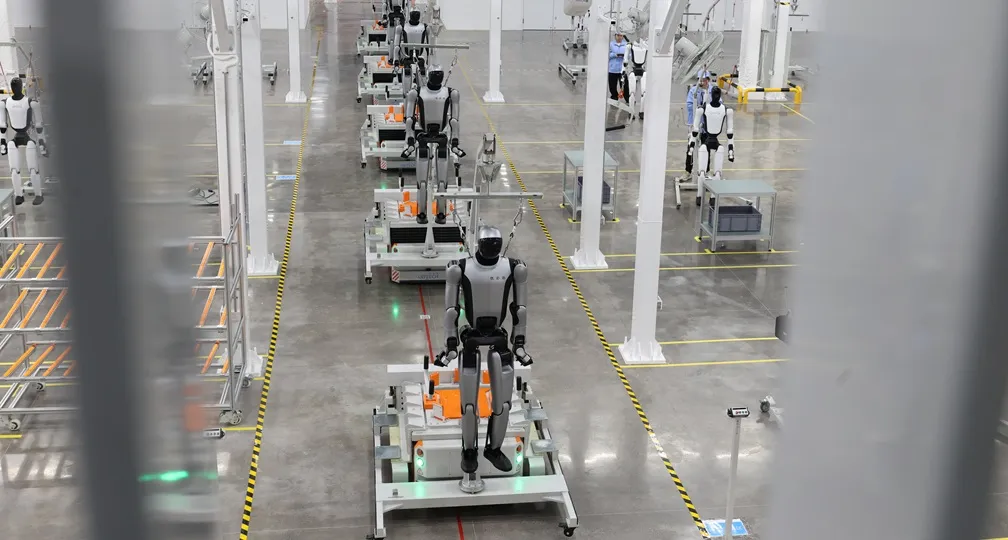
The first is physical AI, which uses sensors and models to perceive surroundings, adapt actions and improve through field data. Applications include intelligent vehicles, drones, logistics equipment and humanoid robots. China accounted for 54% of global industrial robot installations in 2024. Its AI Plus policy targets penetration rates for intelligent terminals and AI agents exceeding 70% by 2027 and 90% by 2030.
The second is low-cost, open-weight models from companies including DeepSeek, Alibaba’s Qwen and Moonshot AI’s Kimi. Users can obtain model weights and adapt them to local environments and languages. In a reported May 2026 comparison, Kimi K2.6 cost $1.71 per million tokens, against $11.25 for GPT-5.5. Efficient design, engineering talent, relatively low labor costs and intense competition help Chinese companies cut costs.
China faces constraints, including restricted access to advanced semiconductors, overinvestment, uncertain profitability and concerns about safety and overseas trust. Its potential advantage lies in combining affordable models with a vast manufacturing base and extensive real-world deployment, allowing rapid improvement at scale.
Beijing is also promoting AI adoption across the Global South. Its Global AI Governance Initiative dates to 2023, while the outline of its 15th Five-Year Plan, released in March 2026, called for an open AI ecosystem and support for developing countries. In July, 29 countries signed an agreement establishing the World AI Cooperation Organization, or WAICO. China has pledged 5,000 training opportunities for developing countries over five years and plans cooperation hubs with regional organizations.
Developing countries, however, are not necessarily choosing sides. They seek competitive prices, technology transfer, jobs and data sovereignty. Kazakhstan joined the U.S.-led Pax Silica initiative in June 2026 and China-led WAICO the following month. Reports in August said the U.S. State Department had drafted a document pressing countries participating in both initiatives to choose sides, although whether it was formally sent remains unconfirmed.
Chinese models are already supporting locally developed AI. Uganda’s nonprofit Sunbird AI built Sunflower on Qwen 3 to support 31 Ugandan languages. The model reportedly achieved the highest translation accuracy among those compared in 24 languages. Sunflower v2, released in September 2026, expanded support to 67 African languages and added voice functions and offline smartphone use.
In Thailand, OpenThaiGPT 1.5 was further trained on Qwen 2.5 using more than 2 million Thai instruction pairs. Its 7-billion-, 14-billion- and 72-billion-parameter versions have been released, with 2.4 million requests to its public API and more than 260 derivative models.
Such projects allow Chinese models to become foundational technologies for national AI systems, even without direct sales by Chinese companies. Physical AI offers another route overseas: WeRide operates Level 4 fully driverless robotaxis with Uber and local operator Tawasul in Abu Dhabi, while Baidu’s Apollo Go has launched driverless commercial ride-hailing in Dubai.
The United States still leads in frontier models, semiconductors and cloud computing. But global adoption will not depend on peak performance alone. Chinese AI could gain ground through affordability, local-language adaptability, modifiability, modest computing requirements and integration with equipment. Its expansion in the Global South resembles a strategy of “surrounding the cities from the countryside.”
Japan’s role
For Japan, security and information-management concerns encourage caution. Yet Chinese models and equipment, U.S. cloud services and local data-sovereignty requirements increasingly coexist in overseas markets. Japanese companies may find it harder to compete in these markets without understanding Chinese AI.
Studying China’s open-weight models, application-first approach and physical AI also offers research and development benefits. Japan must understand cost reduction, model-equipment integration and improvements driven by field data to develop its own technological strengths. After visiting Shenzhen in August, Akihisa Shiozaki, a member of the House of Representatives and state minister for digital transformation and Cabinet Office affairs, wrote: “Not looking is not security.”
Japan should distinguish among research, general business operations and critical infrastructure, determining which applications permit Chinese AI, require isolation or warrant exclusion. Strict safeguards should apply to defense, critical infrastructure, core financial operations and sensitive information, while lower-risk uses remain open to evaluation.
The answer is neither blanket exclusion because a technology is Chinese nor adoption based solely on price. Companies should retain the ability to switch among domestic and international models, ensure data portability, preserve audit rights and include exit clauses in contracts. The government should establish standards for high-risk applications, independent evaluation and interoperability, while supporting transitions that individual firms cannot manage alone.
Japan must assess Chinese AI according to the risks and realities of each application. Protecting national security should not mean surrendering the ability to learn, innovate and compete.
(Photo Credit: Tada Images / Shutterstock.com)
[Note] This article was posted to the Japan Times on November 2, 2026:
https://www.japantimes.co.jp/commentary/2026/11/02/japan/chinese-builds-ai-global-advantage/

Geoeconomic Briefing
Geoeconomic Briefing is a series featuring researchers at the IOG focused on Japan’s challenges in that field. It also provides analyses of the state of the world and trade risks, as well as technological and industrial structures (Editor-in-chief: Dr. Kazuto Suzuki, Director, Institute of Geoeconomics (IOG); Professor, The University of Tokyo).
Disclaimer: The opinions expressed in this Geoeconomic Briefing do not necessarily reflect those of the International House of Japan, the Institute of Geoeconomics (IOG) or any other organizations to which the author belongs.

Senior Research Fellow
Senior Research Fellow of the China Group at the Institute of Geoeconomics (IOG). Doi specializes in China and the world (geoeconomic issues, such as development finance and emerging technologies), and global governance in the social development sectors, including education and health. He graduated from the University of Kitakyushu with a B.A. in International Relations (Contemporary China Studies) and a Master of Public Policy from the University of Tokyo. Doi joined the Japan International Cooperation Agency (JICA) in 2008, where he worked on the implementation of the Japanese government’s foreign aid to China at the JICA Beijing Office and conducted financial investments in economic and social infrastructure, sovereign credit risk analysis and research on China’s development cooperation with the Global South at the Africa Department. In 2018, he began his doctoral studies in the Department of Education Economics at Peking University in China, where he received his PhD in Public Policy in 2022. Doi served as a senior researcher and advisor at Diinsider Co., Ltd, a China-based international development consultancy, and as an adjunct researcher at the Center for the Study of International Cooperation in Education, Waseda University, before being appointed to his current position in August 2024. His research has been published in books by international publishers, including Routledge and Springer Nature, as well as in international peer-reviewed journals such as Development Policy Review, Educational Review, Higher Education Research & Development, Public Health Action, and Compare. [Concurrent Positions] Adjunct Researcher, Center for the Study of International Cooperation in Education, Waseda University, Japan. (2023-Present) Visiting Lecturer, Department of International Business and Management, Kanagawa University, Japan. (2025-2026).
View Profile