
Semiconductor chokepoints define U.S.-China rivalry
The reciprocal tariffs introduced by the Trump administration in April 2025 jolted the global economy and triggered wide-ranging diplomatic and economic consequences. As negotiations unfolded, countries were forced to confront a central question: What constitutes strategic economic strength, and how can it be protected or leveraged?
Japan’s automobile industry, Taiwan’s semiconductor sector and South Korea’s shipbuilding industry quickly emerged as prominent examples.
At the same time, competition between the United States and China has increasingly centered on economic chokepoints. Through tariffs and export controls, each side has tested the other’s vulnerabilities. Two chokepoints now stand out: advanced semiconductors for China and rare earth minerals for the United States.
U.S. strategy
Washington’s approach to China has often been described as a “technology gap strategy,” aimed at preventing China from accessing cutting-edge technologies while strengthening domestic innovation and manufacturing to maintain a decisive lead.
Since October 2022, the United States has restricted exports of advanced semiconductors and the equipment needed to produce them. The CHIPS and Science Act has simultaneously supported research and expanded domestic manufacturing capacity.
Under Trump’s second administration, this framework remains largely intact. While preserving the CHIPS Act structure inherited from the Biden administration, Washington has paired it with tariffs designed to attract large-scale foreign investment. The goal is consistent: strengthen domestic capacity, reshore production and expand employment in strategic industries.
Japan, for example, has pledged roughly $550 billion in U.S. investment. In semiconductors, this includes production tied to wafer dicing saws, advanced materials and, looking ahead, synthetic diamonds that could serve as substrates for next-generation chips.
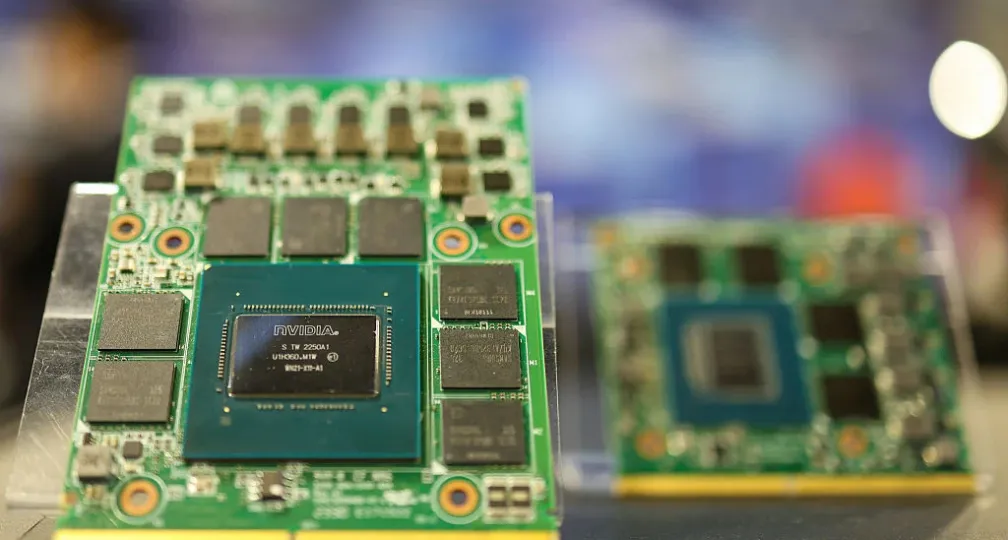
U.S. export policy toward China, however, has been less consistent. NVIDIA’s advanced chips — critical for artificial intelligence and supercomputing — have been central to these shifts. The H20 chip has been widely used in China, while the more advanced H200 has generally been restricted.
This changed after China tightened export controls on rare earth minerals in April 2025 and again in October. The United States subsequently allowed conditional exports of the H200, while China agreed to suspend its stricter rare earth controls for one year, through November 2026.
Both moves were unexpected. China’s willingness to ease restrictions and Washington’s decision to partially loosen chip controls underscored the strategic importance of these chokepoints.
China’s vulnerability
For China, advanced semiconductors remain a critical weakness. Their importance for artificial intelligence and national security makes dependence on foreign suppliers a strategic risk.
Beijing recognized this as early as its 2015 “Made in China 2025” plan, which identified reliance on imported chips as a major vulnerability. Since then, China has pursued an aggressive effort to close the gap.
Some analysts argue that Washington’s technology gap strategy emerged in response to China’s progress. By 2023, China reportedly achieved mass production of chips at the 7-nanometer level using less advanced lithography equipment. In December 2025, reports suggested China had prototyped an extreme ultraviolet lithography system — a potentially significant milestone if confirmed.
Even so, Chinese chips, including those from Huawei and Cambricon, still lag behind NVIDIA’s H200 chips produced by Taiwan Semiconductor Manufacturing Co.
Washington’s willingness to allow conditional H200 exports may reflect the pace of technological advancement. NVIDIA’s next-generation Blackwell B300 reportedly delivers more than twice the performance of the H200, while its Rubin architecture — expected to enter mass production this year — could achieve 3.5 to five times the B300’s performance.
China, meanwhile, appears focused on long-term self-reliance. Despite eased restrictions, Beijing has reportedly limited domestic use of imported H200 chips to government-controlled applications. While foreign chips could offer short-term gains, reliance on them risks slowing China’s push for technological autonomy.
These policy shifts illustrate how deeply semiconductors are tied to national security.
Japan’s strategy
Amid this competition, Japan has pursued its own semiconductor strategy, built on two pillars: rebuilding domestic manufacturing capacity for advanced chips and strengthening supply chain resilience for critical materials.
On manufacturing, progress has been steady. In Kumamoto, the Japan Advanced Semiconductor Manufacturing facility is producing chips in the 12- to 28-nanometer range, with a second plant planned to produce chips approaching the 3-nanometer level, though delays remain possible.
Rapidus, following prototype production last year, is now working with clients using its Process Design Kit framework. A roadmap for a second facility targeting 1.4-nanometer technology has also been reported.
Japan’s 2022 Economic Security Promotion Act has further reinforced supply chains and supported development in critical technologies.
Still, significant challenges remain.
One is achieving high manufacturing yields for leading-edge chips — a technical hurdle essential for commercial viability.
Another is the lack of a complete domestic production chain. Facilities in Kumamoto and Hiroshima focus on front-end fabrication, but wafers must still be sent overseas for back-end processing, leaving a gap in Japan’s economic security ecosystem.
Even if these issues are resolved, Japan faces a final challenge: creating viable use cases.
At present, Japan lacks a large domestic ecosystem of products incorporating leading-edge chips at the 2-nanometer level. Without strong downstream demand, even advanced manufacturing capacity may struggle to remain sustainable.
Rapidus aims to address this with a flexible business model integrating design, fabrication and packaging. If its chips can be incorporated into Japanese products, the country’s semiconductor revival would gain credibility.
However, Rapidus differs from Taiwan Semiconductor Manufacturing Co., whose scale and partnerships with major customers such as NVIDIA and Apple drive profitability. Semiconductor development requires heavy investment, particularly in design intellectual property, and economies of scale are critical.
Rapidus instead plans to focus on small-volume, high-variety production, which may make cost recovery more difficult.
To succeed, it will need to carve out niches that larger players overlook. Potential applications extend beyond artificial intelligence and autonomous vehicles to telecommunications, medical technology, space systems and robotics.
By identifying and rapidly commercializing such use cases, Japan could establish new areas of technological strength centered on Rapidus.
This effort will require more than a single company. Japan’s broader industrial and academic sectors must work together to develop globally competitive products incorporating advanced semiconductors.
Ultimately, Japan’s goal is not just to rebuild its semiconductor industry but to achieve strategic indispensability within global supply chains. The direction is clear. The challenge now is execution.
[Note] This article was posted to the Japan Times on May 18, 2026:
https://www.japantimes.co.jp/commentary/2026/05/18/japan/us-china-semiconductor-chokepoints/
(Photo Credit: Anadolu / Getty Images)

Geoeconomic Briefing
Geoeconomic Briefing is a series featuring researchers at the IOG focused on Japan’s challenges in that field. It also provides analyses of the state of the world and trade risks, as well as technological and industrial structures (Editor-in-chief: Dr. Kazuto Suzuki, Director, Institute of Geoeconomics (IOG); Professor, The University of Tokyo).

Visiting Senior Research Fellow
Eiki Tagami is a visiting senior research fellow in Institute of Geoeconomics at International House of Japan from May 2024. With over 30 years of experience at a Japanese trading house, Mr. Tagami has specialized in risk management and industry analysis. From 2006 to 2017, he worked at a think tank within the trading house, covering a wide range of industry analysis work with a particular focus on value-chain analysis. In 2021, he was appointed to be in charge of economic security in the trading house. He completed the Executive Management Program at the University of Tokyo and holds a BA in Political Science from Waseda University
View Profile-
 Semiconductor chokepoints define U.S.-China rivalry2026.05.19
 - Digital Currencies and Monetary Hegemony, Part I of III: Financial Weaponization and the Burden of Reserve Currency Status2026.05.15
-
 Japan-India Cooperation Takes Off2026.05.12
 - Canada’s China recalibration: Rapprochement or risk-hedging?2026.05.12
- Shifting costs to allies won’t ‘restore’ U.S. maritime dominance2026.05.07




 Geoeconomic Connectivity Index - user guide2026.04.23
- Geoeconomic Connectivity Index2026.04.23
- Two Narratives on the Chinese Economy2026.04.10
- Trump Is Rebuilding His Tariff Wall – Will the Courts Knock Down this One As Well?2026.04.23
- Economic security has become central to America’s National Security Strategy2026.04.20