
Why Pax Silica Is About More Than AI Chips
The latest regulatory developments on economic security & geoeconomics
By Paul Nadeau, Visiting Research Fellow, Institute of Geoeconomics (IOG)
Strait of Hormuz Update: On July 7, the U.S. Treasury Department ended the suspension of sanctions on Iranian oil after three tankers, including a liquified natural gas (LNG) tanker, were struck by Iranian missiles during transit through the Strait of Hormuz. Hostilities have resumed since, and on June 12 Iran’s Islamic Revolutionary Guard Corps (IRGC) Navy announced it had closed the Strait of Hormuz once again. As of July 13, it is unclear to what extent the June Memorandum of Understanding (MOU) remains in force. As of Sunday, July 5, the seven-day moving average of ships passing through the Strait of Hormuz is 32 according to the International Monetary Fund’s Portwatch. The seven-day moving average at this time last year was 99.
Treasury Department Issues License for Venezuela Earthquake Aid: On June 25, the U.S. Treasury Department’s Office of Foreign Assets Control (OFAC) issued a general license authorizing transactions related to earthquake relief efforts in Venezuela.
FCC Blocks Import of Chinese Telecom Equipment: On June 26, the U.S. Federal Communications Commission (FCC) announced it would ban the import of new models of telecommunications and video surveillance equipment made by China’s Huawei, ZTE, Hikvision, and Dahua, citing national security risks. The ban includes old models of equipment used for “public safety, security of government facilities, physical security surveillance of critical infrastructure, and other national security purposes.”
Treasury Sanctions Sudan’s RSF: On June 26, the U.S. Treasury Department’s Office of Foreign Assets Control (OFAC) imposed sanctions on eight individuals and entities linked to procurement and recruitment networks that continue to fuel Sudan’s civil war between the Sudanese Armed Forces and the Rapid Support Forces (RSF) paramilitary group.
Commerce Department Lifts Anthropic Export Controls: On June 30, the U.S. Commerce Department lifted export controls on Anthropic’s most advanced Fable and Mythos AI models following the implementation of safeguards after blocking their export three weeks earlier.
Treasury Sanctions Brazilian Criminal Gang: On July 1, the U.S. Treasury Department’s Office of Foreign Assets Control (OFAC) designated two Brazilian nationals, three Brazilian companies, and one Portuguese company for their links to Latin America’s largest criminal gang, the Brazil-based Primeiro Comando da Capital.
U.S. Launches Section 232 Investigation into Anthracite Coal Imports: On July 2, 2026, the U.S. Department of Commerce’s Bureau of Industry and Security (BIS) announced the initiation of an investigation into the national security implications of importing anthracite coal, with a particular focus on metallurgical coal used in steel production. The investigation comes under Section 232 of the Trade Expansion Act of 1962, which permits the president to impose tariffs to restrict the imports of products that may pose a threat to national security. The investigation may take up to one year from the date of the announcement and a public comment period is open until July 21, 2026. The United States imported roughly $125 billion of this coal in 2025, mostly from Canada and Peru.
EU, UK Sanction Russian Poison Scientists: On July 3, the European Council sanctioned six Russian scientists and researchers within Russia’s military sphere who were involved in Alexei Navalny’s poisoning and death. In a separate announcement on July 6, the United Kingdom’s Foreign, Commonwealth, and Development Office sanctioned seven individuals and two Russian state scientific research institutes involved in the development of the chemicals used in the poisonings of Alexei Navalny and Dawn Sturgess.
FCC Adds Digitalsystem Technology to National Security Risk List: On July 7, the U.S. Federal Communications Commission (FCC) announced that it would add California-based Digitalsystem Technology to a list of companies posing risks to U.S. national security, citing links to Chinese telecom firms PCCW, China Unicom, and China Mobile, and ownership by a Chinese national.
U.S. Rescinds Syria’s Status as State Sponsor of Terror: On July 8, the U.S. State Department formally informed Congress that it was initiating the recission process of Syria’s designation as a state sponsor of terror following a 45-day notification period provided to Congress. The recission follows a June 30 executive order directing sanctions relief for Syria.
Analysis: Why Pax Silica Is About More Than AI Chips
By Andrew Capistrano, Visiting Research Fellow, Institute of Geoeconomics (IOG)
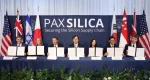
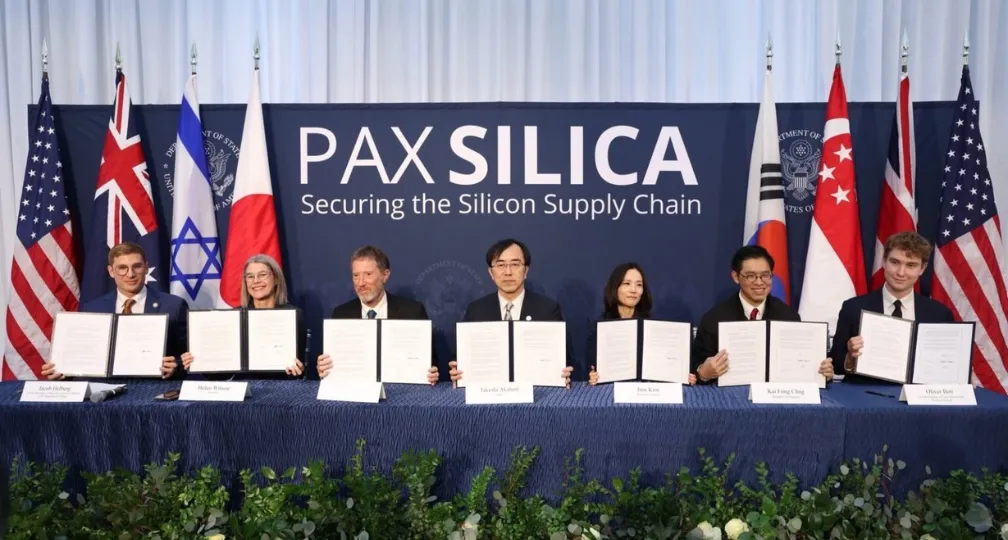
When 10 new signatories, including the EU, joined the US “Pax Silica” initiative at its June 2026 summit, it looked at first glance like another agreement in the expanding web of AI and semiconductor diplomacy. There are now 24 members of the seven-month-old grouping, which is formally concerned with securing AI supply chains, trusted compute, chip production, and related infrastructure. Beneath the surface, however, such rapid expansion suggests that Pax Silica should be understood as more than a US-led framework for selected technology partners: when combined with other initiatives, it has become part of a broader attempt to organize the industrial foundations of the AI age.
Pax Silica is also important for another reason, as it shows that critical mineral security is moving downstream. The US has recognized that the challenge is not only one of upstream extraction, concerning where lithium, cobalt, nickel, graphite, rare earths, copper, or tungsten are mined. In fact, it is proving more difficult to ensure these materials can be processed, financed, transported, and embedded in trusted industrial systems outside what is still a China-centered ecosystem. From this standpoint, Pax Silica is both an AI initiative and a key node in an emerging US effort to connect mineral access to refining, component manufacturing, power systems, and trusted end-use demand.
This represents a significant shift in the locus of economic security. Until now, the default response to China’s dominance in critical minerals has been “diversification”. As the centrality of critical minerals to advanced technologies became obvious, and the risk that China could “weaponize” its control over the supply chain grew impossible to ignore, governments sought new mines, new partners, and new sources of supply. That endeavor remains necessary, but will be insufficient. Alternative sources do not automatically become alternative supply chains, and a mineral deposit outside China is strategically useful only if it can attract investment, reach production, secure processing capacity, survive price cycles, and find reliable buyers. In other words, critical mineral vulnerability is not only a dependency problem—it is a bankability problem.
Indeed, China’s advantage lies less in mineral access than in the industrial ecosystem it has constructed beyond the mine. Refining, separation, battery materials, magnets, and component production are where many of the real chokepoints sit. As a result, non-China projects must compete with China-centered incumbent firms that often benefit from scale, integrated downstream demand, and state support to endure periods of weak prices. If alternative producers cannot become commercially durable, diversification will remain a slogan rather than a supply-chain strategy.
The Trump administration’s recent critical mineral initiatives appear to address this problem. Over the past year, the US has accumulated a dispersed pipeline of resource arrangements spanning the globe. Some are tied to reconstruction and military support, as in Ukraine, while others are tied to infrastructure corridors, such as the Lobito route through Angola, Zambia, and the DRC, or to strategic access in resource-rich regions such as Central Asia. Still more are linked to tariff agreements that include processing and domestic value addition in Southeast Asia, or involve allied industrial partners that can provide finance, technology, and downstream demand.
Taken individually, these deals look ad hoc, and it is true that the US accumulated many of them as part of diplomatic agreements covering a wide range of unrelated issue areas. Together, however, they create a map of potential non-China supply chains: where resources might come from, what infrastructure is needed to move them, and which partners might help turn them into industrial capacity.
But a map of mines is not an architecture. While resource diplomacy can accumulate options, it cannot by itself make those options bankable, coordinated, or connected to end-use demand. This is why three emerging US initiatives—Project Vault, the Forum on Resource Geostrategic Engagement (FORGE), and Pax Silica—are more than the sum of their parts. They should be viewed as an attempt to impose architectural logic on what would otherwise remain a fragmented pipeline of ad hoc mineral agreements.
First, Project Vault addresses the upstream side of the problem. Its confirmed mechanism is the creation of a US Strategic Critical Mineral Reserve backed by large-scale US Export-Import Bank (EXIM) financing. EXIM has announced that Project Vault includes a direct loan of up to $10 billion, along with nearly $2 billion in private-sector investment. A less understood effect of reserve creation is demand assurance. By using stockpiling, reserve demand, and public finance, Project Vault can reduce exposure to disruption, price volatility, and weak offtake. This should not be confused with a confirmed statutory “price floor”, but analytically it performs a market-floor role. In short, it signals that the US government is willing to use its balance sheet to stabilize selected supply chains.
Second, FORGE responds to the network problem. By succeeding the Minerals Security Partnership, it is intended to organize cooperation among governments, firms, financiers, and project developers. FORGE is essential because it is designed to create a mechanism for turning scattered bilateral and regional deals into supply-chain governance. In practical terms, this means identifying priority projects, matching them with finance, coordinating where processing capacity should be built, aligning standards, and connecting output to industrial users. These functions cannot be performed by markets or memoranda alone.
Third, Pax Silica anchors downstream demand. Its significance is that it links minerals to the AI and semiconductor systems that increasingly define advanced industrial power. The initiative’s early core included major US allies and technology partners such as Australia, Israel, Japan, Korea, Singapore, and the UK; its expansion, including the EU’s entry, shows that the US is trying to deepen the international demand-side coalition behind its critical minerals and AI supply-chain agenda. The State Department has also announced an intended $250 million allocation for a Pax Silica Fund to support critical minerals extraction, processing, critical infrastructure, and manufacturing assets. That amount is modest relative to the scale of the challenge, but it is the direction that matters more than the size of the fund.
The emerging pattern can be summarized as follows: Vault stabilizes the upstream floor; FORGE coordinates the network; and Pax Silica anchors the downstream destination. Together, they suggest that US policy is moving from a narrow minerals agenda toward a broader “mine-to-model” strategy. The aim is more ambitious than merely finding more minerals outside Chinese control; it is connecting the physical inputs of industrial power to the AI and semiconductor systems that increasingly define economic and military competitiveness.
Financing will be essential to this strategy. Governments may label a mineral project “strategic”, but private investors still evaluate price risk, construction risk, permitting delays, political exposure, and the credibility of future buyers. Public finance can restructure those risks: EXIM can provide scale and export-linked industrial support; the US International Development Finance Corporation (DFC) and the World Bank’s MIGA can reduce political and sovereign risk; offtake agreements and stockpiles can create demand visibility; and allied and sovereign capital can spread exposure across partners. If those instruments are sustained, they could go beyond subsidizing strategic projects, making them investable before private capital can make them scalable.
This is where the concept of a “protected allied market” becomes useful. Since a purely domestic supply chain is unrealistic, the three US initiatives point to the next-best option: a bounded zone of reliability within the global economy, or a set of supply chains in which access, finance, industrial capacity, and final demand are increasingly coordinated among trusted partners. The goal is strategic insulation, not isolation, for an era of weaponized interdependence.
Still, the strategy faces at least five constraints. First is industrial execution. Advanced economies often want mineral resilience but resist the processing and refining facilities required to produce it—and these facilities are expensive, technically demanding, environmentally sensitive, and politically difficult to site. The second is market design. Price floors, preferential trading arrangements, offtake agreements, and stockpiles can help make non-China projects bankable, but they create governance problems. If support is too weak, it will not unlock investment; if it is too generous, it may subsidize inefficient production, burden public budgets, or create disputes among allies over who pays and who benefits.
The third constraint is future demand. The US and its partners cannot plan only around current mineral needs, as AI infrastructure, defense production, grid expansion, electrification, batteries, and substitution technologies will change demand over time. A strategy built around today’s bottlenecks could underinvest in tomorrow’s critical industrial inputs. The fourth, policy credibility, also concerns the future. Private firms will not invest at scale if they believe US support may disappear after one budget cycle, one election, or one diplomatic bargain with China. The same is true for international cooperation: partners must believe the rules of the protected market will be durable enough to justify long-term capital commitments.
And fifth, China is sure to respond. Export controls, licensing discretion, price pressure, and counteroffers to resource-rich states can all raise the cost of building alternatives. Moreover, China does not need to block an entire system to weaken it; selective delays, temporary restrictions, or targeted price pressure may be enough to complicate project finance and partner coordination. But this leverage is a double-edged sword. The more visibly China uses (or threatens to use) chokepoint power, the harder it becomes for advanced industrial partners to treat dependence on China-centered processing and licensing discretion as an acceptable commercial risk.
That is why Pax Silica’s expansion deserves close attention. Beyond the need for AI chips, the initiative is evidence that the US is trying to move from resource deals to market architecture and international coordination. What began as a dispersed and partly ad hoc pipeline of critical mineral agreements is becoming a more coherent attempt to organize the material, financial, and technological foundations of allied industrial power.
Success, of course, is not guaranteed. The US and its partners can announce projects, summits, funds, and frameworks, but the real test is whether they can make the system credible, investable, and durable over time. Yet the logic is clearer than ever: in an era of weaponized interdependence, supply security may depend on finding new mineral sources, but it will be illusory without building the market structures that can carry them from mine to model.
(Photo Credit: U.S. Department of State Website)
Disclaimer: The views expressed in this IOG Economic Intelligence Report do not necessarily reflect
those of the API, the Institute of Geoeconomics (IOG) or any other organizations to which the author belongs.
IOG English Newsletter
Subscribe to the English IOG Newsletter to stay up to date on IOG’s activities across various briefings, op-eds, YouTube videos, podcasts, as well as new publications, events, research activities, and more.


Visiting Research Fellow
Andrew Capistrano is a geopolitical risk consultant based in Tokyo, and Director of Research at PTB Global Advisors in Washington, DC, where he specializes in industrial policy, international trade and capital flows, and US-China relations. He is also a visiting scholar at the Waseda Institute of Political Economy and a visiting lecturer at the School of Political Science and Economics, Waseda University. Previously, he worked at the US Embassy’s American Center Japan, and as a research associate at the Rebuild Japan Initiative Foundation/Asia-Pacific Initiative. Dr Capistrano holds a BA from the University of California, Berkeley; an MA in political science (international relations and political economy) from Waseda University; and a PhD in international history from the London School of Economics. His academic work focuses on the diplomatic history of East Asia from the mid-19th to the mid-20th centuries, applying game-theoretic concepts to show how China's economic treaties with the foreign powers created unique bargaining dynamics and cooperation problems. During his doctoral studies he was a research student affiliate at the Suntory and Toyota International Centres for Economics and Related Disciplines (STICERD) in London.
View ProfileVisiting Research Fellow
Paul Nadeau is an adjunct assistant professor at Temple University's Japan campus, co-founder & editor of Tokyo Review, and an adjunct fellow with the Scholl Chair in International Business at the Center for Strategic and International Studies (CSIS). He was previously a private secretary with the Japanese Diet and as a member of the foreign affairs and trade staff of Senator Olympia Snowe. He holds a B.A. from the George Washington University, an M.A. in law and diplomacy from the Fletcher School at Tufts University, and a PhD from the University of Tokyo's Graduate School of Public Policy. His research focuses on the intersection of domestic and international politics, with specific focuses on political partisanship and international trade policy. His commentary has appeared on BBC News, New York Times, Nikkei Asian Review, Japan Times, and more.
View Profile