
The Case for Underground Defense: Japan’s Military Lessons from the Iran War
Iran’s experience is especially relevant because one of Japan’s major defense scenarios involves responding to a possible Chinese first strike. The lessons of the Iran War should therefore not be limited to the AI-enabled operations of the United States and Israel. Japan also needs to study how Iran preserved combat power, sustained command and control, and imposed costs despite an overwhelming military and technological disadvantage. Indeed, Iran’s combat strategy provides useful examples for thinking about Japan’s “new ways of defense.”
How Iran fought
Iran’s strategy appears to have rested upon prolonging the conflict and expanding its effects beyond the military domain. Rather than seeking battlefield victory, Iran aimed to widen the conflict across the Middle East, impose costs on the United States and Israel, and push the war into political and economic domains where U.S. tolerance for escalation might weaken. To do so, Iran needed to survive decapitation strikes and prevent the collapse of the military and Islamic Revolutionary Guard Corps (IRGC); maintain drone and missile attacks; and apply pressure to the global economy, including through threats to the Strait of Hormuz.
The central enabler of this strategy was resilience. Iran sought to ensure that even after leadership losses and attacks on military infrastructure, organized resistance could continue. It did so through two mutually reinforcing measures: a decentralized command-and-control structure; and a passive defense system built around underground tunnel networks. Together, these measures allowed Iran to preserve enough combat power to conduct counterattacks.
Decentralized Decision-Making
The first pillar was decentralized decision-making. Israeli strikes reportedly killed numerous senior military officers and government officials, yet neither the IRGC nor Iran’s regular military was paralyzed. A key reason appears to have been Iran’s Mosaic Defense Doctrine, developed over roughly two decades in anticipation of decapitation attacks. Under this doctrine, substantial authority and independent operational capability were delegated to the IRGC’s regional units. These units could continue fighting even if communications with the center were severed. Missile units, for example, could execute pre-planned strikes against fixed targets without explicit orders from higher headquarters.
This approach prevented the collapse of organized resistance by allowing units to operate even when central command was under attack. Yet it came with significant risks. The more authority is delegated, the harder it becomes to control escalation, as autonomous or semi-autonomous units may take actions that intensify a conflict or undermine crisis management. This may explain why Iran had previously favored tightly controlled retaliation against Israel over fully activating its Mosaic Defense concept. In the latest war, however, ensuring the regime’s survival took precedence over escalation management, prompting Iran to unleash the latent autonomy built into Mosaic Defense.
Passive Defense Through Tunnels
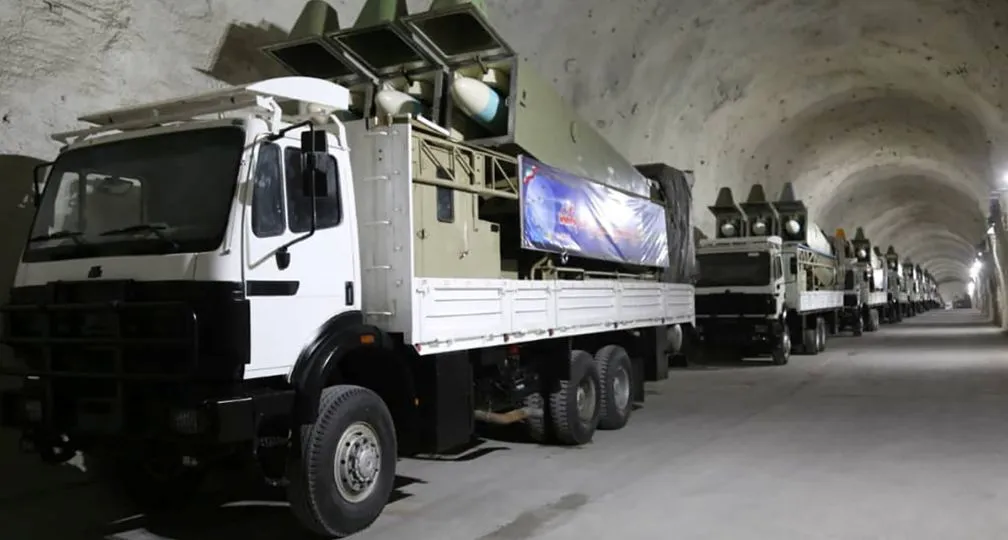
The second pillar was passive defense through underground facilities. Iran’s extensive tunnel network helped preserve its missile force by providing concealment and protection. As AI accelerates detection, analysis, and targeting, aboveground facilities are becoming increasingly vulnerable to precision strikes. Underground forces, by contrast, are far harder to find and destroy, reducing the attacker’s decision-making advantage. Despite sustained attacks, Iran reportedly retained around 70 percent of its missile arsenal, underscoring the effectiveness of underground concealment.
The value of tunnels extends beyond simple survivability. U.S. strikes that collapsed tunnel entrances temporarily prevented missile launchers from reaching firing positions, but disabling a launcher is not the same as destroying it. If tunnel entrances can be repaired and buried launchers recovered, combat power can be restored quickly. Indeed, Iran reportedly began reopening tunnel entrances and recovering long range strike capabilities once U.S. strikes subsided. This imposed an asymmetric burden on the attacker: even previously struck sites had to be monitored and, if necessary, hit again. Furthermore, repairing tunnel entrances is often cheaper than conducting repeated surveillance and precision strikes, the defender can impose disproportionate costs over time.
Lessons for Japan
For Japan, the broader lesson is that missile forces must be built for resilience. Given China’s geographic proximity, Japan could face strikes on a far greater scale than Iran did. Command-and-control nodes, bases, missile units, and supporting infrastructure must be able to continue operating under sustained attack. A force that can absorb an initial strike and keep fighting would strengthen deterrence by reducing the incentives for a first strike.
That said, Iran’s Mosaic Defense Doctrine cannot be imported directly into Japan’s defense system. Japan places strong emphasis on civilian control, and granting highly autonomous attack authority to subordinate units would sit uneasily with Japan’s defense principles. Operationally, Japan’s most important strike missions, such as anti-ship missile operations, require timing and synchronization across multiple units under higher command. Moreover, striking mobile surface vessels require continuous targeting information from satellites, unmanned systems, and other sensors. It would not be realistic for Japanese missile units to attack independently based only on pre-planned target sets.
The command-and-control lesson Japan should draw is therefore not autonomy, but resilience adapted to Japan’s institutions. Japan should strengthen procedures for maintaining command continuity if a higher headquarters is destroyed or disabled. Command post exercises should test whether subordinate units can be flexibly reassigned to other higher headquarters during joint anti-ship operations. Japan should also consider dispersing political decision-makers before a crisis to ensure that political authority and decision-making functions remain resilient under attack.
The lesson most directly applicable to Japan is the value of tunnels and other forms of passive defense. As China’s precision-strike capabilities and missile arsenal expand at an unprecedented pace, Japanese bases, missile units, and critical infrastructure will become increasingly vulnerable. Moving key assets into complex underground tunnel networks would significantly enhance their survivability, but protection alone is not enough. Japan must also be able to rapidly recover buried launchers and restore access to launch positions after an attack. Doing so would force China into the same costly cycle Iran imposed on the United States: continuous surveillance, repeated battle damage assessment, and restrikes against facilities that can quickly return to operation.
Iran’s approach was not designed to defeat a superior adversary outright, but to deny it a quick victory. Its logic was simple: preserve combat power, recover quickly from disruption, and continue imposing costs. As Japan revises its strategic documents, it should look beyond the offensive, AI-enabled operations of the United States and draw lessons from Iran’s experience as a defender. Doing so would help Japan develop a defense strategy better suited to its own geography and security environment.
(Photo Credit :IRGC/WANA [West Asia News Agency]/Reuters/Aflo)
Geoeconomic Briefing
Geoeconomic Briefing is a series featuring researchers at the IOG focused on Japan’s challenges in that field. It also provides analyses of the state of the world and trade risks, as well as technological and industrial structures (Editor-in-chief: Dr. Kazuto Suzuki, Director, Institute of Geoeconomics (IOG); Professor, The University of Tokyo).
Disclaimer: The opinions expressed in this Geoeconomic Briefing do not necessarily reflect those of the International House of Japan, the Institute of Geoeconomics (IOG) or any other organizations to which the author belongs.

Research Fellow
Rintaro Inoue is a Research Fellow at the Institute of Geoeconomics, International House of Japan, and a PhD student at Keio University. His research focuses on alliance network in the Indo-Pacific and strategic studies. He holds a B.A. and M.A. in Law from Keio University.
View Profile-
 Trump Faces a Reckoning in the Midterms, but it Might Not Matter for Tariffs2026.10.09
 -
 BRICS in India2026.10.09
 - Can Japan build a defense-startup ecosystem?2026.10.07
- Economic security in health and medicine through strategic alignment2026.10.06
-
 Inside Japan’s New Growth Strategy: The Economic Security Implications2026.10.01