
Merz’s China Policy: Adjustment Under Constraint – From De-Risking Rhetoric to Managed Engagement
By Aya Adachi, Associate fellow in DGAP’s Center for Geopolitics, Geoeconomics, and Technology
Kikyo Taguchi, Research Assistant at the Institute of Geoeconomics
As 2026 gets underway, Germany is reassessing its China policy in response to a worsening security environment and mounting economic pressures. Russia’s war on Ukraine continues to absorb Berlin’s attention, while heightened U.S. strategic demands – from pressure over Greenland to the release of a new National Defense Strategy – have further narrowed Germany’s room for maneuver. Against this backdrop, China has kept a lower profile, yet it continues to shape the strategic environment confronting key U.S. allies.
For Germany, these overlapping pressures are complicating efforts to advance more ambitious measures to de-risk from China, in both the security and economic security domains. How Berlin responds carries implications not only for Europe, but also for partners such as Japan, which share concerns over China’s growing leverage and the need for coordination among middle powers.
In this unsettled international environment, this commentary examines the China policy of the Merz government, which took office in May 2025, and analyzes recent changes and the current state of Germany’s policy toward China. By examining relevant domestic policies—such as the appointment of the foreign minister and the establishment of the National Security Council—as well as the significance of the visit to China and the messages conveyed to the international community during that visit, this paper explores the current administration’s stance toward China from multiple perspectives and offers implications for Japan regarding future Japan-Germany and Japan-EU cooperation.
Why Germany’s China Policy Matters for Japan
Germany’s China policy matters for Japan because Berlin occupies a pivotal position in Europe’s strategic and economic engagement with China. As China adopts a more assertive posture and increasingly uses economic and technological leverage, Germany’s choices carry implications that extend beyond Europe.
From a security perspective, Germany has traditionally exercised restraint in adopting a hard line on China, prioritizing economic interests and diplomatic stability. Whether Berlin adjusts this posture will influence Europe’s approach to China-related risks, including those with consequences for the Indo-Pacific. For Japan, which faced sustained pressure from China in its immediate neighborhood, Germany’s willingness to factor security considerations more explicitly into its China policy is therefore of growing relevance.
Germany’s importance is even more pronounced in the economic domain. As the EU’s largest economy and central node in Europe’s trade and investment relationship with China, Germany plays a key role in de facto implementing and thereby shaping the EU’s approaches to de-risking, investment screening, critical infrastructure protection and technology exposure. Decisions taken in Berlin can either accelerate or constrain collective EU action and can nudge or discourage other member states from moving toward a tougher – or more permissive – line.
From Japan’s perspective, Germany functions as a European “swing state” on China policy. If Berlin moves decisively on de-risking, other European countries are more likely to follow, potentially shaping the EU’s broader geopolitical posture. Conversely, hesitation in Germany would make deeper Japan-EU coordination more difficult.
Japan’s own approach to China evolved much earlier than that of European countries. Maritime incidents around the Senkaku Islands in the 2010s and Beijing’s subsequent restrictions on rare earth exports, accelerated Japan’s recognition of China as both a security and economic challenge. Against this backdrop, Germany’s long-standing emphasis on engagement – particularly under the approach of the Merkel government – stood in contrast to Japan’s growing focus on economic security. Germany’s evolving China policy under successive governments thus warrants close attention from Japan.
Germany’s Shifting Perception of China: From Economic Partner to Systemic Rival
For much of the past two decades, Germany’s approach to China was shaped by the assumption that deepening economic engagement would moderate Beijing’s behavior. Under the Merkel government, this logic – often summarized as Wandel durch Handel (“change through trade”) – prioritized market access, export growth, and investment opportunities, while downplaying strategic and security risks. China was viewed primarily as an indispensable economic partner rather than a source of systemic vulnerability.
This perception only began to shift around 2019, towards the end of the Merkel administration, driven by growing concerns over supply-chain dependencies, Beijing’s use of economic coercion and China’s increasingly assertive foreign and security policy. This reassessment was formalized in the China strategy released in the summer of 2023 under the Scholz government, which defined China as a “partner, competitor, and systemic rival,” and emphasized “de-risking, not decoupling”, signaling a move away from earlier assumptions that economic interdependence alone could ensure stability.
At the same time, Germany’s reassessment has remained cautious and incomplete. While awareness of risk has increased at the strategic level, German industry remains deeply invested in China, and concrete policy adjustments have proceeded unevenly. As a result, Germany has moved closer to Japan’s economic security mindset in principle, but gaps persist between strategic diagnosis and policy implementation.
China Policy under the Merz Government: Continuity and Adjustment
Since taking office in May 2025, the Merz government has focused less on redefining Germany’s overall China framework than on adjusting how that framework is articulated and applied in practice. The administration has emphasized changes in diplomatic tone and signaling, particularly on security-related issues.
These adjustments have been most visible in foreign policy messaging. The appointment of Johann Wadephul – who had long served as deputy parliamentary group leader for foreign and defense affairs in the CDU/CSU faction of the Bundestag and is known for his pragmatic diplomatic approach – reflected this shift. His public remarks in Asia on China’s growing military assertiveness further indicated a greater willingness to address security concerns more directly in Germany’s China diplomacy.
At the same time, the limits of this approach have quickly become apparent. Wadephul had planned to visit China in October, but the trip was postponed shortly before his scheduled departure. According to the German Foreign Office, it proved impossible to arrange a sufficiently substantive diplomatic program beyond a meeting with Foreign Minister Wang Yi. While the precise circumstances surrounding the postponement of the visit have not been made public, it is highly likely that Wadephul’s statements in Asia played a role. The episode underscored the sensitivity of China-related diplomacy and the difficulty of sustaining a firmer tone while maintaining functional engagement with Beijing.
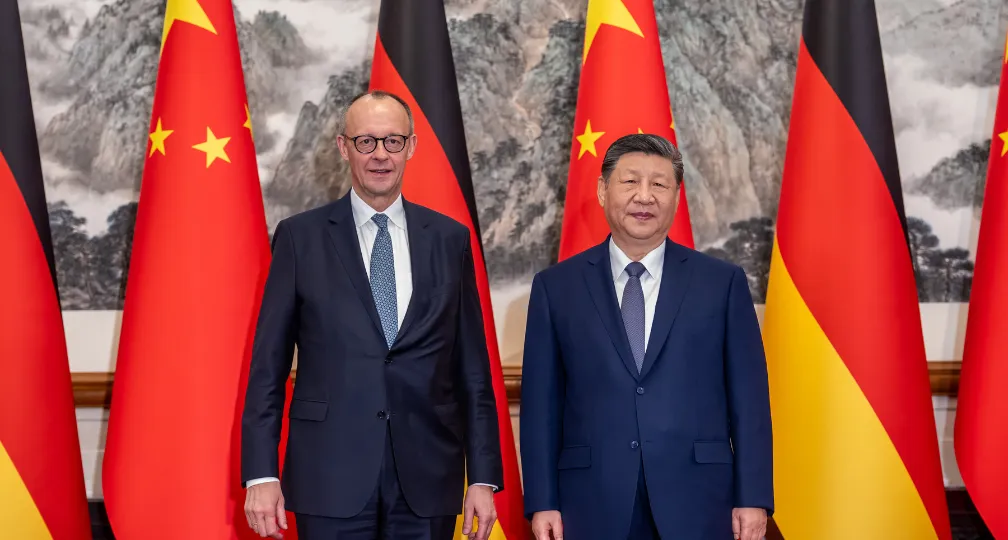
Foreign Minister Wadephul’s visit to China was ultimately rescheduled and took place three weeks after the German-Chinese Financial Dialogue. While the proceeded, its diplomatic impact appeared limited: Wadephul spent two days visiting Chinese companies, and the initial postponement had already weakened momentum for what was originally conceived as a preparatory step toward a potential visit by Chancellor Merz. The late-February trip to Beijing marked the first concrete test of how the new government would balance security signaling with high-level diplomatic engagement.
In the run-up to the visit, the Chancellor’s Office outlined five guiding principles for Germany’s China policy: strengthening Germany’s competitiveness as the foundation of a prudent China strategy; advancing a policy of de-risking; insisting on fair and transparent competition; acknowledging China’s status as a major power; and embedding policy firmly within a European framework. The visit was also framed as an opportunity to address Russia’s war against Ukraine, with Berlin signaling that Beijing’s influence in Moscow made China a relevant actor in any future diplomatic process. Taken together, these guidelines suggested an effort to combine firmer strategic language with continued engagement.
In practice, however, the diplomatic outcome appeared more restrained. Public messaging during the visit placed stronger emphasis on economic cooperation and stability, while references to Ukraine noticeably softened – shifting from “Russia’s war against Ukraine” in Merz’s statement to the more neutral “Ukraine question” in the joint communiqué. Familiar strings of formulaic references – including mentions of the One China policy and the UN Charter – rendered the statement conventional and diplomatically cautious in tone. The outcome underscored that Germany’s recalibration remains incremental: rhetorical emphasis on de-risking has not yet translated into far-reaching economic or strategic adjustments.
Competing Channels: Security Signaling and Economic Diplomacy
The dynamics visible during the Chancellor’s visit reflect a broader structural feature of Germany’s China policy: security-oriented signaling coexists with sustained economic diplomacy. While Berlin has sharpened its language on strategic competition and de-risking, it has simultaneously sought to stabilize economic ties and preserve channels of high-level engagement. This dual-track approach reflects Germany’s enduring exposure to the Chinese market and growing concern over vulnerabilities in critical supply chains, particularly in sectors affected by export controls. For example, debates over Chinese export controls on rare earth elements, as well as the fallout around the Nexperia case, have raised concerns in Germany over weaponization of economic interdependence. This series of developments has underscored the tension between safeguarding economic security and maintaining economic openness.
Following the postponement of the foreign minister’s visit, Berlin moved to re-engage Beijing through financial channels. In November, Finance Minister and Vice Chancellor Lars Klingbeil led a ministerial-level visit, marking the first cabinet-level visit of the Merz administration. Unlike Merz and Wadephul, Klingbeil is a Social Democratic politician known for a more accommodating stance toward China, who participated in the China-Germany High-Level Financial Dialogue alongside senior officials from the Bundesbank and the Federal Financial Supervisory Authority (BaFin), and held talks with his counterparts, including Vice Premier He Lifeng. The emphasis on financial and economic dialogue likely stemmed from the view that it would be more effective for Klingbeil of the SPD—who traditionally takes a pro-China stance—to seek avenues for dialogue in the financial sectors, where both sides are more likely to find common ground, rather than having Wadephul—a CDU politician who is not averse to taking a hard line toward China—discuss foreign and security policy.
Taken together, Germany’s parallel pursuit of security signaling and economic diplomacy helps explain the cautious pace of its China policy recalibration. While awareness of strategic risk has increased, concrete steps to reduce exposure have remained selective and incremental, shaped by concerns over economic stability and political feasibility. Rather than reflecting inconsistency, this dual-track approach underscores how de-risking in the German context has thus far proceeded as a process of risk management within existing interdependence, not a decisive break from it.
Institutional Change: The National Security Council and Policy Coordination
An important development shaping Germany’s security and approach to China under the Merz administration, is the establishment of a National Security Council. While Germany has long relied on the cabinet-level Federal Security Council (Bundessicherheitsrat, BSR), to deliberate national security policy – particularly defense, disarmament, and arms control – the new body is intended to strengthen strategic coordination across foreign, economic and security policy.
Plans to upgrade the BSR into a more comprehensive National Security Council had stalled under the previous Scholz administration, reflecting disagreements between the Chancellor’s Office and the Foreign Ministry over authority and scope. The Merz administration revived this initiative, explicitly committing in its coalition agreement to elevate the BSR into a National Security Council. In August the cabinet formally approved the establishment of the new body and its first meeting was held in early November, with an initial focus on countering hybrid threats.
For China the significance of this institutional change lies less in its formal mandate than in its potential to improve coherence. A centralized security body could help bridge longstanding gaps between economic policy, foreign diplomacy, and security planning – particularly on issues such as economic security, technology exposure, and responses to coercive practices.
Strategic Space and Opportunities
Despite these constraints, the Merz government retains limited strategic space in shaping Germany’s China policy. Having been in office for less than a year, the administration is not yet locked into a fixed trajectory. Yet the Chancellor’s February visit to Beijing underscored how narrow this room for maneuver remains when strategic signaling meets diplomatic and economic realities.
Germany’s remaining flexibility is therefore likely to be exercised through incremental adjustments and coordination rather than unilateral moves. At the same time, the fiscal and political priority attached to defense modernization and alliance commitments in response to broader geopolitical turbulence – including Russia’s war against Ukraine and shifts in transatlantic relations – absorbs much of Berlin’s strategic attention, limiting the scope for more ambitious economic security initiatives. Close alignment with European Commission leadership consequently offers one important avenue for action particularly as the EU continues to advance initiatives on economic security, trade diversification, and risk management.
In this context, timing becomes critical: delayed action risks locking in dependencies, while premature moves could impose economic costs without sufficient European backing. The challenge for Berlin lies in identifying moments when limited adjustments can be aligned with broader EU processes, allowing Germany to reduce exposure gradually without overextending political or economic capital.
Implications for Japan: Cooperation, Timing and Strategic Alignment
For Japan, Germany’s evolving approach to China carries strategic significance, but expectations of rapid convergence would be misplaced. Berlin’s recalibration has proceeded cautiously, shaped by economic exposure, defense priorities, and EU-level coordination. A more security-conscious German stance – particularly on de-risking, technology exposure, and economic coercion – could expand scope for practical cooperation, but such alignment is likely to emerge incrementally rather than through abrupt policy shifts.
Opportunities for cooperation extend beyond bilateral ties. Germany’s position within the EU means that alignment with Berlin can facilitate deeper Japan-EU coordination on economic security, supply chain resilience, and regulatory approaches. Such coordination would also reinforce shared positions within the G7, where Japan and Germany play complementary roles in bridging Indo-Pacific and European perspectives. Progress with France on economic security could also reinforce EU-level momentum, influencing the strategic environment in which Germany calibrates its China policy.
Crucially, for Japan the key issue is not only whether Germany moves toward deeper de-risking, but when and how it does so. Early, well-coordinated steps by Berlin would lower the political and economic costs of alignment, while delayed or ambiguous moves would narrow Japan’s strategic options.
Alignment in a Shifting Strategic Environment
Recent international developments have reinforced the temptation to focus narrowly on Washington’s actions. Yet behind this intense attention, China and Russia have continued to advance strategies that challenge the security and economic interests of advanced economies. In this environment, coordination among other major actors becomes more, not less, important. If Chancellor Merz’s first visit to Japan—reportedly under coordination—materializes this autumn, it would be a rare opportunity to advance Japan-Germany cooperation.
For Japan and Germany, alignment does not require identical policies but practical coordination — on timing, sequencing, and risk management — across bilateral, EU, and G7 frameworks. How Germany navigates its China policy under the Merz government will therefore matter not only for Europe, but also for Japan’s strategic environment. For Tokyo, close attention to Berlin’s choices – and proactive engagement when opportunities arise – will be essential to shaping a more coherent and resilient response to China in the years ahead.
(Photo Credit: Pool/Getty Images AsiaPac)
Aya Adachi
Dr. Aya Adachi is an associate fellow in DGAP’s Center for Geopolitics, Geoeconomics, and Technology. She specializes in economic security, geoeconomics, and de-risking strategies. Her work focuses on analyzing the foreign economic policies of the EU, Germany, China, and Japan, with particular emphasis on their engagement with the Indo-Pacific and the Global South.
Adachi was a fellow at the Bundeskanzler-Helmut-Schmidt-Stiftung. Before that, she worked at the Mercator Institute for China Studies (MERICS) and regularly served the German Agency for International Cooperation (GIZ) as an external consultant for regional economic cooperation.
Adachi completed her PhD at Ruhr University Bochum. During her doctoral studies, she was a visiting scholar in Tokyo at Waseda University and the German Institute for Japanese Studies (Max Weber Foundation) and in Suzhou (China) at Xi’an Jiaotong-Liverpool University. Previously, she studied international relations, economics, and East Asian politics, as well as Mandarin Chinese, at the University of Groningen, Ruhr University Bochum, and Zhejiang University of Technology.

Research Assistant
Kikyo Taguchi assumed her current position in July 2025, after serving as a Researcher/Advisor in the Political Section at the Embassy of Japan in Germany and as Project Manager for the Japan Program at the Konrad Adenauer Foundation’s Japan Office. She holds an MA from Keio University’s Graduate School of Law (Political Science) and an MA from the Friedrich Schiller University of Jena in Germany (History and Political Science), and is currently pursuing a PhD in Political Science at Keio University. Her research focuses on German foreign and security policy and German politics.
View Profile-
 India's Indo-Pacific Pivot2026.08.07
 - Merz’s China Policy: Adjustment Under Constraint – From De-Risking Rhetoric to Managed Engagement2026.08.07
-
 What Ukraine and Iran Teach Us About Deterrence2026.08.03
 - USMCA Renewal Is a Pothole, Not a Cliff – Right?2026.07.30
-
 Trump’s new world order and what it means for Japan2026.07.30

 Why Pax Silica Is About More Than AI Chips2026.07.15
 Japan and India: Historic Strategic Convergence2026.07.07
- China’s Rare Earth Export Controls: “International Rules” Orientation and the Avant-Garde Use of Security Exceptions2026.07.03
- USMCA Renewal Is a Pothole, Not a Cliff – Right?2026.07.30
- Sovereign AI After Fugu: From Vertical Dominance to Horizontal Resilience2026.06.24