
Order from Chaos: Introducing the Geoeconomic Connectivity Index
The latest regulatory developments on economic security & geoeconomics
By Paul Nadeau, Visiting Research Fellow, Institute of Geoeconomics (IOG)
Strait of Hormuz Update: As of Sunday, May 24, the seven-day moving average of ships passing through the Strait of Hormuz is 6 according to the International Monetary Fund’s Portwatch, consisting of tankers and dry bulk ships. The seven-day moving average at this time last year was 111.
Limited Outcomes from Trump-Xi Summit: U.S. President Donald Trump’s summit with China’s Xi Jinping in Beijing concluded on May 15. According to a fact sheet issued by the White House on May 17, China agreed to purchase $17 billion annually in agricultural products through 2028, on top of purchase agreements previously reached in Busan, South Korea in October 2025. Also according to the fact sheet, China agreed to resume poultry imports from U.S. states deemed free of avian influenza by the U.S. Department of Agriculture, and China renewed expired registrations for more than 400 U.S. beef facilities, added new listings, and will work with U.S. regulators to lift suspensions on remaining facilities. China also committed to purchase 200 Boeing aircraft. Export controls were not discussed during the meeting.
India Floats Revising Agreement with U.S.: On May 15, Indian Commerce Minister Piyush Goyal suggested that his country would reconsider its trade deal with the United States in light of the U.S. Supreme Court’s decision to dismiss the “reciprocal” tariffs the Trump administration imposed in April 2025. India and the United States agreed on a framework in February 2026 under which the United States would apply a tariff rate of 18 percent under the now-discarded International Economic Emergency Powers Act (IEEPA), while India would purchase $500 billion in U.S. energy and other products over the next five years. Following the Supreme Court’s February decision, the United States applies a 10 percent tariff on India under Section 122 of the Trade Act of 1974.
U.S. State Department Adds Cuba Sanctions: On May 18, the U.S. Department of State designated 11 Cuban regime-aligned elites associated with the country’s security apparatus, as well as Cuba’s Ministry of the Interior, the Directorate of Intelligence, and the National Revolutionary Police Force.
U.S. Treasury Department Sanctions Gaza Flotilla: On May 19, the U.S. Treasury Department’s Office of Foreign Assets Control (OFAC) sanctioned four individuals associated with a flotilla, the Popular Conference for Palestinians Abroad (PCPA), for attempting to access Gaza in support of Hamas, as well as key actors operating within Hamas-aligned Muslim Brotherhood networks.
U.S. Treasury Department Sanctions Mexican Cartel: On May 20, the U.S. Treasury Department’s Office of Foreign Assets Control (OFAC) sanctioned more than a dozen individuals and entities, comprising two distinct networks, involved in cryptocurrency-based money laundering and narcotics trafficking on behalf of the Sinaloa Cartel in Mexico.
U.S. Courts Debate Sanctions on UNHCR Rapporteur for Palestinian Territories: On May 21, the U.S. Treasury Department removed Francesca Albanese, UN Human Rights Council Special Rapporteur for the Israeli-occupied Palestinian territories, from its list of sanctioned individuals after a U.S. District Court judge found that U.S. sanctions against her violated her First Amendment protections to freedom of speech under the U.S. Constitution. She was returned to the list of sanctioned individuals on May 27 after the U.S. Court of Appeals for the District of Columbia Circuit issued an administrative stay on the District Court ruling, which allowed the Treasury Department to enforce sanctions against her while the case is being decided.
U.S. Treasury Department Sanctions Hezbollah-Aligned Officials in Lebanon: On May 21, the U.S. Treasury Department’s Office of Foreign Assets Control (OFAC) designated nine Hezbollah-aligned officials in Lebanon’s parliament, military, and security sectors for obstructing the peace process and impeding the disarmament of Hezbollah.
EU Extends Framework to Sanction Iran Over Hormuz Closure: On May 22, the European Council extended the European Union’s legal framework to allow the EU to sanction individuals and entities involved in Iran’s actions and policies in its closure of the Strait of Hormuz.
UK Sanctions Russia-Aligned Crypto Exchanges: On May 26, the United Kingdom’s Foreign, Commonwealth & Development Office announced sanctions targeting crypto exchanges and illicit finance networks exploited by Russia to circumvent existing restrictions.
EU Issues Sanctions on Israeli, Palestinian Entities: On May 28, the European Council expanded the scope of its restrictive measures regarding Hamas and the Palestinian Islamic Jihad to also target members of the Political Bureau of Hamas and listen ten individuals to that end. In a separate announcement that day, the Council adopted restrictive measures against four entities and three individuals responsible for serious and systematic human rights abuses against Palestinians in the West Bank.
Economic Fury Updates: The U.S. Treasury Department announced the following updates under the Economy Fury campaign of maximum economic pressure against Iran as part of wider U.S. efforts against the country:
・On May 19, the U.S. Treasury Department’s Office of Foreign Assets Control (OFAC) designated an Iranian foreign currency exchange house and its associated front companies that oversee transactions on behalf of sanctioned Iranian banks, as well as 19 vessels involved in Iranian petroleum and petrochemicals shipments to foreign customers.
・On May 27, OFAC sanctioned the Persian Gulf Strait Authority, the entity established by Iran’s Islamic Revolutionary Guard Corps (IRGC) to collect and process tolls levied on ships passing through the Strait of Hormuz.
・On May 28, OFAC sanctioned a network involved in Iran’s military oil sales, which enable the country to fund the rebuilding of its armed forces.
Analysis: Order from Chaos: Introducing the Geoeconomic Connectivity Index
There is no need to recapitulate the centrality of economic connectivity in modern geopolitics or the ways that crises may reverberate around the world. Each day gives a new example of those impacts, whether that might be the cost of children’s clothing in Maine or the shades of color on potato chip bags in Japan’s convenience stores. Governments have been building out their toolkits for economic statecraft and will continue to do so, probing for ways to exploit vulnerabilities and searching for ways to protect their own vulnerabilities. Private companies are doing the same amidst their search for revenue and innovations, while media and the public try to keep up with the changes. What’s needed at this point isn’t an awareness of global connectivity, but an ability to see their forest for the trees, understanding the bigger picture when granular details begin to overwhelm.
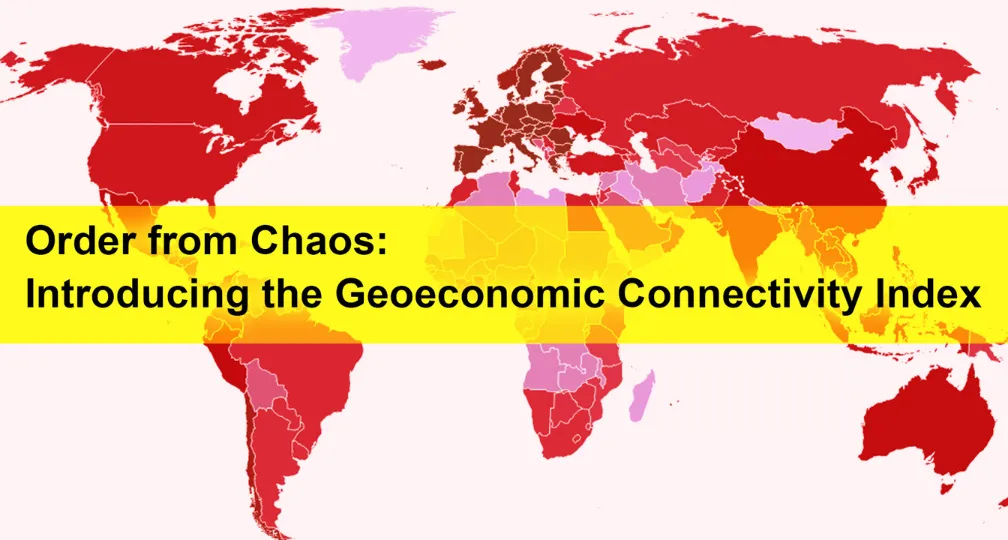
This is the motivation for the Global Connectivity Index (GCI) which was released recently on the IOG’s website and has been developed with the support of Letizia Suera, a research assistant at the IOG who collected data and developed the methodology, and Yusuke Ishikawa, research fellow and digital communications officer at the IOG who organized and arranged everything on the IOG’s website. Rather than just recording connections, the GCI measures the extent to which a country is economically linked and integrated into global markets, illustrating the key nodes in the global economy and demonstrating why those nodes are so central.
At this point, this connectivity is illustrated through a country’s trade activity and its structural embeddedness in global trade relationships, providing an overview of how structurally open, institutionally connected, and effectively accessible a country’s trade regime is. Common measures such as trade dependency focus on the scale of trade flows – for example, the share of exports or imports in GDP, and as a result primarily capture exposure to trade. By contrast, the GCI captures how trade relationships are structured, incorporating tariffs, institutional agreements, and trade intensity to reflect how market access is organized and mediated. In this way, it helps users better understand the structure of the global economy. Connectivity is not only a question of volume, but reflects how market access is structured, how open a trade regime is under multilateral rules, and how far access is mediated through institutional arrangements such as free trade agreements. To that end, the GCI disaggregates the different dimensions of connectivity by illustrating baseline tariff openness, realized trade integration, and institutionalized market access through FTAs and PTAs. In this way, the GCI can demonstrate the links between economic connectivity, the vulnerabilities that countries may have exposed themselves to through such connectivity, and the areas in which countries may be indispensable to global supply chains or the global economy more broadly.
The index brings together four components that capture both policy-based and outcome-based dimensions of trade connectivity: applied MFN tariffs, trade openness, each country’s number of active FTAs and PTAs, and the overall trend in each country’s tariff rate. Taken together, these indicators provide an overview of how structurally open, institutionally connected, and effectively accessible a country’s trade regime is. These component scores help clarify whether a country’s position is driven more by baseline trade openness, actual integration into global trade flows, institutionalized connectivity through agreements, or recent changes in tariff policy, while the strategic selectivity indicators provide an additional perspective by showing whether strategic sectors are protected at levels above or below the national average.
The goal is to help illustrate two key concepts that will be central to the GCI as we continue to build it out further: geoeconomic indispensability and strategic selectivity. Geoeconomic indispensability is the extent to which access to a country’s market is structurally valuable and difficult to substitute, based on how costly, policy-mediated, and institutionally conditioned that access is. This concept goes beyond understanding economic connectivity by illustrating how access to their markets may be increasingly mediated through agreements, institutions, or selective policy structures that make that access more valuable and harder to replace or even becoming a critical node in global economic relations.
Strategic selectivity is a concept that attempts to capture how trade policy is frequently selective in terms of which sectors or activities are singled out for greater trade protections, particularly those which may be considered economically or geopolitically strategic. Incorporating indicators based on tariff peaks and tariff deviations from national averages within predefined strategic sectors helps illustrate the extent to which countries concentrate trade restrictiveness in specific sectors, even when their overall trade connectivity may remain high. This concept is a component of many countries’ industrial policies, where otherwise open economies will designate certain industries or sectors as deserving of particular protections if deemed to be essential to national security or economic autonomy. The strategic selectivity section focuses on five broad sector groups: advanced digital technologies, critical raw materials, energy and climate technologies, health and biotechnology, and advanced industrial manufacturing. These sectors are treated as strategic because they share features such as systemic importance in value chains, low short-term substitutability, high entry barriers, supply concentration, and strong technological spillovers. Examples may include steel production in the United States, energy production in Europe, and critical minerals production in many countries.
While we’re excited to share our work to this point, the GCI remains a developing project to which we will add further information and additional measures to get as close as possible to a complete and continuously updating image of global economic connectivity. The next layers of the GCI are in progress and there will be more to come from there. We look forward to feedback and suggestions that could make this project more informative to users. For now, we will continue to develop the project in such a way that makes it easier to understand how the small details create the bigger picture and help provide order to the chaos of global connectivity.
Disclaimer: The views expressed in this IOG Economic Intelligence Report do not necessarily reflect
those of the API, the Institute of Geoeconomics (IOG) or any other organizations to which the author belongs.
IOG English Newsletter
Subscribe to the English IOG Newsletter to stay up to date on IOG’s activities across various briefings, op-eds, YouTube videos, podcasts, as well as new publications, events, research activities, and more.

Visiting Research Fellow
Paul Nadeau is an adjunct assistant professor at Temple University's Japan campus, co-founder & editor of Tokyo Review, and an adjunct fellow with the Scholl Chair in International Business at the Center for Strategic and International Studies (CSIS). He was previously a private secretary with the Japanese Diet and as a member of the foreign affairs and trade staff of Senator Olympia Snowe. He holds a B.A. from the George Washington University, an M.A. in law and diplomacy from the Fletcher School at Tufts University, and a PhD from the University of Tokyo's Graduate School of Public Policy. His research focuses on the intersection of domestic and international politics, with specific focuses on political partisanship and international trade policy. His commentary has appeared on BBC News, New York Times, Nikkei Asian Review, Japan Times, and more.
View Profile-
 Sustained Denial and Strategic Depth: Policy Recommendations for Japan’s Next Strategic Documents2026.07.21
 - As shared values shift, what's next for U.S.-Japan relations?2026.07.17
- Why Pax Silica Is About More Than AI Chips2026.07.15
- The Case for Underground Defense: Japan's Military Lessons from the Iran War2026.07.14
-
 Strategy Amidst Weaponized Economics2026.07.14
 Sovereign AI After Fugu: From Vertical Dominance to Horizontal Resilience2026.06.24
- European Industry and the “Second China Shock”2026.06.19
- China’s Rare Earth Export Controls: “International Rules” Orientation and the Avant-Garde Use of Security Exceptions2026.07.03
- Why Pax Silica Is About More Than AI Chips2026.07.15
- The Iran-U.S. MOU Offers a Reprieve, but Not Relief2026.07.02