
Sustained Denial and Strategic Depth: Policy Recommendations for Japan’s Next Strategic Documents
Looking ahead to the revision of the Three Strategic Documents, this report offers policy recommendations centered on two pillars: sustained denial, the defense capabilities Japan needs to withstand aggression, and strategic depth, which leverages the geographic breadth of Japan’s surrounding region.
Summary
The 2022 Three Strategic Documents marked a historic turning point in Japan’s defense policy, introducing counterstrike capabilities and a substantial increase in defense spending. Yet a significant gap remains between the documents’ appropriate but ambitious objectives and the concrete capabilities needed to achieve them. Those objectives include “disrupting and defeating invasion much earlier and at places further afield,” “ensuring asymmetric advantages,” and “operating in a swift as well as persistent manner.” To realize them, Japan must further strengthen the posture of the Japan Self-Defense Forces (JSDF), develop the doctrine needed to support that posture, reinforce its social and industrial foundations, and improve its defense equipment research and development system.
These challenges have been compounded by major changes in Japan’s strategic environment since the 2022 documents were formulated. Under these conditions, regional stability and Japan’s security cannot be ensured simply by extending existing concepts of deterrence and capability development. In particular, Japan now faces both growing military threats from revisionist states such as China and increasing uncertainty about the role of the United States. Japan must therefore strengthen the autonomy of its own defense capabilities so that it can better repel aggression, improve its own response capacity, and encourage sustained U.S. involvement.
Based on this understanding of the problem, this report examines the policymaking process behind the current Three Strategic Documents, drawing on interviews with officials involved at the time. It then proposes strategies and policies to address both the challenges revealed through that process and the subsequent changes in Japan’s strategic environment. At the center of the report is the need to build an asymmetric, sustainable, denial-oriented defense capability that can continue operating under enemy threat. This capability would combine long-range missiles, efficient air defense, unmanned systems, distributed forces, and various forms of passive defense. It would also make use of Japan’s complex geography, including islands, underground tunnels, and the underwater domain. Together, these elements would create a temporal buffer that enables Japan to resist aggression, attrit an enemy’s invasion forces, and help trigger U.S. involvement. The report also argues that standoff airpower, operated with allies from overseas bases that provide strategic depth, should play a key role in facilitating U.S. involvement. Its survivability and maneuverability would also help Japan seize the initiative in defense operations. Finally, these concepts must not remain theoretical. Japan needs to strengthen the resilience and sustainability of its defense industrial base and critical infrastructure, establish secure sea lines of communication (SLOC) with the support of allies and like-minded countries, and build a research and development foundation capable of supporting and accelerating new ways of warfare using drones and AI.
To translate these concepts into practice, this report presents the following 20 policy recommendations.
A Trigger Strategy and Sustained Denial Strategy to Strengthen Extended Deterrence
1. As an overarching strategy, Japan should shift from high-value, concentrated defense capabilities toward distributed and asymmetric capabilities that can provide an advantage in long-term strategic competition. To this end, Japan should redesign the JSDF’s force structure so that it can contribute to the cumulative attrition of an enemy over time, achieve sustained denial, and help induce U.S. involvement within the framework of the Japan-U.S. alliance.
2.To strengthen the credibility of extended deterrence, Japan should make greater use of strategic depth to improve the survivability of its defense capabilities and the sustainability and initiative of its operations. To this end, Japan must establish mechanisms through which the JSDF’s initial response to an armed attack can smoothly trigger U.S. involvement. Specifically, Japan should develop overseas operational bases for JSDF transport aircraft and other platforms capable of carrying large numbers of low-cost, long-range missiles. These “long-range multipurpose weapon carriers” should be operated in wartime as part of an “Allied Depth Task Force,” integrated with U.S. forces and other partners. Japan should also conduct regular rotational deployments and joint training to make this concept operational.
3.These rotational deployments and joint training activities should be designed in a distributed manner. They should be centered on the Japan-U.S. alliance and make use of bases in the United States, while also including deployments to Australia, the Philippines, and other countries. Japan should also hold regular consultations with allies on wartime role-sharing, conditions for transitioning to operations, and doctrine, and should institutionalize these arrangements. At the same time, Japan should promote the creation of a real-time integrated ISR network, the constant sharing of a common operational picture, and the standardization of data links. This process of institutionalization should also be communicated externally as a strategic message.
4.As a core element of a sustained denial strategy, the defense of Japan’s Southwest Islands should focus on the limited operational objective of area denial. On this basis, Japan should prioritize active and passive defense, resupply under contested conditions, and standoff fire support from distant locations, so that forces deployed to the Southwest Islands can continue operating under enemy threat.
5.To conduct sustained denial operations against an adversary with quantitative and qualitative superiority across multiple domains, Japan should make maximum use of asymmetric advantages. These include AI and unmanned systems, as well as Japan’s geographic characteristics: its islands, underground tunnels, the underwater domain, and strategic depth provided by the territories of allies and like-minded countries. In addition to peacetime preparations such as ammunition stockpiles, Japan should establish a system for rapidly modifying and upgrading equipment in response to changes in the character of warfare. To ensure that operations can continue even if some assets are destroyed, Japan should also field large numbers of relatively low-cost platforms that are mobile and easy to disperse, rather than relying on a small number of high-value assets.
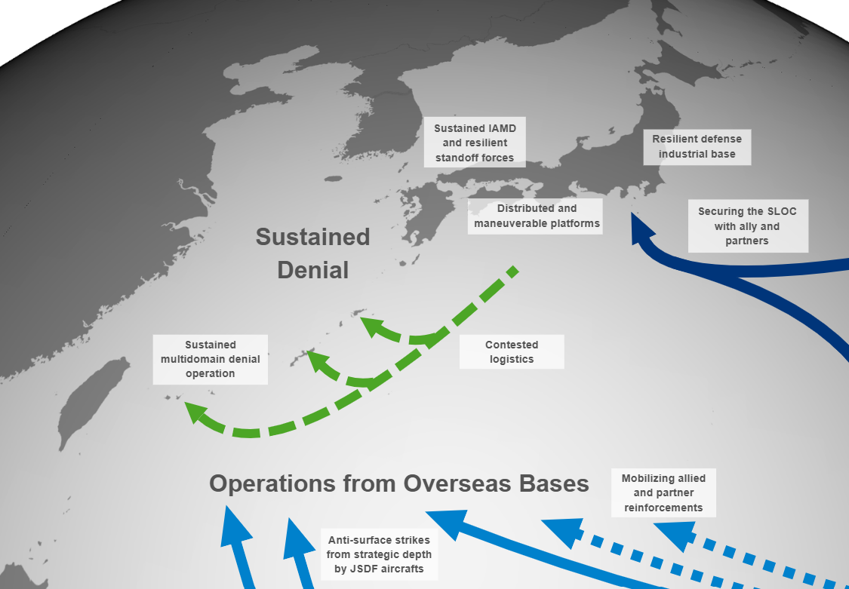
Figure 1: Conceptual image of a trigger strategy based on the two pillars of sustained denial and operations from overseas bases. Created by the author.
Redesigning JSDF Capabilities and Force Structure
6.To narrow the quantitative missile gap with China and acquire asymmetric advantages, Japan should substantially expand the Ground Self-Defense Force’s long-range missile units to the scale of multiple missile brigades. It should also strengthen their resilience by concealing and protecting these units within underground tunnel networks. Japan should also begin the domestic development of ballistic missiles to increase payload capacity. In addition, it should deploy anti-ship missile units and other forces along the second island chain and export ground-launched anti-ship missiles to the Philippines. These steps would strengthen the ability of Japan and its partners to restrict the passage of Chinese naval vessels through the Bashi Channel.
7.To accelerate the operationalization of drones, Japan should make them an indispensable element of the Japan Ground Self-Defense Force’s (JGSDF) combined-arms capabilities. This could be done by establishing specialized drone units, creating dedicated branches, or incorporating drones into the standard structure of existing units. To acquire asymmetric advantages at sea and underwater, Japan should also introduce large and small USVs and UUVs at an early stage and on a large scale. These systems should be assigned diverse roles, including strike, sensing, mine-laying, and counter-satellite disruption. In addition, Japan should consider developing unmanned systems capable of operating across both the underwater and air domains.
8.To use Japan’s limited defense capabilities and personnel more effectively, Japan should further reduce personnel requirements for manned submarines while also expanding the fleet size. It should also build a mesh-type, wide-area seabed sensor network to detect enemy underwater assets and begin developing underwater counter-drone systems capable of disabling the propulsion systems of enemy UUVs.
9.To direct personnel and budgets more effectively toward units with capabilities that will be needed in the future, Japan should make bold reductions to existing JGSDF divisions, brigades, and similar units. It should also substantially reduce general-purpose destroyer and fixed-wing patrol aircraft units that would have low survivability under China’s A2/AD threat, replacing them with unmanned systems and more survivable platforms such as Aegis-equipped vessels. For relatively new vessels such as Mogami-class frigates, Japan should consider developing modular variants with more specialized onboard functions, rather than equipping every ship in the same class with the same full range of capabilities.
10.To operate airpower by making use of terrain and strategic depth, Japan should reorganize the Japan Air Self-Defense Force’s (JASDF) capabilities into three concentric rings. The first ring should consist of a high-low mix air defense system that combines low-cost and expendable capabilities able to counter the enemy’s cost-imposition strategy. The second should consist of stealth airpower that can survive in contested areas and deliver effective strikes against the enemy, supported by space-based ISR capabilities. The third should consist of rotationally operated standoff defense capabilities based at overseas operational bases, including large transport aircraft and other platforms equipped with large numbers of palletized long-range missiles.
11.To preserve airpower against enemy attacks, Japan should strengthen passive defense measures. These should include expanding aircraft shelters, reinforcing runway repair units, dispersing aircraft through the expanded joint use of U.S. military air bases and civilian airports, and acquiring decoys on a large scale. Similarly, to improve the survivability of JGSDF missile units, Japan should also consider a limited revival of tunnel excavation units.
12.In the space domain, Japan should develop its ISR satellite constellation into a system that can provide effective targeting capabilities against moving maritime targets. To achieve this, the project should be led by JASDF, which has a clearer understanding of operational requirements. Japan should also substantially increase the number of satellites in the constellation and disperse its ground stations. The next defense communications satellite system should be designed to flexibly support the communications needs of the Ministry of Defense and the JSDF. This should be done by distributing communications satellites across multiple orbits, ensuring redundancy, and making greater use of commercial communications satellite capabilities. In addition, to disrupt an adversary’s ISR and communications capabilities in the space domain, Japan should establish a posture that enables small, mobile counter-satellite disruption systems to be deployed on land and at sea in large numbers and with high mobility.
13.To make effective use of AI in command and control, Japan should strengthen the headquarters functions of the Joint Operations Command and frontline units. At the same time, it should rationalize the organization and functions of intermediate headquarters and shift toward a more non-hierarchical, distributed command structure.
Foundations for War-Sustaining Production Capability
14.To prepare for a rapid surge in wartime demand and strengthen emergency production and rapid modification capabilities, Japanese companies should expand excess production capacity by capturing overseas demand during peacetime. The government should also move quickly to establish government-owned, contractor-operated facilities, especially for ammunition, missiles, and drones, which are likely to be consumed in large quantities during a conflict.
15.To ensure that defense equipment can continue to be produced and repaired even under attack, Japan should strengthen both passive and active defense measures for the defense industrial base and critical infrastructure. Passive measures should include dispersal, undergrounding, and hardening, while active measures should include designation as “important facilities” and the provision of point air defense. Japan should also strengthen the rapid recovery capabilities of key factories. The costs of these measures should be borne by the government.
16.To retain and secure personnel at defense companies and infrastructure facilities that would face a high risk of attack, Japan should first implement the protective measures described above. It should then establish appropriate systems for certain private-sector civilians and employees, drawing on the allowances, compensation, and social recognition provided to SDF personnel. Japan should also make active use of retired SDF personnel, who may be better prepared to work in wartime environments due to their professional background and organizational experience. The government should support the education and training needed for retired SDF personnel to transition into such companies.
17.For securing the SLOC, Japan should strengthen maritime domain awareness over wider areas in cooperation with allies and like-minded countries. It should also establish a system in which the government provides or reinsures the war-risk insurance needed for maritime transport. In addition, Japan should introduce the technologies and legal frameworks needed to enable unmanned navigation by civilian vessels in high-risk maritime areas.
18.To compensate for vulnerabilities in its defense industrial base, Japan should leverage the strategic depth of allies and like-minded countries to build systems for overseas production, maintenance, storage, and data backup.
Research and Development for Sustaining New Ways of Warfare
19.To promote the domestic development of drones by both existing defense companies and start-ups seeking to enter the market, Japan should establish airfields and test areas where companies can conduct drone flight testing. These should include maritime test areas. At the same time, Japan must ensure compatibility with civilian aviation safety and the commercial use of radio spectrum. Japan also needs a mechanism to rationalize regulations under the Civil Aeronautics Act and the Radio Act within these designated areas. In such cases, the Ministry of Defense should be able to grant testing permits to companies through the delegation of such authority by the Ministry of Land, Infrastructure, Transport and Tourism and the Ministry of Internal Affairs and Communications. Furthermore, Japan should consider providing opportunities for flight testing at sea through the operation of Japan Maritime Self-Defense Force (JMSDF) vessels or the chartering of civilian vessels. It could also rent military airfields and testing facilities in the territories of overseas allies and like-minded countries, such as Australia, and provide companies with testing opportunities there.
20.To create incentives for companies to produce inexpensive, low-margin drones while encouraging product improvement and innovation, the JSDF should procure drones in large quantities and use them as consumables in peacetime training and other activities. This would help generate continuous demand. Japan should also increase opportunities for JSDF operators, development divisions, and companies to work together. Such collaboration would allow them to rapidly advance development and improve capabilities based on lessons from testing and training. Furthermore, to encourage knowledge-intensive software development incorporating AI, companies should review salary levels for the highly skilled engineers needed for such work. Correspondingly, the Ministry of Defense should revise the way it calculates processing and design costs under its cost-estimation system for determining defense equipment prices.
Japan itself bears the primary responsibility for defending its own territory. By strengthening its ability to deny enemy aggression over a sustained period, Japan can make it far more difficult for an adversary to create a fait accompli. It can also increase the credibility of U.S. alliance commitments. Given Japan’s geographical position, stronger Japanese defense capabilities are also indispensable for regional stability. The formulation of the next Three Strategic Documents will therefore have far-reaching effects, and the policymaking process itself can contribute to deterrence. However, the effectiveness of that process will depend on Japan’s ability to implement policies that give concrete form to its intended defense strategy. Going forward, greater attention must be paid to the implementation phase of policy. The recommendations presented above have been designed with particular emphasis on concreteness and feasibility so that they can have a meaningful effect at precisely that stage.
(Photo by Sgt. Perla Alfaro, U.S. Army Pacific Public Affairs Office)
Authors
Group Head, International Security Order / Visiting Senior Research Fellow
Born in 1964, Kuniharu Kakihara graduated from the National Defense Academy and holds master’s degrees in Regional Studies from the University of Tsukuba and in National Security Strategy from the National Defense University in the United States. Additionally, he completed the Senior Executives in National and International Security Course at the John F. Kennedy School of Government at Harvard University. A retired Lieutenant General of the Japan Air Self-Defense Force (JASDF), Kakihara served in key leadership roles, including Commander of the Air Development and Test Command and Chief of Staff at the Air Defense Command. [Concurrent Positions] Principal Research Director, National Security Institute, Fujitsu Defense & National Security, Ltd
View ProfileSenior Research Fellow
Hirohito Ogi is a senior research fellow at the Institute of Geoeconomics (IOG) studying military strategy and Japan’s defense policy. Before joining the IOG, Mr. Ogi had been a career government official at the Ministry of Defense (MOD) and Ministry of Foreign Affairs (MOFA) for 16 years. From 2021 to 2022, he served as the Principal Deputy Director for the Strategic Intelligence Analysis Office, the Defense Intelligence Division at the MOD, where he led the MOD’s defense intelligence. From 2019 to 2021, he served as a Deputy Director of the Defense Planning and Programming Division at the MOD. His recent publications include "Military Innovation and Procurement Trade-Offs: Explaining Japan’s Drone Adoption," The Pacific Review, September 2026; "Japan’s Information Security and Defence Reforms: From Inner Circle to National Standardisation," The RUSI Journal 171, no. 1 (February 2026): 58-69 (co-authored); From Decline to Surge: The Defense Industry in the Era of Excess Demand (Institute of Geoeconomics, January 2026) (co-authored). He holds a Master’s degree in international affairs from the School of International and Public Affairs (SIPA), Columbia University, and a Bachelor’s degree in arts and sciences from the University of Tokyo.
View ProfileResearch Fellow
Rintaro Inoue is a Research Fellow at the Institute of Geoeconomics, International House of Japan, and a PhD student at Keio University. His research focuses on alliance network in the Indo-Pacific and strategic studies. He holds a B.A. and M.A. in Law from Keio University.
View ProfileSenior Research Fellow
Kota Umeda is a senior research fellow at the Institute of Geoeconomics at the International House of Japan. Since 2026, he has also served as an adjunct lecturer at Keio University, where he teaches space policy. From 2015 to 2025, he worked at the Japan Aerospace Exploration Agency (JAXA), where he focused on researching U.S. space policy, coordinating with other space agencies, and developing JAXA's cybersecurity policy and incident response strategies. From 2019 to 2022, Mr. Umeda served as JAXA's liaison officer in Washington, D.C., collaborating with the U.S. government, industry leaders, and various stakeholders to promote Japan-U.S. space cooperation. Prior to his career in the space sector, Mr. Umeda spent five years at the Japan Ministry of Defense, where he researched military activities surrounding Japan and contributed to the formulation of arms control and disarmament policies. He holds a Master of Laws from Kyoto University and a Bachelor's degree in Policy Studies from Kwansei Gakuin University.
View ProfileVisiting Research Fellow
Yuki Goto is a Visiting Research Fellow at the Institute of Geoeconomics. He has led the intelligence of external affairs at Japan Petroleum Exploration, Co., Ltd. His research focuses on security risks associated with the maritime transportation of energy resources. He holds a Bachelor of Arts in Policy Management from Keio University. He completed the Senior Executives in National and International Security program at Harvard Kennedy School in December 2025. He has held his current position since October 2025.
View Profile-
 Connecting Europe and the Indo-Pacific: Why Japan and Germany Need Stronger Space Security Cooperation2026.10.20
 - China’s Calculus Behind the State Visit to the U.S.: Different Visions of “Stability”2026.10.16
- Trump Faces a Reckoning in the Midterms, but it Might Not Matter for Tariffs2026.10.09
-
 BRICS in India2026.10.09
 - Can Japan build a defense-startup ecosystem?2026.10.07