
Japan and India: Historic Strategic Convergence
This report examines the longer-term implications of Japan-India collaboration, the wave of hyperscaler investment into India, and the macroeconomic backdrop.
The 16th India-Japan Annual Summit
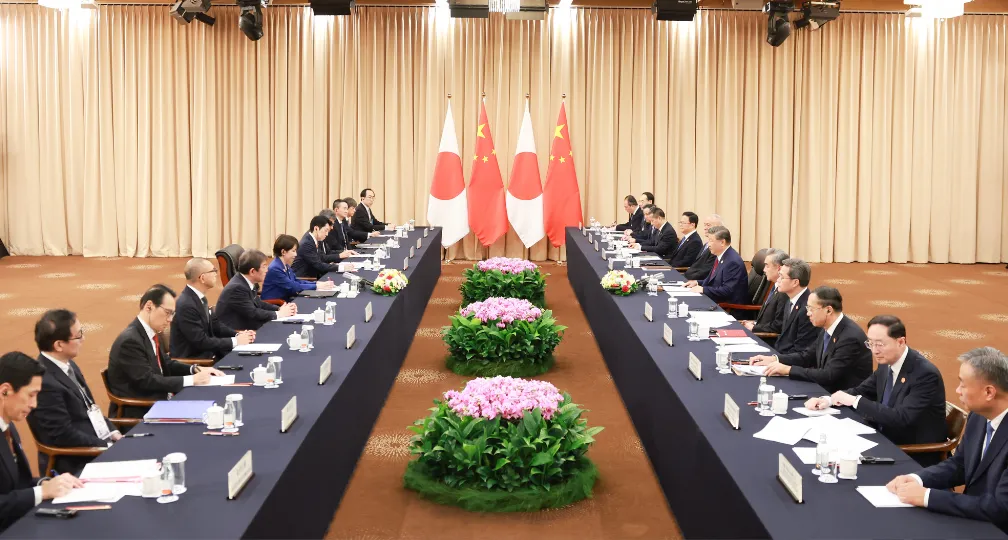
Prime Minister Takaichi arrived in New Delhi accompanied by a large delegation of senior officials and corporate leaders (signalling the visit’s commercial intent). The summit was hailed for “strategic convergence and trust,” and enshrined the bilateral cooperation around three pillars: defence and security; economic partnership (including economic security, energy and technology); and people-to-people exchange. They designated 2027 as the “Year of Shared Horizons” marking seventy-five years of diplomatic relations.
Backdrop: Prime Minister Takaichi’s government is seeking reliable partners at a moment when the United States under the current administration has grown less predictable on trade and alliance questions, and when China has become more assertive in the maritime periphery. India, with a large and growing domestic market, a widening manufacturing base and supportive industrial policy, is the natural partner for building national resilience.
Tokyo and New Delhi now regard economic strength, industrial resilience and tech capability as inseparable part of national security and have begun to build institutions reflecting this view.
Economic security and supply-chain resilience
Centrepiece: India-Japan Joint Declaration on Economic Security Cooperation recorded grave concern over economic coercion, non-market practices and arbitrary export restrictions, particularly in critical minerals, and stressed the importance of diversified and reliable supply chains and the need to “avoid reliance on any one country.” The declaration commits the two sides to project-based collaboration in semiconductors, critical minerals, information and communication technology, clean energy and pharmaceuticals, and to ease high-technology trade between them while tightening it against less trusted destinations. For manufacturers dependent on Chinese inputs for rare earths, batteries and electronic components, this establishes a bilateral channel through which alternative sourcing and co-investment can be organised with government support.
Mechanism: The two governments will use the fast-track mechanism under the India-Japan Industrial Competitiveness Partnership (IJICP) to smooth approvals for incoming Japanese investment. They also agreed to accelerate a review of the 15 year-old Comprehensive Economic Partnership Agreement (CEPA) so that it better reflects current trade. An India-Japan SME Forum was inaugurated (in 2025) to connect Japanese SMEs with India’s tier-two and tier-three supplier ecosystem, an important detail given that the resilience of any relocated supply chain depends on the depth of local component suppliers.
Investment scale and financial plumbing
The leaders reviewed progress toward the ¥10 trillion private investment target (set at the previous summit), and Indian officials reported that roughly 120 new business agreements concluded over the past year would channel more than $10 billion of Japanese investment into the country, with fresh commitments from around 150 firms. The more structurally interesting outcome concerns financial infrastructure. The two sides reaffirmed the importance of local-currency settlement and cooperation on payment systems, with officials targeting a memorandum between Japan’s finance ministry and the Reserve Bank of India that would allow direct rupee-yen settlement of bilateral transactions. If implemented, it would reduce exposure to dollar funding costs and exchange volatility for trade between the two countries. Japan also secured facilitation for its banks and financial institutions to expand their presence in India’s banking and non-banking sectors.
Defence and energy
The summit launched the first India-Japan defence co-development project and reached agreement in principle on the remaining technical details of the Unified Complex Radio Antenna, known as UNICORN, a naval mast system, to be pursued under the Make in India framework. Ministers will hold a fourth two-plus-two meeting in Tokyo by year-end, and the two navies agreed to deepen maritime domain awareness, exercises and maintenance and overhaul cooperation. Prime Minister Modi welcomed Japan’s ongoing review of its three principles on defence equipment transfer, which, if liberalised, would widen the field for joint programmes and for Japanese defence suppliers.
Both nations, as major energy importers, agreed to cooperate on strategic petroleum reserves, green ammonia (notably a flagship JV in Odisha between ACME group and IHI), green hydrogen and the maritime energy transport chain. Japan affirmed support for India’s membership of the International Energy Agency. A cooperative biogas initiative will support India’s goal of one thousand biogas and organic-fertiliser plants, pairing Japanese green technology with India’s rural dairy cooperative network.
Technology, mobility and high-speed rail
The Joint Statement on Artificial Intelligence launched an India-Japan AI Strategic Dialogue and committed both sides to a trusted and resilient AI supply chain, aligned with the Hiroshima AI Process. The two governments also signed a letter of intent on quantum technologies and noted continued progress on the LUPEX lunar mission between their space agencies. For industrial firms, the most tangible tech outcome was the Memorandum of Cooperation on a Next-Generation Mobility Partnership. Japan reaffirmed full support for commencing operations on the priority section of the Mumbai-Ahmedabad High-Speed Rail in 2027, endorsed introduction of the next-generation E10 Shinkansen, and joined India’s vision of a 7,000 kilometre national high-speed rail network. Prime Minister Modi explicitly invited Japanese companies to participate in future corridors, an unusually direct commercial opening. Japanese development finance also advanced projects on the Mumbai and Bengaluru metros and in Maharashtra and Punjab.
Long-term implications for both countries
For Japan, the summit converts a hedging strategy into an industrial policy conducted jointly with a partner of comparable strategic outlook. It offers Japanese firms a demand market of continental scale, an English-speaking engineering workforce, and a government willing to fast-track approvals, while spreading the geopolitical risk of overconcentration in China. The northeast of India, where the statement highlighted industrial value chains connecting the region to the Bay of Bengal, points toward a longer-term corridor strategy that could integrate Japanese-supported manufacturing with Southeast Asian markets through BIMSTEC.
For India, the partnership supplies what its growth model most needs: patient capital, advanced manufacturing technology, infrastructure financing on concessional terms, and entry into a trusted-partner economic-security network. The mutual pledges of support for permanent United Nations Security Council seats, and the coordinated non-permanent candidacies, indicate that the two intend to act together in multilateral forums as well.
The principal risk is execution. Previous investment targets have faced delays involving disbursement, land acquisition and regulatory friction. The institutional support created at this summit is designed to reduce that gap between announcement and delivery, and its effectiveness will be the true test of the relationship’s new phase.
Big Projects and Investments
A wave of hyperscalers
The global tech capital continues to flow into India even amid regional instability. On 25 June, Amazon’s CEO met Prime Minister Modi and raised the company’s cumulative India investment commitment to $48 billion by 2030, weighted toward artificial intelligence and cloud infrastructure. This built on Google’s five-year, $15 billion plan for AI infrastructure, subsea connectivity and cloud capacity announced earlier in the year. The data-centre segment drew further capital, including a $30 billion plan by Australia’s AirTrunk to build five gigawatts of capacity by 2030. These moves coincide with record global capital expenditure by the large tech firms, on the order of seven hundred billion dollars this year, of which India is capturing a rising share.
India-France engagement
Prime Minister Modi met President Emmanuel Macron in France in mid-June, with defence and civil nuclear energy at the centre of the agenda. India has issued a formal request for one hundred and fourteen additional Rafale fighter aircraft, and both sides emphasised co-design, co-development and co-production under Make in India, including transfer of technology and integration of Indian weapons and systems.
India’s Macroeconomic Story
SBI Research confirmed real growth of 7.7 percent for the 2025-26 fiscal year, led by manufacturing and construction. Domestic indicators remained firm into June: goods and services tax collections rose 13.9 percent from a year earlier to around 1.94 lakh crore rupees, the strongest in more than a year, and passenger-vehicle sales set records. The external accounts, however, reflected the year’s energy shock. Consumer price inflation was a contained 3.93 percent in May, but the Reserve Bank of India held its policy rate at 5.25 percent, raised its inflation projection for the coming year to 5.1 percent and lowered its growth forecast to 6.6 percent, citing elevated crude prices and the West Asia conflict. The rupee traded near record lows around 95 to 96 to the dollar, the merchandise trade deficit stayed elevated at roughly 28 billion dollars in May, and foreign investors, while still net sellers of equities across the first half, turned to buying Indian government debt after a tax exemption on such holdings.
IN SUM: India’s growth story is intact at its core but exposed to oil and currency risk.
(This report is based on information/data available as of July 5, 2026, and represents an analysis of geoeconomic trends. It is intended for informational purposes only and should not be construed as business advice.)
IOG English Newsletter
Subscribe to the English IOG Newsletter to stay up to date on IOG’s activities across various briefings, op-eds, YouTube videos, podcasts, as well as new publications, events, research activities, and more.
Visiting Research Fellow
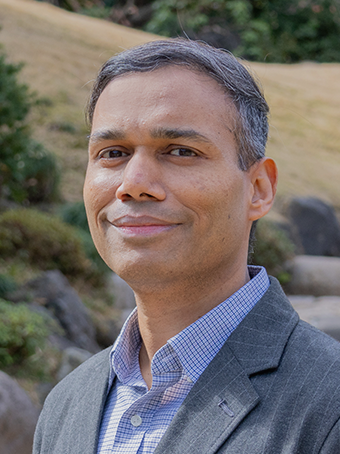
Manish Sharma is an ex-investment banker, with over two decades of experience spanning academia, consulting, think tank and corporate finance. His academic journey includes research and teaching positions at renowned institutions including Jawaharlal Nehru University, University of Tokyo, London School of Economics, and Doshisha Business School. Currently, he is a professor of economics, at Hosei University in Tokyo. Until 2012, Dr. Sharma served as Director (M&A) in the Corporate Finance Department at Daiwa Capital Markets' Tokyo headquarters, providing strategic financial guidance to major corporations. He subsequently transitioned to full-time academia, bringing his extensive practical knowledge to universities across Asia. His other notable experiences include 13 years of radio newscasting with NHK World, and running an investment advisory. His teaching and research interests cover Indian/ASEAN markets, tech sector, corporate finance, investments, valuation, geoeconomics and day-trading. Dr. Sharma holds a Ph.D. in Financial Economics.
View Profile-
 Japan and India: Historic Strategic Convergence2026.07.07
 -
 Japan positioned to link U.S. and Europe in a fragmented world2026.07.06
 - China’s Rare Earth Export Controls: “International Rules” Orientation and the Avant-Garde Use of Security Exceptions2026.07.03
- The Iran-U.S. MOU Offers a Reprieve, but Not Relief2026.07.02
- Japan’s manufacturing sector and the race for physical AI2026.06.26
 Sovereign AI After Fugu: From Vertical Dominance to Horizontal Resilience2026.06.24
- European Industry and the “Second China Shock”2026.06.19
- Order from Chaos: Introducing the Geoeconomic Connectivity Index2026.06.05
- China’s Rare Earth Export Controls: “International Rules” Orientation and the Avant-Garde Use of Security Exceptions2026.07.03
- The Iran-U.S. MOU Offers a Reprieve, but Not Relief2026.07.02