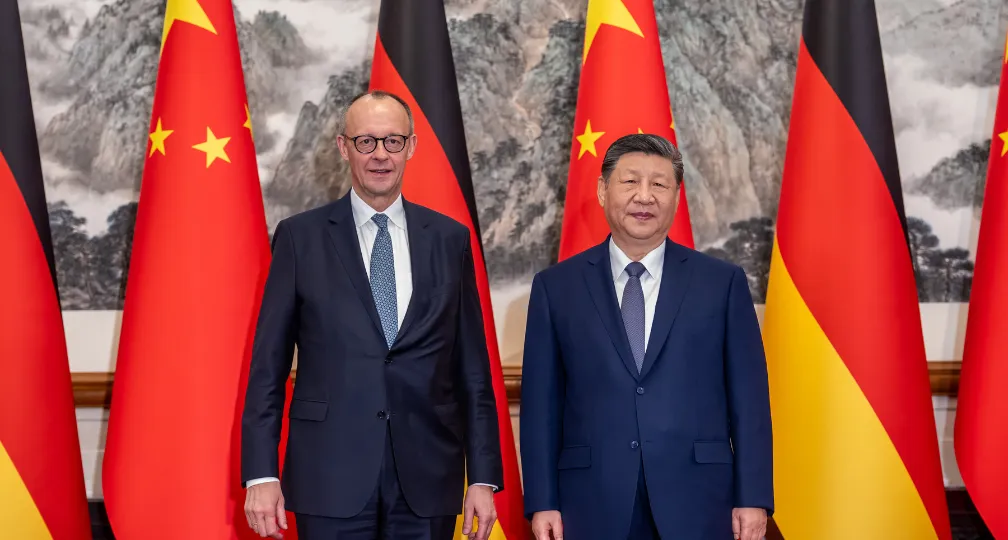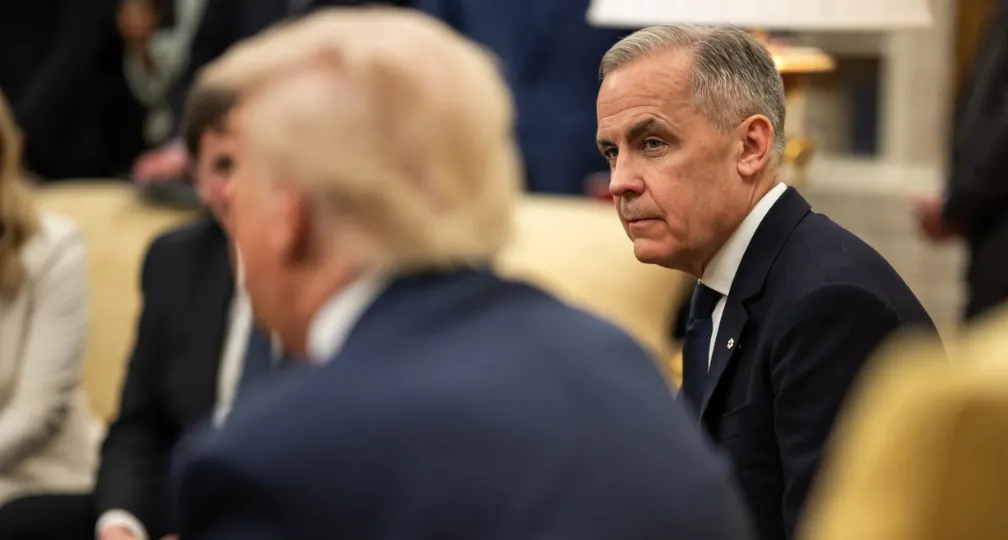

Will the “UK-China Golden Era” Return?
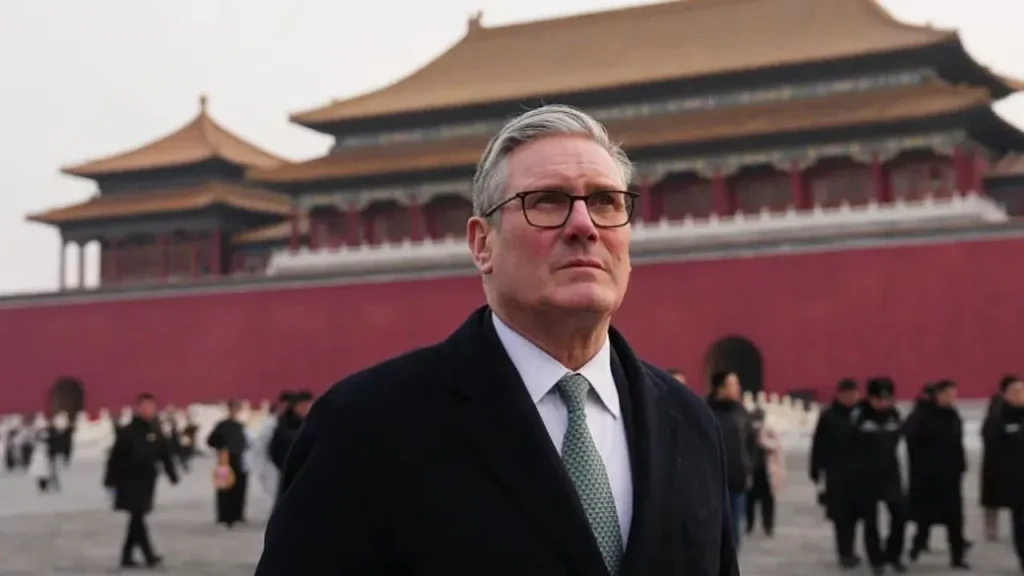
Yet any assessment of U.K.-Japan cooperation must also consider London’s relationship with Beijing. Notably, Starmer’s brief five-hour stop in Japan followed a far longer three-night visit to China—his first as prime minister and the first by a British leader in eight years. Describing the trip as “making history,” Starmer signaled a potential recalibration of U.K. policy toward China under the Labour government.
Whether this marks a fundamental shift remains an open question. To assess this, it is necessary to revisit the dramatic swings in U.K.-China relations over the past decade.
The Rise and Fall of the “Golden Era”
In 2015, Chinese President Xi Jinping’s state visit to the United Kingdom—complete with a state banquet at Buckingham Palace—symbolized the high-water mark of bilateral ties. At the time, enthusiasm across Europe for China’s outward economic strategy, epitomized by the Belt and Road Initiative, was surging. The government of then-Prime Minister David Cameron, particularly Chancellor George Osborne, actively pursued deeper economic engagement with China.
That same year, the United Kingdom became the first G7 country to join the China-led Asian Infrastructure Investment Bank (AIIB), diverging from the more cautious stance of the United States and Japan. Even more controversial was the decision to involve China in the Hinkley Point nuclear power project, despite national security concerns. These developments led Cameron to proclaim the beginning of a “golden era” in U.K.-China relations—one that prioritized economic gains over concerns related to human rights and security.
However, this approach soon faced mounting domestic criticism. Cameron’s liberal, pro-European, and China-friendly stance clashed with rising skepticism within the Conservative Party and broader public opinion. The 2016 Brexit referendum, which led to Cameron’s resignation, marked a turning point. Under the next Prime Minister Theresa May and her successors, the party’s right wing gained influence, bringing with it a more hawkish posture toward China.
This shift was accelerated by several developments: China’s handling of the COVID-19 outbreak, the imposition of the National Security Law in Hong Kong, and intensifying U.S.-China rivalry. In 2020, Conservative lawmakers established the China Research Group (CRG), advocating a tougher stance. Under Prime Minister Boris Johnson, the government banned Huawei from the U.K.’s 5G network on security grounds. By 2022, Prime Minister Rishi Sunak declared that the “golden era” of U.K.-China relations was over, while simultaneously strengthening ties with Japan through initiatives such as the Hiroshima Accord.
Strategic Convergence with Japan and the Costs of Confrontation
The hardening of British policy toward China coincided with a deepening of security cooperation with Japan. Britain’s “Indo-Pacific tilt,” outlined in its 2021 Integrated Review, was manifested in actions such as deploying the HMS Queen Elizabeth carrier strike group to Japan. China was formally designated a “systemic competitor,” and Beijing responded critically to London’s increased military presence in the region.
During this period, no British prime minister visited China for eight consecutive years. In contrast, U.K.-Japan defense ties advanced rapidly, culminating in the 2022 agreement among Japan, the U.K., and Italy to jointly develop a next-generation fighter under the Global Combat Air Programme (GCAP).
Yet these policies carried economic costs. Brexit, the COVID-19 pandemic, and the financial burden of supporting Ukraine following Russia’s 2022 invasion strained the U.K. economy. A second Trump administration in the United States further undermined confidence in Washington as a reliable ally. Against this backdrop, calls within the Labour Party to improve relations with China gained traction, particularly as the U.S. itself began exploring a more transactional approach toward Beijing.
Labour’s 2024 election manifesto prioritized economic growth, and some within the party advocated scaling back global security commitments while restoring economic ties with China. These pressures have shaped Starmer’s cautious engagement with Beijing.
Continuity, Constraints, and the Limits of Rapprochement
Despite renewed engagement with China, the Starmer government has maintained elements of its predecessor’s policies. Strong U.K.-Japan relations persist, and London continues to voice concerns about China’s human rights record. Following his return from Beijing, Starmer confirmed in Parliament that he had directly raised the case of detained Hong Kong activist Jimmy Lai with Xi.
But criticism from opposition parties has been sharp. Conservative leader Kemi Badenoch accused the government of sacrificing human rights for economic gain, while Liberal Democrat deputy leader Daisy Cooper condemned any move toward closer ties with a government engaged in repression and espionage.
These tensions underscore the structural constraints on any revival of a “golden era.” As long as the United Kingdom remains committed to democratic values—rule of law, human rights, and political freedoms—relations with China are unlikely to return to the heights seen in the mid-2010s. At the same time, these shared values reinforce the strategic logic of closer ties with Japan, particularly in areas such as economic security.
Nevertheless, signs of caution remain. During a period of heightened Chinese criticism following Takaichi’s remarks concerning a possible Taiwan contingency, Starmer refrained from publicly defending Japan—likely reflecting sensitivity ahead of his visit to Beijing. This suggests that even within a framework of shared values, the United Kingdom is balancing its diplomatic posture carefully.
An Unfinished “Golden Era”
The prospect of a renewed U.K.-China “golden era” appears remote. Domestic political pressures, economic constraints, and strategic considerations will continue to shape a cautious, pragmatic approach toward Beijing. While deeper economic engagement may be pursued, it will likely remain bounded by security concerns and value-based constraints.
For Japan, this evolving landscape underscores the importance of strengthening partnerships among like-minded countries. As Canada’s Prime Minister Mark Carney has argued, coordination among middle powers is increasingly critical in an era of great-power competition. Within this framework, the U.K.-Japan “enhanced global strategic partnership” should be positioned as a central pillar—anchoring cooperation across economic security, defense, and technology.
In short, the “golden era” of U.K.-China relations is unlikely to return in its previous form. Instead, it remains an unfinished chapter—one that has been overtaken by a more complex and contested geopolitical environment.
(Photo Credit: Carl Court / Getty Images)

Geoeconomic Briefing
Geoeconomic Briefing is a series featuring researchers at the IOG focused on Japan’s challenges in that field. It also provides analyses of the state of the world and trade risks, as well as technological and industrial structures (Editor-in-chief: Dr. Kazuto Suzuki, Director, Institute of Geoeconomics (IOG); Professor, The University of Tokyo).
Disclaimer: The opinions expressed in this Geoeconomic Briefing do not necessarily reflect those of the International House of Japan, the Institute of Geoeconomics (IOG) or any other organizations to which the author belongs.
Director, International House of Japan
Group Head, Europe & Americas,
Director of Research, Asia Pacific Initiative
Director, International House of Japan
Yuichi Hosoya is professor of international politics at Keio University, Tokyo. Professor Hosoya was a member of the Advisory Board at Japan’s National Security Council (NSC) (2014-2016). He was also a member of Prime Minister’s Advisory Panel on Reconstruction of the Legal Basis for Security (2013-14), and Prime Minister’s Advisory Panel on National Security and Defense Capabilities (2013). Professor Hosoya studied international politics at Rikkyo (BA), Birmingham (MIS), and Keio (Ph.D.). He was a visiting professor and Japan Chair (2009–2010) at Sciences-Po in Paris (Institut d’Études Politiques) and a visiting fellow (Fulbright Fellow, 2008–2009) at Princeton University. [Concurrent Position] Professor, Faculty of Law, Keio University
View Profile