
Turning Dual-Use Technology Into Defense Capability

Reflecting that priority, Prime Minister Sanae Takaichi’s Cabinet in March approved the Seventh Science, Technology and Innovation Basic Plan, a five-year directive that calls for closer coordination between science, technology and national security.
That makes “implementation” critical: starting with defense requirements, moving through demonstration and procurement, and ultimately putting new technologies into operational use. Japan’s success will depend not simply on identifying or adapting commercial technologies, but on getting them into the field.
The U.S. experience offers useful lessons. In 2015, the Defense Department established the Defense Innovation Experimental Unit, or DIUx, later renamed the Defense Innovation Unit, or DIU, to rapidly adapt relatively mature commercial technologies for defense use. Examining the history of DIUx and DIU helps clarify the challenges involved in implementing dual-use technologies and what Japan can learn from them.
Why DIUx?
Against the backdrop of growing concern over Chinese and Russian military modernization, the Obama administration launched the Third Offset Strategy in 2014. Its goal was to restore U.S. technological superiority and offset the military capabilities of China and Russia, with defense innovation central to this effort.
As the source of U.S. innovation increasingly shifted to the commercial sector, the Defense Department faced the challenge of incorporating advanced technologies from commercial ecosystems such as Silicon Valley.
Defense Secretary Ashton Carter, who took office in 2015 under President Barack Obama, created DIUx as a bridge between the Defense Department and the commercial technology ecosystem. DIUx built networks with startups, investors and other actors and sought to identify promising commercial technologies. To avoid the Pentagon’s long and complex procurement processes, it used flexible mechanisms such as Other Transaction Authority to move quickly into prototype contracts with startups.
In its early years, however, DIUx faced strong resistance within the Defense Department and budget pressure from Congress, placing the organization’s survival at risk. Former officials have recalled that when DIUx signed a contract with Earth observation satellite company Capella Space in 2017, opposition from parts of the intelligence community led to a temporary suspension of DIUx funding.
Under these conditions, DIUx focused on accumulating visible short-term achievements, especially prototype development, to demonstrate its necessity. It also expanded beyond Silicon Valley to Boston, Austin and other locations, creating a national network to search for technologies from companies, research institutions and investors.
In August 2018, during the first Trump administration, the “x” for “experimental” was removed and DIUx became DIU. This signaled that the Defense Department had begun to treat commercial technology adoption not as a temporary experiment but as a permanent function.
Still, what DIU had proven at that point was its ability to establish faster methods for acquiring commercial technologies and developing prototypes. Prototype development, however, does not necessarily translate into operational capability.
Former Deputy Assistant Secretary of Defense Melissa Flagg criticized DIU for having weak links with the military services’ procurement organizations and for rarely connecting prototypes to actual procurement. Douglas Beck, who later led DIU, also acknowledged that before his tenure, few DIU prototypes had affected major operational plans or deterrence. The challenge of implementing DIU-developed prototypes at an operationally meaningful scale therefore remained unresolved.
DIU 3.0
In April 2023, under the Biden administration, Defense Secretary Lloyd Austin appointed Beck as DIU director, placed him under the direct authority of the defense secretary and positioned DIU as a key Defense Department organization for rapidly fielding commercial technologies.
In August of that year, DIU began shifting toward a new approach known as “DIU 3.0.” To respond to the military threats posed by China and Russia, DIU sought to deliver “strategic effect” through three elements: focus, scale and speed.
To implement this approach, DIU strengthened cooperation with the military services responsible for procurement and the combatant commands responsible for operations. It placed greater emphasis on transitioning prototypes into actual equipment, mass production and operational use. Congress also codified DIU in the fiscal 2024 National Defense Authorization Act, reinforcing its institutional status.
One test case for DIU 3.0 is the Replicator initiative, led by Deputy Defense Secretary Kathleen Hicks. It seeks to introduce large numbers of low-cost autonomous systems, whose value was demonstrated in the war in Ukraine, to compete with China in both scale and cost. DIU is deeply involved as an implementing organization, making Replicator one measure of whether DIU 3.0 can produce tangible results.
In January 2026, under the second Trump administration, the Pentagon’s defense innovation system was reorganized. DIU was positioned as the core organization for “commercial product innovation,” while the military services were made responsible for the “last mile” of delivering capabilities to the force.
In other words, the reorganization made clear that implementing defense innovation depends not only on DIU but also on existing organizations responsible for procurement and operations.
Lessons for Japan
The U.S. experience shows that DIU has strengthened its institutional position across administrations, even while facing threats to its survival and barriers to implementation. Japan can draw several lessons from this experience.
Although Japan and the United States differ in their procurement systems, defense market size, startup ecosystems and perceptions of the reputational risks associated with defense work, these lessons remain relevant.
First, identifying and using dual-use technologies should be treated as a means of improving defense capabilities, not as an end in itself. Early DIUx leaned toward visible outputs such as the number of contracts and prototypes to justify its survival. To avoid this, Japan should establish indicators that measure actual implementation, such as the time from prototype development to unit deployment, procurement quantities and effects observed in real operations.
Second, Japan must strengthen links between organizations responsible for defense innovation and those responsible for force development and operations. DIU was criticized for its disconnect from the services’ procurement organizations, and the 2026 reorganization clarified that the services would be responsible for the “last mile.”
Japan should identify who is responsible for implementation at an early stage. For projects selected through Japan’s defense SBIR program or startup technology proposal evaluation programs, the Acquisition, Technology & Logistics Agency, the Joint Staff, the service staffs, and Self-Defense Forces procurement and operational units should be involved from the beginning. It should also be clear who will secure follow-on funding and take responsibility for mass production.
Third, if the Japanese government seeks to use startups’ dual-use technologies for defense, it must consider the business continuity of participating companies. Delayed contracts, unstable funding, lengthy screening and excessive security requirements can deter startups from entering the defense market and may threaten their survival even after they enter.
The government must not only clearly communicate the Defense Ministry’s needs but also create an environment in which companies can remain engaged in the defense market over time.
Finally, implementing dual-use technologies requires considerable trial and error, including in organizational arrangements. While speed in individual projects is important, Japan needs an institutional framework that allows it to learn from failure while sustaining medium- and long-term investment.
Policy expectations for dual-use technology are growing in Japan, and institutions are being developed to identify commercial technologies and expand engagement with startups. Yet these mechanisms must not remain merely an “entry point.”
What Japan now needs is an end-to-end implementation process that can transform dual-use technologies into operational capabilities at meaningful scale and speed.
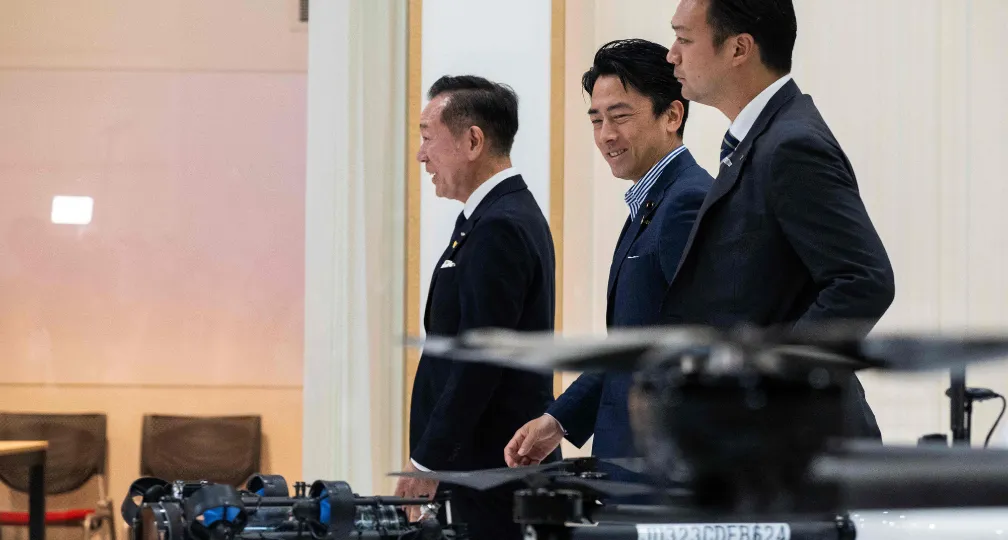
(Photo Credit: Devon Bistarkey, Defense Innovation Unit, U.S.)
*The appearance of U.S. Department of War (DoW) visual information does not imply or constitute DoW endorsement.
[Note] This article was posted to the Japan Times on September 6, 2026:
https://www.japantimes.co.jp/commentary/2026/09/06/japan/dual-use-defense-technology/

Geoeconomic Briefing
Geoeconomic Briefing is a series featuring researchers at the IOG focused on Japan’s challenges in that field. It also provides analyses of the state of the world and trade risks, as well as technological and industrial structures (Editor-in-chief: Dr. Kazuto Suzuki, Director, Institute of Geoeconomics (IOG); Professor, The University of Tokyo).
Disclaimer: The opinions expressed in this Geoeconomic Briefing do not necessarily reflect those of the International House of Japan, the Institute of Geoeconomics (IOG) or any other organizations to which the author belongs.

Senior Research Fellow
Kota Umeda is a senior research fellow at the Institute of Geoeconomics at the International House of Japan. Since 2026, he has also served as an adjunct lecturer at Keio University, where he teaches space policy. From 2015 to 2025, he worked at the Japan Aerospace Exploration Agency (JAXA), where he focused on researching U.S. space policy, coordinating with other space agencies, and developing JAXA's cybersecurity policy and incident response strategies. From 2019 to 2022, Mr. Umeda served as JAXA's liaison officer in Washington, D.C., collaborating with the U.S. government, industry leaders, and various stakeholders to promote Japan-U.S. space cooperation. Prior to his career in the space sector, Mr. Umeda spent five years at the Japan Ministry of Defense, where he researched military activities surrounding Japan and contributed to the formulation of arms control and disarmament policies. He holds a Master of Laws from Kyoto University and a Bachelor's degree in Policy Studies from Kwansei Gakuin University.
View Profile-
 Connecting Europe and the Indo-Pacific: Why Japan and Germany Need Stronger Space Security Cooperation2026.10.20
 - China’s Calculus Behind the State Visit to the U.S.: Different Visions of “Stability”2026.10.16
- Trump Faces a Reckoning in the Midterms, but it Might Not Matter for Tariffs2026.10.09
-
 BRICS in India2026.10.09
 - Can Japan build a defense-startup ecosystem?2026.10.07