
China’s Geoeconomic Power at The Auto China 2026 Show: The Pursuit — and Limits — of “Autonomy” in the AI Vehicle Age
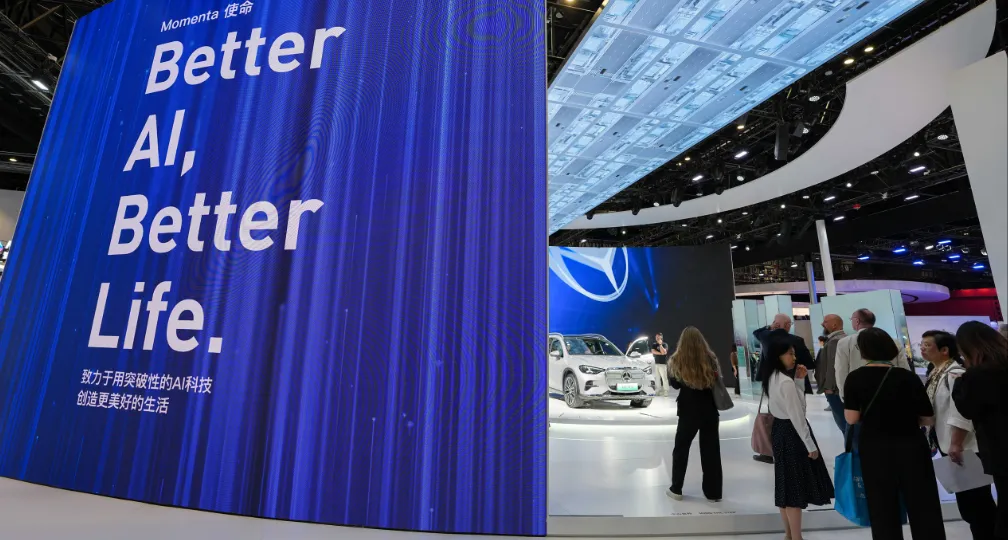
Drawing on observations from Auto China 2026 in Beijing, this article examines the geoeconomic power demonstrated by China’s automotive industry and the realities surrounding its pursuit of “autonomy.”
1. The Motor Show That Signaled the Arrival of the “AI Vehicle” Age
In May 2026, the author of this IOG Commentary attended the final two days of the “Auto
China 2026” show in Beijing. Held under the theme of “Leading the Era, Intelligence for the
Future,” the exhibition featured 1,451 vehicles and 181 global premieres across approximately
380,000 square meters of exhibition space. What stood out most was that Chinese automakers
no longer emphasized EVs themselves as the primary competitive axis. Instead, they
emphasized “intelligentization” — AI, autonomous driving, in-vehicle software, and
semiconductors.
This shift reflects broader changes surrounding China’s automotive sector. Between January and
March 2026, China exported 2.226 million vehicles, up 56.7 percent year-on-year, while exports
of new-energy vehicles surged further still. At the same time, the domestic market has begun to
slow, with price competition intensifying sharply. Chinese automakers are therefore seeking
survival through overseas expansion while navigating increasingly excessive competition at
home. In this sense, Auto China has been transformed. It is no longer merely a venue for
unveiling new models, and increasingly serves as a stage on which Chinese firms demonstrate
how they intend to compete globally.
Indeed, the exhibition made it clear that the industry’s focus has shifted from EVs themselves to
what comes “after EVs.” BYD highlighted cold-weather charging performance in an effort to
differentiate beyond price competition. Meanwhile, smartphone giant Xiaomi showcased a
high-performance EV concept car, underscoring a strategic pivot toward competition centered
on software and user experience. Across Chinese manufacturers’ booths, AI-assisted driving
systems, smart cockpits, and vehicle software occupied central positions, signaling a clear transition from “electrification” to “intelligentization.”
Particularly striking was the extent to which Chinese firms actively incorporated concepts such
as world models, Vision-Language-Action (VLA) systems, end-to-end autonomous driving, and
“physical AI” into mass-production plans and commercial technology presentations rather than
limiting them to research discourse. In addition to large-scale AI models developed by major
Chinese technology firms — including ByteDance’s Doubao, Alibaba’s Tongyi Qianwen, and
Baidu’s AI systems — automakers themselves are increasingly developing proprietary in-
vehicle AI models. These models are rapidly being integrated into smart cockpits and advanced
driver-assistance systems. In short, Auto China 2026 demonstrated that China is no longer just
an EV superpower; it is now positioning itself aggressively in the struggle for leadership in the
age of AI vehicles.
2. The Sources of China’s Competitiveness
Why have Chinese firms been able to advance toward AI-driven vehicles so rapidly? A key
factor lies in what is often described as China’s “new whole-of-nation system.” In China, state
strategy, local governments, research institutions, corporations, venture capital, and a vast
domestic market are relatively tightly interconnected, enabling unusually rapid transitions from
research to commercialization. In sectors such as AI, autonomous driving, and automotive
software, development, demonstration, mass production, and over-the-air updates cycle at
remarkable speed. This “implementation velocity” constitutes one of China’s greatest
advantages relative to Japan and Europe.
Moreover, fierce domestic competition itself is accelerating industrial evolution. As earlier
purchase subsidies faded in 2026, China’s auto market entered a new phase of intensified price
competition. Under what Chinese observers describe as “involution” — excessive inward-
oriented competition that drives down prices — firms can no longer survive through pricing
strategies alone. Consequently, companies are attempting to redefine the basis of competition
itself through integrated combinations of batteries, AI-assisted driving, vehicle software, and
smart cockpits. The emphasis placed by firms such as BYD and Geely on comprehensive
“intelligentization,” including AI functionality and performance, symbolizes this
transformation.
The contrast between Chinese and foreign exhibitors was also revealing. At Auto China,
Chinese automakers prominently displayed large technical panels explaining AI, autonomous
driving, world models, and automotive semiconductors, drawing intense attention from visitors.
Foreign brands, by contrast, tended to emphasize heritage models, brand identity, and nostalgic
displays of past successes. To be sure, foreign automakers continue to enjoy advantages in
safety, quality, and brand trust. Yet at least in terms of momentum as the actors most rapidly
industrializing future technologies, Chinese firms appeared to possess greater dynamism.
Equally important is China’s simultaneous possession of both a vast manufacturing base and a
powerful digital sector. PC and IT Technology firms such as Lenovo o showed a significant presence at the exhibition, reflecting how automobiles are increasingly evolving from transportation devices into integrated computational platforms combining AI, cloud computing, IoT, semiconductors, and telecommunications. One automotive executive who had previously worked in the United States remarked that “parts procurement in China is extremely convenient — required materials can be obtained faster than in the United States.” In the age of physical AI, the density and speed of supply chains themselves become sources of competitiveness. Auto China 2026 thus conveyed the impression that China is attempting to transform itself from a “manufacturing power” into an “AI-integrated industrial state.”
3. Semiconductors as the Core Bottleneck
Yet the exhibition also underscored a critical contradiction. Alongside the remarkable
momentum behind China’s AI vehicle push, Auto China 2026 highlighted how China itself
increasingly recognizes semiconductors as its greatest bottleneck. Domestic semiconductor-related firms such as Horizon Robotics, Huawei, and Black Sesame Technologies exhibited a major presence at the show, with terms such as “localization” and “indigenous R&D” prominently emphasized throughout the venue. This reflects the Chinese government’s strategic prioritization of automotive semiconductor self-sufficiency as a foundation for AI, autonomous driving, and robotics industries.
However, China’s AI vehicle industry remains heavily dependent on U.S. semiconductor technology. Exhibits such as Geely’s Afari Smart Driving system and QCRAFT highlighted
advanced proprietary AI driving-assistance capabilities, yet discussions at the booths indicated
that these systems continue to rely heavily on NVIDIA-based chips and U.S.-origin architectures. In particular, NVIDIA’s Orin platform remains widely adopted across China’s smart EV market. Meanwhile, Qualcomm’s Snapdragon platforms continue to dominate the smart cockpit segment.
In other words, China’s AI vehicle revolution is not self-contained. Much of the rapid evolution
in AI-assisted driving and automotive intelligence continues to rest upon U.S. high-performance
semiconductors, EDA software, and broader software ecosystems. While China may currently
be among the world’s fastest commercializers of AI vehicles, the core of this transformation
remains dependent on the “indispensability” of American technology.
Chinese policymakers are acutely aware of this vulnerability. Firms such as XPeng and NIO are
developing proprietary AI chips, while the government is supporting localization efforts through
massive subsidies and tax incentives. Nonetheless, the semiconductor sector — encompassing
GPUs, advanced lithography equipment, EDA tools, and broader ecosystems — rests upon
deeply globalized supply chains, making complete self-sufficiency difficult to achieve in the
short term. Auto China 2026 therefore simultaneously showcased China’s pursuit of
“autonomy” and the substantial obstacles that continue to constrain it.
4. Cooperation with China and Geoeconomic Risk
Against this backdrop, China is increasingly evolving beyond a mere “large market” into a
critical development and production base for the AI vehicle era. Nissan Motor, for example,
plans to export its China-developed N7 EV to overseas markets including ASEAN countries,
while Honda Motor is moving to introduce China-produced EVs into the Japanese market.
Volkswagen has likewise begun positioning China not simply as a sales destination but as a
strategic hub for software development and rapid innovation. Japanese and European manufacturers alike are increasingly being forced to decide whether — and how — to leverage
China’s supply chains, development speed, and AI integration capabilities.
At the same time, this structure carries substantial geoeconomic risks. As repeatedly
demonstrated throughout the exhibition, China’s AI vehicle sector remains fundamentally
dependent on U.S. technology in the critical domain of advanced automotive semiconductors.
Should Washington further tighten export controls targeting automotive AI chips, development
and production activities in China could face severe disruption. Thus, while China is building
formidable geoeconomic power through manufacturing capacity, data scale, EV production, and
AI integration speed, its industrial foundation remains constrained by continued reliance on
American technological indispensability.
In this sense, Auto China 2026 offered a revealing portrait of the industrial structure emerging
in the AI era. China is accelerating efforts to localize advanced semiconductors and has
achieved meaningful progress, yet semiconductors remain embedded within vast global supply
chains encompassing materials, manufacturing equipment, design, and software ecosystems.
China’s pursuit of “autonomy” in the age of intelligent vehicles therefore remains incomplete,
and the trajectory of this struggle will continue to shape the future international industrial order.
(Photo Credit: Xinhua New Agency / Aflo)
Disclaimer: The views expressed in this IOG Commentary do not necessarily reflect those of the API, the Institute of Geoeconomics (IOG) or any other organizations to which the author belongs.

Senior Research Fellow
Senior Research Fellow of the China Group at the Institute of Geoeconomics (IOG). Doi specializes in China and the world (geoeconomic issues, such as development finance and emerging technologies), and global governance in the social development sectors, including education and health. He graduated from the University of Kitakyushu with a B.A. in International Relations (Contemporary China Studies) and a Master of Public Policy from the University of Tokyo. Doi joined the Japan International Cooperation Agency (JICA) in 2008, where he worked on the implementation of the Japanese government’s foreign aid to China at the JICA Beijing Office and conducted financial investments in economic and social infrastructure, sovereign credit risk analysis and research on China’s development cooperation with the Global South at the Africa Department. In 2018, he began his doctoral studies in the Department of Education Economics at Peking University in China, where he received his PhD in Public Policy in 2022. Doi served as a senior researcher and advisor at Diinsider Co., Ltd, a China-based international development consultancy, and as an adjunct researcher at the Center for the Study of International Cooperation in Education, Waseda University, before being appointed to his current position in August 2024. His research has been published in books by international publishers, including Routledge and Springer Nature, as well as in international peer-reviewed journals such as Development Policy Review, Educational Review, Higher Education Research & Development, Public Health Action, and Compare. [Concurrent Positions] Adjunct Researcher, Center for the Study of International Cooperation in Education, Waseda University, Japan. (2023-Present) Visiting Lecturer, Department of International Business and Management, Kanagawa University, Japan. (2025-2026).
View Profile-
 Can Germany become a reliable pillar of European security?2026.07.23
 - Sustained Denial and Strategic Depth: Policy Recommendations for Japan’s Next Strategic Documents2026.07.21
- As shared values shift, what's next for U.S.-Japan relations?2026.07.17
- Why Pax Silica Is About More Than AI Chips2026.07.15
- The Case for Underground Defense: Japan's Military Lessons from the Iran War2026.07.14


 Why Pax Silica Is About More Than AI Chips2026.07.15
- China’s Rare Earth Export Controls: “International Rules” Orientation and the Avant-Garde Use of Security Exceptions2026.07.03
- The Iran-U.S. MOU Offers a Reprieve, but Not Relief2026.07.02
 Japan and India: Historic Strategic Convergence2026.07.07
- Sovereign AI After Fugu: From Vertical Dominance to Horizontal Resilience2026.06.24