
Can Germany become a reliable pillar of European security?
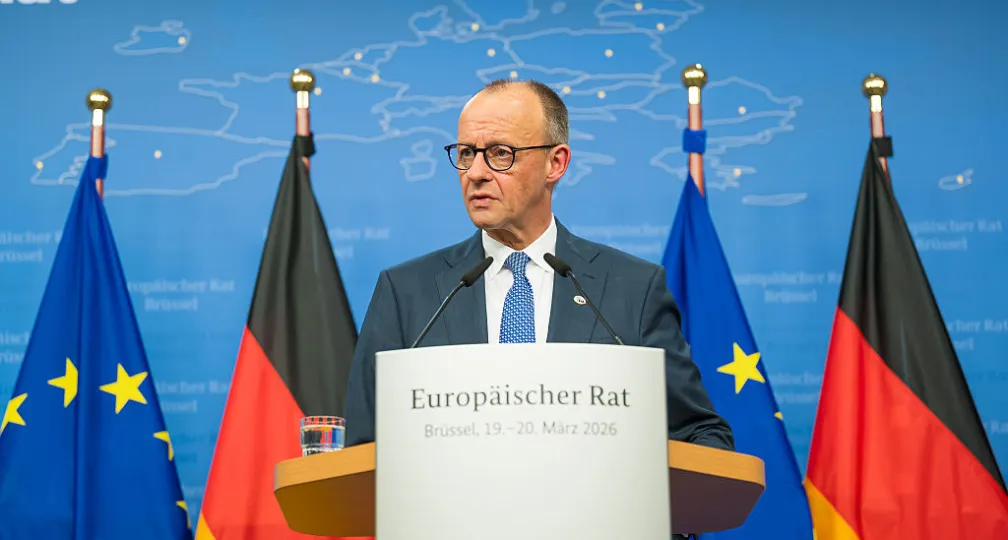
This challenge is most pronounced for Germany, Europe's largest economy and one of NATO's most influential members. Germany's choices have significant implications not only for European security but also for the future of transatlantic relations. Since taking office in May 2025 amid a deteriorating security environment and mounting pressure from Washington, German Chancellor Friedrich Merz has pledged to make the Bundeswehr the strongest conventional military force in Europe. From the outset his government has pursued an ambitious agenda of defense strengthening. It is therefore important to examine how Germany—long associated with its postwar policy of Westbindung (anchoring itself firmly within the Western alliance) and caution toward military expansion—is adapting its security policy in response to the Trump administration.
Turning Point (Zeitenwende)
When Russia launched its full-scale invasion of Ukraine in February 2022, Germany was governed by Chancellor Olaf Scholz of the Social Democratic Party (SPD). Scholz’s declaration of a Zeitenwende (turning point) before the Bundestag three days after the invasion was widely interpreted as signaling a fundamental shift away from Germany’s traditionally cautious defense posture and accommodative approach toward Russia. The term quickly entered both domestic and international discourse. Scholz further elaborated the concept in an article for Foreign Affairs, highlighting Germany’s evolving security outlook and requiring allies to assume greater responsibility rather than relying solely on the United States.
Yet despite the attention and praise that the concept received, it is difficult to conclude that Germany’s security policy underwent a comparable transformation in practice. Arms deliveries to Ukraine, particularly heavy weaponry, were often delayed. Germany struggled to meet NATO’s target of defense spending equivalent to 2% of GDP. Moreover, Scholz’s hesitant and often ambiguous public statements after his landmark speech led many observers to question his leadership.
Domestically, Scholz faced the challenge of governing a three-party coalition. Although the government published Germany’s first National Security Strategy in 2023, plans to establish a National Security Council—a key commitment in the coalition agreement—never materialized. Coalition partners also failed to reach consensus on reforming fiscal rules that constrained defense spending. The eventual withdrawal of the Free Democratic Party (FDP), which controlled the Finance Ministry, led to the coalition’s collapse in November 2024 and an unusually early federal election in February 2025.
Equally important was the broader international context. Public opinion remained divided over the provision of heavy weapons to Ukraine, while in Washington, U.S. President Joe Biden continued to frame support for Kyiv as part of a broader struggle to defend democracy. The continued commitment of the United States to the Western alliance reinforced NATO cohesion and allowed Germany’s Zeitenwende to remain largely within the traditional framework of reliance on American security guarantees. In short, Russia’s invasion alone was arguably insufficient to fundamentally transform Germany’s security policy.
Merz and Trump
Germany’s federal election took place roughly a month after the second Trump administration took office. Friedrich Merz, leader of the Christian Democratic Union (CDU), emerged as the leading candidate for chancellor after having spent nearly two decades away from frontline politics.
A longtime rival of former Chancellor Angela Merkel, Merz brought extensive transatlantic credentials to the office. He had previously served as chairman of the German branch of BlackRock and led Atlantik-Brücke, an organization dedicated to strengthening German-American cooperation.
Even before formally taking office, Merz demonstrated political initiative. In March, the outgoing Bundestag approved amendments to Germany’s constitutional “debt brake,” exempting defense expenditures above 1% of GDP from fiscal restrictions. This created a durable mechanism for expanding defense spending beyond the special funds that had previously been used on an exceptional basis.
Since formally assuming office on May 6, Chancellor Merz has actively supported NATO’s new target of defense spending equivalent to 5% of GDP. Alongside the leaders of Britain, France, and Italy, he accompanied Ukrainian President Volodymyr Zelenskyy during a visit to Washington. He has also taken clear positions in support of the European Union’s €90 billion assistance package for Ukraine and the use of frozen Russian assets. Bilaterally, Germany has initiated discussions with France on European nuclear deterrence and expanded defense cooperation with Ukraine, including joint drone production.
Compared to Scholz’s coalition, Merz’s government appears relatively stable on foreign and security policy despite disagreements over social welfare issues. Cooperation with Defense Minister Boris Pistorius—an SPD holdover from the previous government—has enabled continued reform of the Bundeswehr. A National Security Council was finally established in August 2025, facilitating more comprehensive policy coordination. Germany also adopted its first postwar military strategy in April 2026.
The fiscal implications are equally significant. Following reform of the debt brake, the government’s medium-term budget plan allocates substantial resources to defense despite Germany’s continued economic difficulties. Security-related spending is projected to reach €152 billion by 2029—roughly triple the 2023 level. As a result, Germany now ranks as the world’s fourth-largest military spender.
What, then, has driven this transformation if Russia’s invasion itself proved insufficient? Domestic political factors and coalition dynamics undoubtedly played a role. Yet above all, the Trump administration’s strategic reorientation appears to have served as the decisive catalyst. Among European leaders, a growing recognition has emerged that Europe must move beyond its traditional dependence on the United States — particularly in security matters — and pursue greater strategic autonomy. Only now, perhaps, are both Germany and its European partners prepared to accept the implications of a Germany willing to assume a more robust military role.
Reduce U.S. dependence
Yet the pursuit of a more autonomous Europe does not imply that European security can be conceived without the United States. Nor is it realistic to expect a significant shift in Washington’s approach under the Trump administration. Furthermore, changes in strategic thinking do not automatically translate into military capability. Germany’s defense spending as a share of GDP still lags behind that of frontline states in Eastern Europe and the Baltics while personnel shortages within the Bundeswehr remain severe.
Under these circumstances, Germany’s challenge is not to engage in public confrontation with President Trump. Rather, Berlin should continue reducing its dependence on U.S.-centered defense arrangements through cooperation with European partners and like-minded countries while steadily strengthening capabilities that benefit both Germany and the broader NATO alliance. Equally important is communicating these contributions more effectively to allies.
Germany should also emphasize its role as a defender of the international order. Such messaging may help reassure neighboring countries and domestic audiences that have historically viewed any resurgence of German power with caution due to the legacy of World War II.
Germany faces the difficult task of maintaining constructive relations with the United States while simultaneously strengthening its own defense capabilities and defending a liberal international order grounded in international law. The responsibilities it bears in this new strategic environment are considerable—and likely to grow.
During the first Trump administration, Princeton University scholar John Ikenberry argued that as the United States retreated from aspects of its traditional leadership role, responsibility for sustaining the liberal international order increasingly fell upon countries such as Germany and Japan. Today, that observation appears more relevant than ever.
(Photo Credit: NurPhoto / Getty Images)
Geoeconomic Briefing
Geoeconomic Briefing is a series featuring researchers at the IOG focused on Japan’s challenges in that field. It also provides analyses of the state of the world and trade risks, as well as technological and industrial structures (Editor-in-chief: Dr. Kazuto Suzuki, Director, Institute of Geoeconomics (IOG); Professor, The University of Tokyo).
Disclaimer: The opinions expressed in this Geoeconomic Briefing do not necessarily reflect those of the International House of Japan, the Institute of Geoeconomics (IOG) or any other organizations to which the author belongs.

Research Assistant
Kikyo Taguchi assumed her current position in July 2025, after serving as a Researcher/Advisor in the Political Section at the Embassy of Japan in Germany and as Project Manager for the Japan Program at the Konrad Adenauer Foundation’s Japan Office. She holds an MA from Keio University’s Graduate School of Law (Political Science) and an MA from the Friedrich Schiller University of Jena in Germany (History and Political Science), and is currently pursuing a PhD in Political Science at Keio University. Her research focuses on German foreign and security policy and German politics.
View Profile-
 Connecting Europe and the Indo-Pacific: Why Japan and Germany Need Stronger Space Security Cooperation2026.10.20
 - China’s Calculus Behind the State Visit to the U.S.: Different Visions of “Stability”2026.10.16
- Trump Faces a Reckoning in the Midterms, but it Might Not Matter for Tariffs2026.10.09
-
 BRICS in India2026.10.09
 - Can Japan build a defense-startup ecosystem?2026.10.07