
Seoul hits the China reset button. Or does it?
By Jiseon Shin, Research Fellow at the Sungkyun Institute of China Studies (SICS), Sungkyunkwan University
South Korea’s recent diplomatic thaw with China is not a pivot toward Beijing — it is a hedge against a more volatile world.
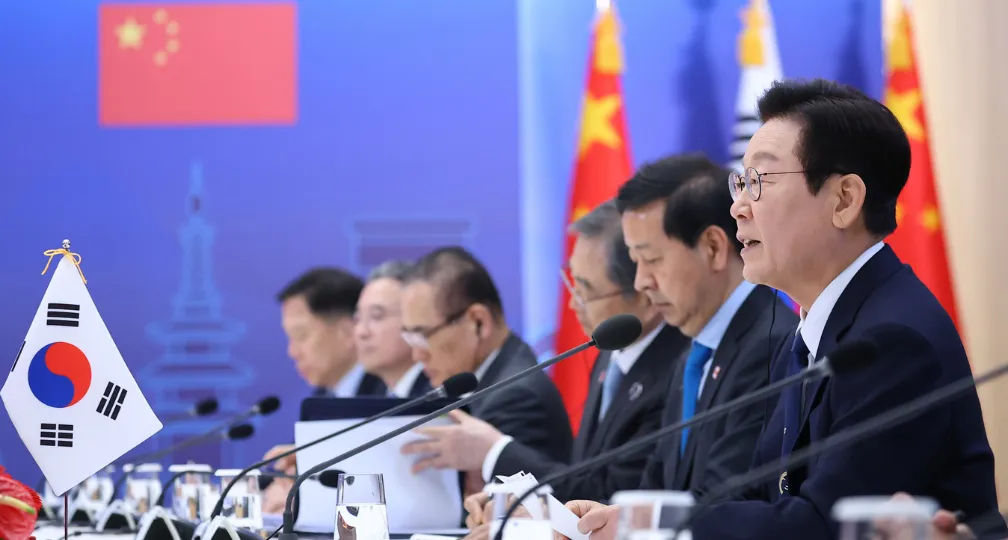
The warming of ties, set in motion at the November 2025 APEC summit in Gyeongju and culminating in President Lee Jae Myung’s January visit to Beijing, marks a clear shift after years of strain under former President Yoon Suk Yeol. But Lee’s push for what he calls “horizontal and mutually beneficial economic cooperation” is better understood not as strategic realignment, but as disciplined risk management by a middle power under pressure.
Seoul is not choosing between Washington and Beijing. It is recalibrating, sector by sector, to reduce exposure where it is most vulnerable while preserving economic opportunity where it remains indispensable. The result is neither rupture nor continuity, but a circumscribed strategy that is quietly reshaping one of Asia’s most consequential relationships.
Cascading crisis
South Korea’s renewed engagement with China is a response to mounting external shocks. The second Trump administration has revived sweeping tariffs and a more transactional approach to alliances, putting Seoul under strain. U.S. demands for increased host-nation support for roughly 28,500 American troops, alongside tariff threats targeting semiconductors, automobiles and batteries, pose a structural challenge to the alliance framework South Korea has long relied on.
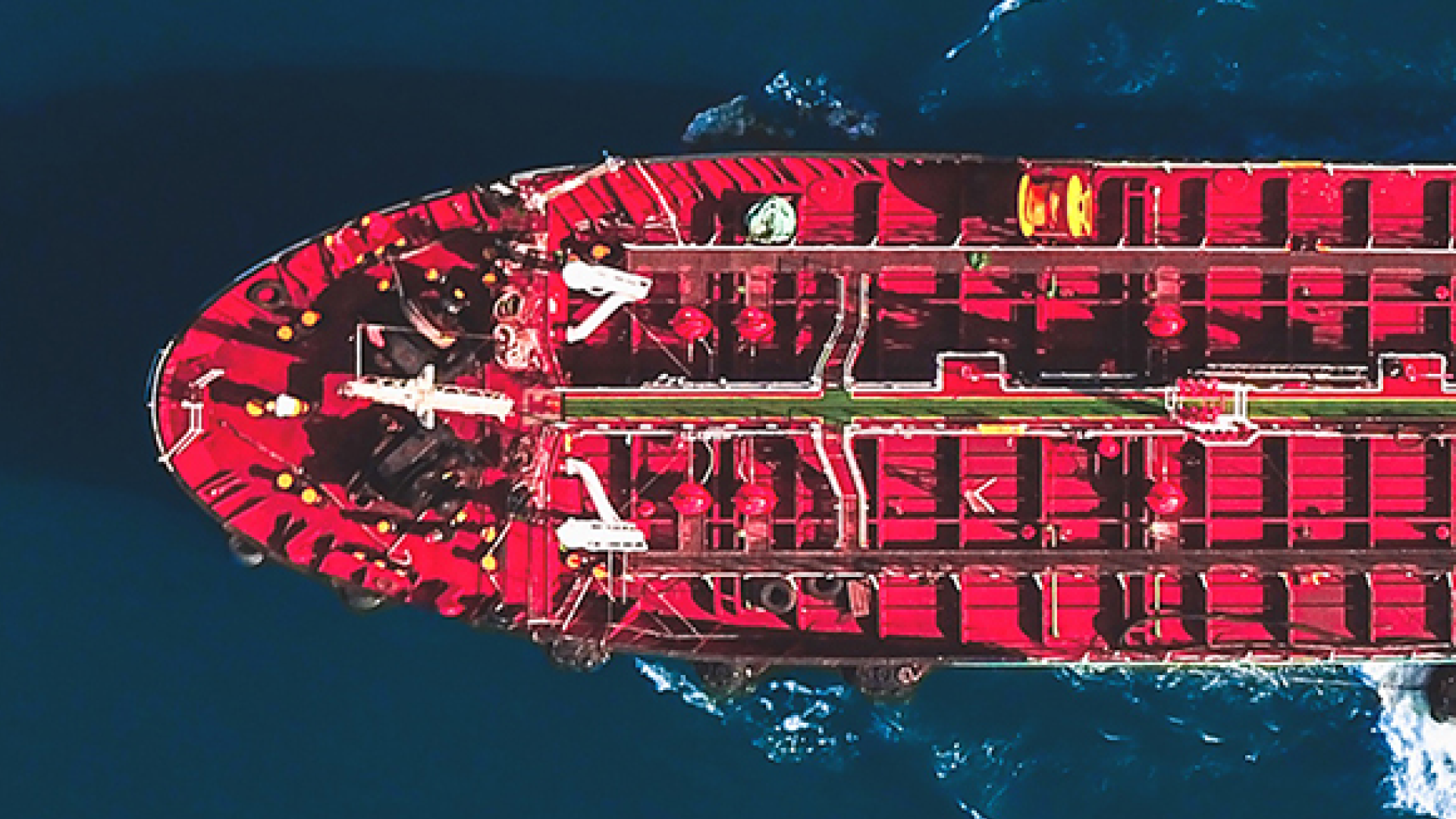
At the same time, the Iran conflict that erupted early this year has exposed the country’s energy vulnerability. South Korea imports more than 70% of its crude oil from the Middle East, with 1.6 million to 2.1 million barrels per day transiting the Strait of Hormuz. Disruptions there have delivered a dual shock: rising input costs for Korean industry and weakening demand transmitted through China.
The OECD’s March 2026 downgrade of South Korea’s growth forecast, from 2.1% to 1.7%, underscored the impact of Middle East instability. While the OECD recently upgraded its forecast to 2.6%, headwinds persist. The result is a cascading crisis: Shocks tied to U.S. policy and regional conflict simultaneously squeeze South Korea’s fiscal space while undercutting its largest export market.
This dilemma — deep security dependence on the United States paired with economic interdependence with China — is not new. What is new is the intensity and simultaneity of pressure on both fronts. Seoul’s response is not to abandon either relationship, but to actively manage the risks each now presents.
Selective engagement
China has been central to South Korea’s economic rise since diplomatic normalization in 1992. But deep integration has also created vulnerabilities. As Korean firms localized production in China, concerns over intellectual property grew, highlighted by a 2023 case involving alleged leaks of Samsung semiconductor data. The 2016-17 THAAD dispute showed how quickly economic ties could be weaponized for political ends.
At the same time, China’s rapid advances in electric vehicles, batteries and advanced manufacturing have eroded South Korea’s technological edge, shifting the relationship from complementarity toward competition. Korean firms increasingly see China less as a production base and more as a critical consumer market.
Even so, major players such as Samsung Electronics and SK Hynix continue to invest in Chinese fabrication facilities, underscoring a central reality: de-risking and deep engagement are not mutually exclusive. China remains the only economy capable of internalizing nearly the entire global value chain. Full disengagement is neither feasible nor desirable.
Within this context, the Lee administration’s approach amounts to selective engagement. Seoul is seeking to deepen cooperation in consumer markets, green technology and cultural industries, while building resilience in sensitive sectors such as semiconductors and critical minerals.
This is not decoupling. It is a pragmatic renegotiation of interdependence — one that prioritizes supply-chain security in strategic industries while preserving access to demand in less sensitive sectors.
Diplomatically, Beijing — facing its own pressure from U.S. trade and technology restrictions — has signaled a willingness to reengage without the political conditions that defined the THAAD era. But the limits of rapprochement are clear. South Korea must maintain U.S. extended deterrence while managing China’s influence over North Korea.
That calculus has grown more complex as military ties between Pyongyang and Moscow deepen, weakening Beijing’s leverage. As Seoul cautiously explores renewed inter-Korean engagement, China remains an important — but less predictable — partner.
South Korea’s outreach to Beijing, then, is not an alternative to its U.S. alliance. It is a bounded effort to manage economic exposure without undermining the security architecture on which it depends.
Diversifying risk
Seoul’s China policy is only one pillar of a broader diversification strategy aimed at reducing dependence on any single partner. This approach was on display in President Lee’s April visits to India and Vietnam.
In India, the two countries agreed to relaunch talks on their Comprehensive Economic Partnership Agreement and established a ministerial-level industrial cooperation committee covering trade, investment and strategic sectors, including critical minerals, nuclear energy and clean energy. The focus reflects a deliberate effort to build redundancy in supply chains most vulnerable to geopolitical disruption.
In Vietnam, the two governments set a target of $150 billion in bilateral trade by 2030 and signed a dozen agreements spanning energy, infrastructure and security. With roughly 10,000 South Korean firms operating in Vietnam, the country has become a key manufacturing hub in Seoul’s global supply chain.
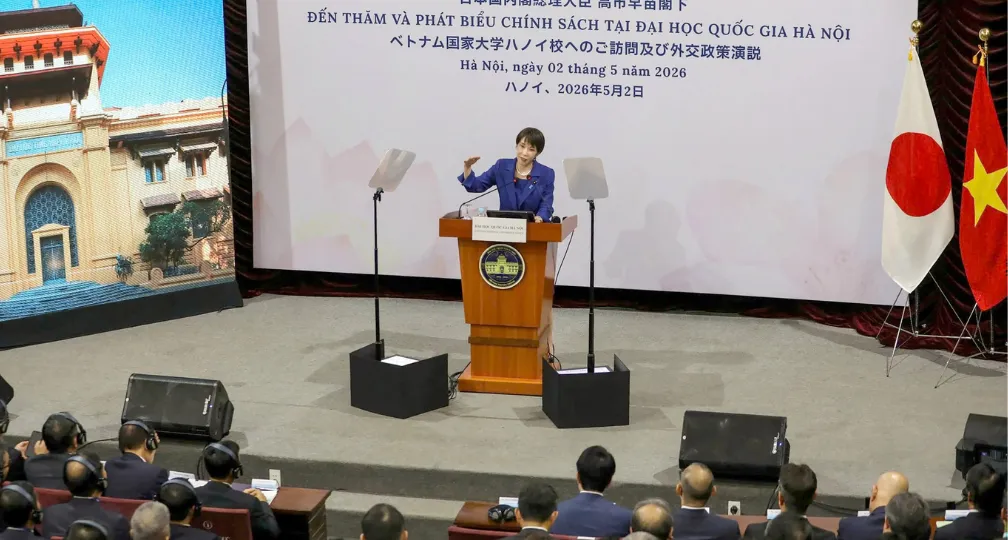
Taken together, these initiatives reflect a broader strategy of middle-power diversification — building ties across emerging markets to reduce concentration risk while positioning South Korea as a reliable partner in the Global South. Japan has pursued a similar approach, reinforcing a wider pattern of coordinated middle-power adaptation in the Indo-Pacific.
Inflection point
South Korea is at an inflection point, not only in its relationship with China but in its broader role in the international system. As an advanced economy with growing regional influence, it is increasingly acting as a proactive middle power, seeking to shape — rather than simply react to — great-power competition.
Part of that strategy involves using engagement with China as leverage in dealings with Washington, strengthening Seoul’s hand in negotiations over tariffs, technology access and defense cost-sharing. But that leverage has limits, defined by South Korea’s reliance on U.S. security guarantees, its exposure in critical technologies and the unresolved challenge of North Korea’s nuclear program.
The central question is not whether Seoul has struck the perfect balance, but whether balance itself is sustainable in an era of intensifying rivalry. For now, there is reason for cautious optimism. South Korea has repeatedly shown an ability to adapt under pressure, turning structural constraints into strategic opportunity.
It also need not navigate this path alone. Japan faces a similar set of dilemmas, and closer coordination between Seoul and Tokyo could prove decisive. As neighboring economies confronting the same geopolitical realities, they are uniquely positioned to craft a shared approach.
If they succeed, their partnership could become one of the most important stabilizing forces in the Indo-Pacific in the years ahead.
(Photo Credit: AP / Aflo)
[Note] This article was posted to the Japan Times on June 9, 2026:
https://www.japantimes.co.jp/commentary/2026/06/09/world/seoul-hits-china-reset-button/

Jiseon Shin
Jiseon Shin is a Research Fellow at the Sungkyun Institute of China Studies (SICS), Sungkyunkwan University. She earned her Ph.D. in International Political Economy (IPE) from the School of International Studies at Peking University, where her research focused on industrial policy, comparative political economy, and China’s economic development.
Her academic work explores China’s industrial transformation, the developmental state, and the political economy of strategic industries, with a particular focus on comparative cases within East Asia. Beyond her research, she is actively involved in teaching and academic inquiry regarding emerging markets, global business, and IPE. Her recent scholarship examines the restructuring of industrial policy amid U.S.–China strategic competition, global supply chain reconfiguration, and the continued evolution of the Chinese development model. She is fluent in Korean, Chinese, and English.
Geoeconomic Briefing
Geoeconomic Briefing is a series featuring researchers at the IOG focused on Japan’s challenges in that field. It also provides analyses of the state of the world and trade risks, as well as technological and industrial structures (Editor-in-chief: Dr. Kazuto Suzuki, Director, Institute of Geoeconomics (IOG); Professor, The University of Tokyo).
-
 Can Germany become a reliable pillar of European security?2026.07.23
 - Sustained Denial and Strategic Depth: Policy Recommendations for Japan’s Next Strategic Documents2026.07.21
- As shared values shift, what's next for U.S.-Japan relations?2026.07.17
- Why Pax Silica Is About More Than AI Chips2026.07.15
- The Case for Underground Defense: Japan's Military Lessons from the Iran War2026.07.14
 Why Pax Silica Is About More Than AI Chips2026.07.15
- China’s Rare Earth Export Controls: “International Rules” Orientation and the Avant-Garde Use of Security Exceptions2026.07.03
- The Iran-U.S. MOU Offers a Reprieve, but Not Relief2026.07.02
 Japan and India: Historic Strategic Convergence2026.07.07
- Sovereign AI After Fugu: From Vertical Dominance to Horizontal Resilience2026.06.24